Two paradoxes lie at the heart of life under communist rule in China, absurdities so ingrained that many have come to accept them as normal.
The first concerns the so-called “Great Firewall.” Officially, it does not exist. No law defines it clearly, and no government agency openly acknowledges it in legal terms. Yet anyone who attempts to bypass it may be punished. Citizens are told that “climbing the wall” is illegal, but few are encouraged to ask the more basic question: is the wall itself legal?
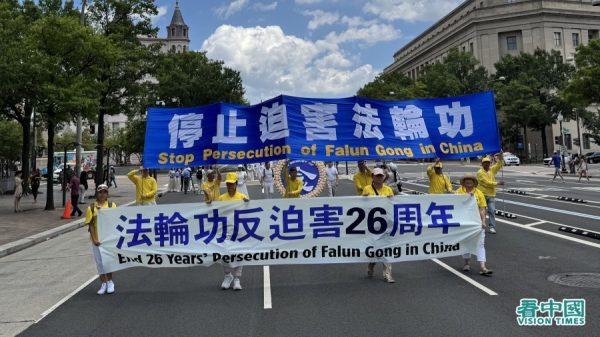
The second paradox is even more sensitive. For decades, the Chinese Communist Party (CCP) has waged a sweeping political campaign against the Falun Gong faith group, which had 100 million adherents in the late 1990s prior to then Party leader Jiang Zemin unilaterally deciding that this community of spiritual cultivators had to be eradicated lest it result in the “downfall of the Party and the country.” Yet nowhere in China’s legal code is Falun Gong explicitly defined as an “evil religion” — as the CCP terms it — or illegal organization. Despite this absence, those who openly practice or even identify with Falun Gong and its teachings risk imprisonment, torture, or even execution by organ harvesting.
Together, these contradictions reflect a broader structural feature of governance in China: law functioning not as a clear boundary on state authority, but as a flexible instrument of political control. While The Constitution of the People’s Republic of China (PRC) formally guarantees freedoms of speech, belief, and assembly, these protections can be overridden through administrative decisions and political directives without transparent judicial review.
The Falun Gong crackdown and information control in China
The question of the firewall illustrates this dynamic starkly. As some Chinese legal scholars have noted, there is no explicit statutory authorization for the system that filters and blocks internet traffic across the country. And yet it operates at vast scale, shaping what more than a billion people can see and say online.
Success
You are now signed up for our newsletter
Success
Check your email to complete sign up
Techniques such as deep packet inspection and traffic filtering — methods that would be criminal if used by private actors — are deployed by the state as routine governance.
This creates a legal “black box”: a system that denies its own existence while punishing those who challenge it.
The same logic underpins the campaign against Falun Gong, which began in July 1999. This horrific persecution was launched on the unilateral order of CCP general secretary Jiang, and clarified only by a commentary article in the People’s Daily. There was no formal legislative process whatsoever to justify the repression of 100 million people for their faith.
Jiang’s top-down political directive mobilized the full machinery of the state without any legal basis. Over the past 27 years, reports from rights groups and researchers have documented widespread abuses and atrocities — which used many thousands of detained Falun Gong adherents to fuel the growing Chinese organ transplant industry.

Information control, domestic governance, and global messaging
The CCP has spent the last 27 years denying all claims about its brutality against Falun Gong, despite overwhelming evidence to the contrary.
Why, then, build and maintain such an extensive system of information control?
There are three overlapping purposes.
First is concealment. The development of the Great Firewall, then called the “Golden Shield Project,” coincided with the onset of the Falun Gong crackdown in 1999. Restrictions on information help limit external scrutiny of sensitive domestic policies.
Second is domestic social control. By shaping the information environment, authorities can influence public discourse, restrict dissent, and normalize limitations on speech and collective action. Over time, critics warn, this may reduce civic space and weaken institutional accountability.
Third is international narrative management. While domestic internet access is tightly controlled, China simultaneously engages in global communications efforts aimed at projecting a positive national image. Critics describe this as a dual-track system: strict internal censorship combined with outward-facing messaging designed to shape global perceptions.
The CCP’s censorship ambitions extend far beyond controlling the vast Chinese population. While the Great Firewall blocks domestic users from accessing outside information, it also serves as a barrier enabling what is described as strategic information asymmetry and narrative manipulation abroad.
Within the Firewall, strict censorship and repression shape domestic discourse; outside the firewall, it leverages the openness of Western societies to conduct large-scale external propaganda campaigns and promote what it calls “telling China’s story well.” This dual structure allows Beijing to present a carefully curated image internationally while obscuring alleged human rights abuses domestically.
Bypassing censorship and the question of information access
Since the onset of the 1999 crackdown, practitioners of Falun Gong have demonstrated resilience and ingenuity in developing anti-censorship tools such as Freegate and UltraSurf to bypass Chinese internet restrictions. Over more than two decades, despite the CCP’s extensive censorship infrastructure.

These efforts, though outmatched by the Party in terms of sheer resources, are attempts to restore informational balance in an environment of asymmetric control that punch far above their weight.
Bypassing censorship is not merely about accessing foreign news or entertainment, but about restoring informational balance in a system where truth is obscured. It is a means of recognizing risk, preventing harm, and resisting manipulation in an environment — that is, China under communist rule — where legal protections and transparency are weak.
As more people break through the Great Firewall of China, seek independent access to information, and reject state-controlled narratives, more individuals will recognize the illegitimacy of the CCP’s censorship and political repression. Without the veil of information control, the regime’s systems built on repression and coercion will eventually disintegrate.