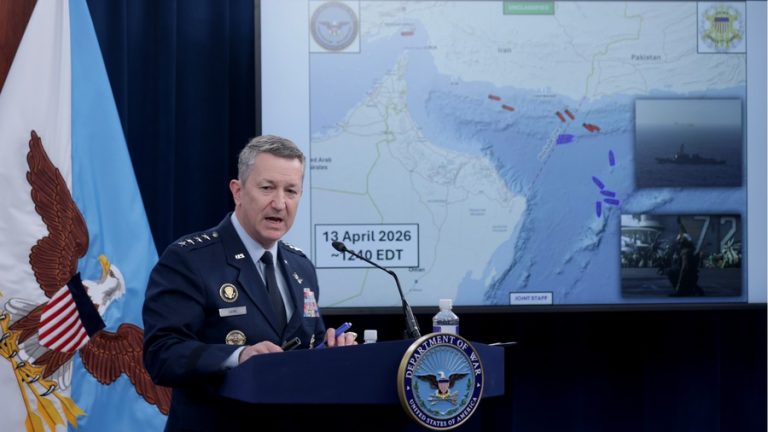
On April 13, the U.S. military imposed a naval blockade sealing the Strait of Hormuz, the narrow waterway through which roughly 20 percent of the world’s oil supply passes. The move cut off Iran’s crude export revenues while avoiding the kind of escalation that could trigger retaliatory strikes on neighboring oil infrastructure. Analysts who follow China’s economy say the impact will extend beyond Iran, with roughly a third to 40 percent of China’s total oil consumption flowing through the same route.
Hours later, the United States Central Command formalized the blockade, extending coverage across the Gulf of Oman and the Arabian Sea east of the Strait. The order targeted all vessels entering or leaving Iranian ports. Two Chinese-designed cargo ships approaching the waterway reversed course. Tanker traffic across the region came to a halt.
The blockade arrived without warning and without a single missile strike. Analysts outside China described it as a move designed to cut off Iran’s finances while also increasing pressure on the Chinese Communist Party (CCP), which had been Iran’s primary commercial backer and diplomatic partner. Some described the episode as the opening act of what they called an “economic world war.”
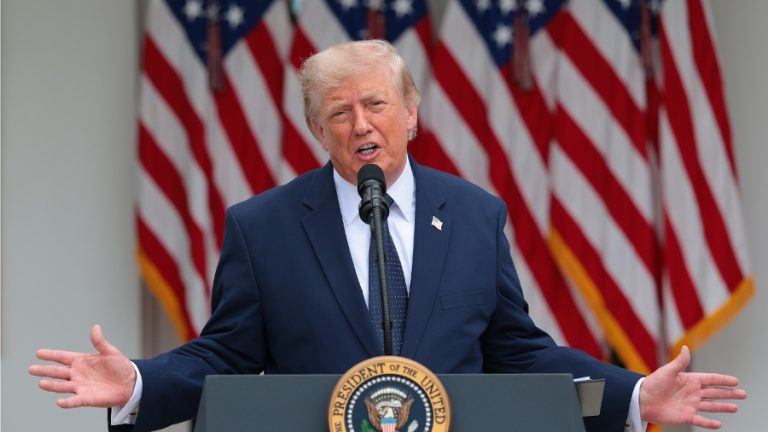
The Strait of Hormuz, long described as the world’s oil valve, had already seen traffic fall to roughly 20 percent of its prewar levels since the Iran war began, but it remained the indispensable artery for Middle Eastern crude exports. Donald Trump, the U.S. president, posted on his Truth Social platform that U.S. naval forces would search and intercept any vessel paying Iran transit fees in international waters, warning that ships making such payments would face serious risks to continued navigation. He outlined three escalating responses: the harshest would push offending ships back into the Persian Gulf; a second tier would blacklist them from future passage; a third would impose financial sanctions barring them from U.S. ports and dollar-denominated transactions. U.S. Central Command subsequently clarified that the blockade would not affect vessels traveling to and from other countries’ ports, a carve-out that prevented a deeper plunge in global stock markets when trading resumed on Monday.

US blockade halts tanker traffic as Iran attempts internal closure of the strait
According to Britain’s Lloyd’s List, tanker movement through the strait appeared to stop entirely within hours of the order taking effect. Two U.S. destroyers transited the strait safely to conduct mine-clearing operations. Iran declared an “inner blockade” of the waterway, creating a standoff: Iran attempting to seal traffic from the inside, the United States sealing it from the outside.
Success
You are now signed up for our newsletter
Success
Check your email to complete sign up
Analysts noted that this counter-encirclement strategy had been in preparation long before the breakdown of negotiations. A fourteen-day bilateral ceasefire Trump announced on April 7 was still technically in force, set to expire April 21, which meant the blockade did not formally violate the truce while giving Washington a strong instrument of pressure in any potential second round of talks.
The blockade cut off Iran’s oil revenues without destroying its physical infrastructure. Iran’s exports of approximately 1.7 million barrels per day were halted at the level of payment and passage rather than at the wellhead or at Kharg Island, Iran’s primary offshore crude export terminal in the Persian Gulf. The approach eliminated Iran’s daily export revenue while preserving the underlying infrastructure, reducing the likelihood of retaliatory strikes on neighboring Gulf producers that could disrupt global supply for years.
Wenzhao, a political commentator with a large following among overseas Chinese audiences, described the calculation this way: a bombing campaign remains an option because of its destructive potential; the blockade cuts current income while keeping strategic options open, and if a deal is eventually reached, Iran can restart its industry rather than rebuild it. The blockade also ended Iran’s long-running attempt to treat the strait as a point of leverage. By establishing control over passage, the U.S. Navy forced shipping companies and governments to choose between operating under U.S. oversight or staying out of the route.
Iran’s negotiating position had rested on an offer to dilute its enriched uranium stockpile without surrendering it, effectively seeking to trade access to the strait for preservation of its nuclear program. The blockade responded directly: control of the strait no longer rests with Iran. Wenzhao drew a historical parallel, noting that naval blockades of this kind—Britain against Germany in World War I, German submarines against Britain in World War II—have long been tools of major power conflict. “He speaks in the language of power,” Wenzhao said, referring to Trump, “and he doesn’t tie his own hands the way previous American presidents did.”

China’s petrochemical and agriculture sectors face immediate supply shock
Wenzhao’s analysis identified Beijing as one of the main areas affected. According to 2025 figures, crude oil transiting the Strait of Hormuz accounts for close to half of China’s total oil imports and between a third and 40 percent of its total petroleum consumption. Even for vessels that might attempt to pay Iran’s fees at a reduced “friendly nation” rate, the risk of U.S. naval inspection, detention, and commercial blacklisting has made such arrangements commercially unviable. “Even a short-term stoppage is an extinction-level economic event,” Wenzhao said. “China was importing 12 million barrels of crude per day before the war, and still over 10 million after it started. That flow cannot stop, not even for a day.”
China’s petrochemical sector absorbed the first impact. Beginning in March, price increases moved through the refining and chemical production chain. Rising upstream costs reduced margins across both basic and specialty chemicals. Manufacturers of plastics, paints, and construction materials began reporting midcontract price increases, project losses, business closures, and unpaid wages. Small and medium-sized plastics and petrochemical enterprises in Shandong and Jiangsu provinces had already begun failing; analysts expected closures to spread more broadly in the second quarter. Wenzhao estimated that the chemical and refining sector directly employs between 7 and 10 million workers, with the broader supply chain affecting 20 to 30 million, exceeding the employment base of the property sector. “When this escalates,” he said, “the impact will be severe.”
Agricultural inputs moved in parallel. Compound fertilizer prices in Liaoning province rose 10.87 percent year-on-year; diammonium phosphate prices climbed 15.22 percent, with similar increases recorded across other provinces. The spring planting season was absorbing these cost increases in real time. The effects on retail food prices were expected to appear after roughly six months, although logistics and fuel costs had already pushed current prices higher. Grain prices themselves had yet to rise sharply, but upward pressure was building.
Wenzhao described the situation as imported inflation driven by supply disruption rather than demand growth, making it difficult to address through China’s usual monetary tools. China’s underlying economic issue is a contraction in credit demand: businesses are unwilling to borrow regardless of interest rates, so cuts to the reserve requirement ratio, interest rate reductions, and special sovereign bond issuances do not directly address the problem. “This is a dimensional-reduction strike determined by the fundamental geography of petroleum civilization,” he said. “No leader can change the fact that the Persian Gulf is the world’s primary oil-producing region, or that Hormuz is the only way out.” He argued that the crisis has brought China and the United States into direct confrontation in both energy and finance, going beyond earlier trade tensions. Beijing had previously promoted Iran’s use of renminbi and cryptocurrency in oil trade; that same arrangement now exposes Chinese-linked vessels to greater scrutiny.

China turns to Russian oil, but pipeline limits remain a constraint
International crude prices surged to $107 per barrel; U.S. benchmark crude reached $101. Li Hengqing, a Washington-based economist specializing in China’s political economy who spoke to this outlet, said a short-term oil price increase was likely but that a repeat of the 1970s global energy crisis remained unlikely. “Iranian oil accounts for about 20 percent of global supply, but the market has diversified substantially. Europe has spent four years adapting to the loss of Russian natural gas. More than 120 tankers have already been rerouted toward South America and North America to source crude. Supply chains are adjusting quickly.” Li said the Iranian clerical regime, whose Revolutionary Guards’ senior commanders have been targeted in precision strikes, may face significant internal pressure in the coming months, with the possibility of a negotiated outcome.
For the Chinese Communist Party, Li said, the calculation remains political as well as economic. Beijing is unlikely to draw down its strategic petroleum reserves to stabilize domestic prices; instead, state-controlled oil companies may benefit from higher prices. He expected Beijing to expand imports, prioritizing Russian supply through existing pipelines, though those pipelines are already operating near capacity. China’s Foreign Minister Wang Yi had already invited his Russian counterpart, Russian Foreign Minister Sergei Lavrov, to visit Beijing in the coming weeks, with expanded oil and gas supply expected to be a central topic. Li said the Party continues to prioritize regime stability. “Even if economic costs rise, they remain secondary to political stability.” He also said the move reflects a broader strategic sequence: Ukraine and Russia first, then Iran, with pressure on China’s energy supply forming part of a longer-term plan.
Blockade shifts great-power competition toward control of energy supply
The blockade also serves another purpose: restricting the movement of Chinese and Russian vessels delivering military supplies to Iran. After Trump was informed that China had supplied Iran with man-portable air defense missiles, he said Beijing would face consequences. Wenzhao said that if the blockade continues for several months, the impact on China’s economy could be severe. Oil supply remains essential for industrial activity, and alternatives cannot be scaled up quickly. Russia’s pipelines are limited in capacity. China’s refining system is concentrated along its coast and depends heavily on seaborne imports. Other potential suppliers, such as Venezuela, remain constrained.
International reactions have diverged. The Chinese Communist Party’s Foreign Ministry described the blockade as “dangerous and irresponsible” and warned that it could increase regional tensions. Some analysts view Washington’s move as an effort to push Beijing to influence Tehran toward a compromise. For tankers already inside the Persian Gulf, the situation remains difficult: refusing to pay Iran’s transit fees carries security risks, while paying them risks interception by U.S. forces. Vessel owners face mounting financial pressure as charter and insurance costs continue to accumulate.
Wenzhao said the situation presents a form of pressure the Chinese Communist Party has not faced in previous economic or diplomatic disputes, placing it beyond the reach of standard monetary and fiscal responses. He said Beijing will need to find ways to secure its energy supply or face significant economic strain in the months ahead. The situation at the strait remains uncertain. Whether U.S.-Iran talks resume, how long the blockade continues, and whether enforcement actions expand will shape both global energy markets and the pressure on China’s economy.