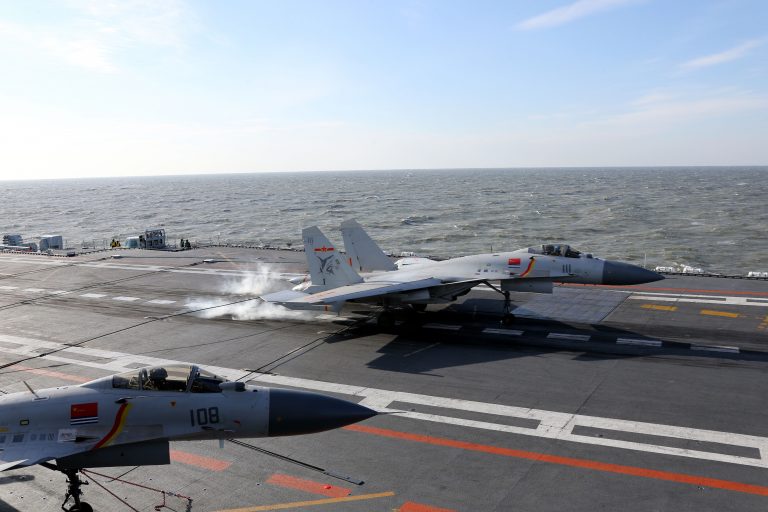
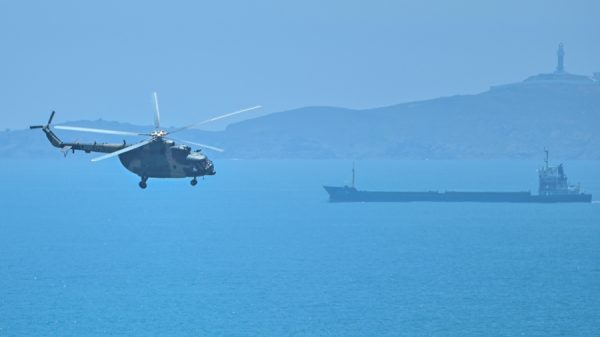
The Chinese Communist Party (CCP) continues to provoke Taiwan by sending naval vessels to operate around the Taiwan Strait and crossing the median line. However, Taiwan’s ruling and opposition parties have still failed to reach a consensus on a special NT$1.25 trillion defense budget bill. Retired U.S. Navy Rear Admiral Mark Montgomery said that it is wrong to remove all commercial procurement items from the budget simply because one disagrees with a specific item in the special defense procurement plan. Doing so would weaken Taiwan’s defense capabilities as well as interoperability and combat effectiveness between Taiwan and the U.S. military.
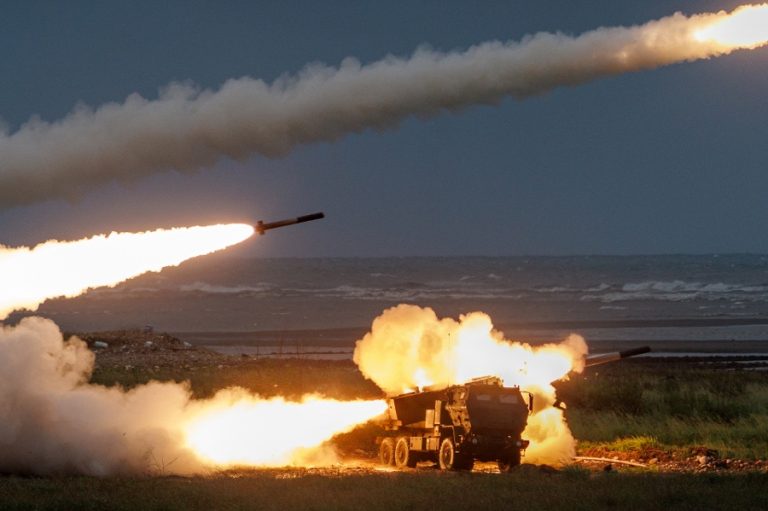
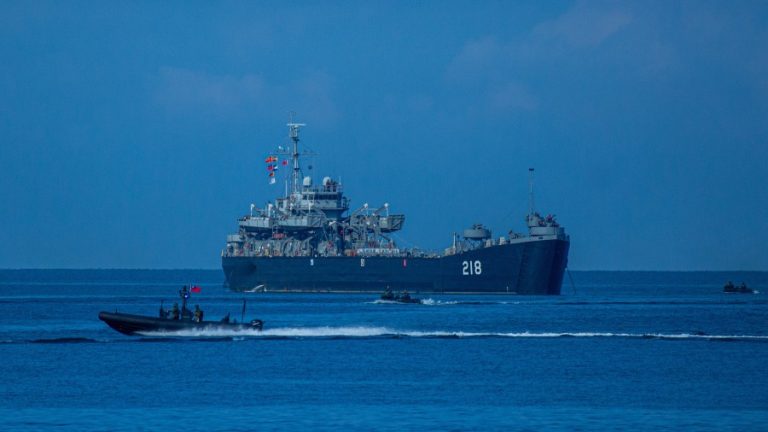
According to Central News Agency (CNA), Taiwan’s Ministry of National Defense stated that from 6 a.m. on the 20th to 6 a.m. on the 21st, it detected 24 Chinese military aircraft, 11 of which crossed the median line entering northern, southwestern, and eastern airspace. It also tracked seven Chinese naval vessels and one government ship, totaling 32 air and sea assets operating around Taiwan. The ministry said it responded with mission aircraft, naval vessels, and shore-based missile systems.
At the same time, the Executive Yuan’s NT$1.25 trillion special defense budget continues to face delays. On the April 20, the Legislative Yuan’s Foreign Affairs and National Defense Committee held a closed-door meeting, inviting Defense Minister Wellington Koo to report on the “Special Act for Strengthening Defense Resilience and Asymmetric Capabilities Procurement Implementation Plan,” followed by questioning.
On the 21st, the Ministry of National Defense released publicly available data outlining seven major procurement categories and their costs, including detailed weapons quantities. The largest allocation—NT$550 billion—is for the purchase of “air defense, anti-ballistic, and anti-armor missiles.” Another NT$64 billion is allocated for “joint U.S.-Taiwan research, development, and procurement,” covering four major items, all classified.
Retired US admiral: Separating FMS and DCS is ‘foolish’
Regarding the lack of consensus on the defense budget, Mark Montgomery, senior director at the Center on Cyber and Technology Innovation at the Foundation for Defense of Democracies (FDD) and retired U.S. Navy rear admiral, said both Foreign Military Sales (FMS) and Direct Commercial Sales (DCS) must be prioritized.
Success
You are now signed up for our newsletter
Success
Check your email to complete sign up
He said it is wrong to cut all commercial sales items simply due to disagreement with certain procurement projects in the special budget.
At a forum hosted by NOWnews titled “Taiwan’s Critical Choice: Defense Security, Energy Policy, and Economic Realities,” Montgomery explained that military interoperability has four levels: de-conflicted (lowest), coordinated, integrated, and unified (highest). For example, the U.S. and South Korea are at the unified level with a joint command, the U.S. and Japan are integrated, the Philippines is coordinated, while Taiwan and the U.S. are currently only at the de-conflicted stage.
Montgomery said Taiwan’s special defense budget aims to improve interoperability with the U.S., but separating FMS and DCS provides no benefit and is “foolish and counterproductive.” It would directly weaken Taiwan’s interoperability and combat capability with U.S. forces, as software upgrades and unmanned systems contracts often rely on commercial procurement channels.
He also said the upcoming May “Trump–Xi meeting” is, for Taiwan, like an election with only two voters: U.S. President Donald Trump and Chinese Communist Party leader Xi Jinping. To “win,” Taiwan must quickly pass the defense budget and become a model ally of the U.S.
Michael Sobolik, senior fellow at the Hudson Institute, said that although U.S.-Taiwan relations are fundamentally strong and stable, the military relationship remains variable. Trump expects partner countries to invest in and strengthen their own defense capabilities, and he admires Israel for prioritizing self-defense and striving to win.
Sobolik, a former staffer for U.S. Senator Ted Cruz, said U.S. lawmakers want Taiwan to be prepared with asymmetric warfare capabilities, strong resilience, and domestic production capacity for key weapons so it does not rely on external partners in a conflict.
He added that if Taiwan passes the special defense budget, it will strengthen U.S.-Taiwan relations and place Taiwan in a very favorable position, because Beijing and Xi Jinping do not want the world to believe Taiwan has agency, and instead aim to isolate Taiwan to convince the world it cannot defend itself.
Hsu Yu-jen: Internal division must not become a national security gap
Former Kuomintang legislator and Hudson Institute senior researcher Hsu Yu-jen emphasized that Taiwan must not be seen by the U.S. as an unreliable partner, or it could become an “option on the menu” in negotiations between Xi Jinping and Trump.
He urged his former colleagues to oversee the government pragmatically rather than proposing irresponsible alternative budgets such as the NT$380 billion-plus version.
Hsu said inconsistent messaging—saying one thing to the U.S., another to China, and yet another internally—would make Washington see Taiwan as untrustworthy. He argued that under transactional political leaders like Trump, Taiwan must reduce internal disputes, as Trump focuses on price and contract execution.
He added that the U.S. views Taiwan’s defense budget debate through two key questions: whether Taiwan is committed to self-defense, and whether internal political disputes are being turned into international issues. In Trump’s view, this makes Taiwan a “problem maker.” Internal uncertainty could become a security vulnerability that Beijing could exploit, using Taiwan’s internal divisions as leverage in external diplomacy.
By Li Jingyao