According to a U.S. Central Command press release, American forces seized an Iranian-flagged cargo vessel in the northern Arabian Sea on April 19 after it failed to respond to repeated warnings, bringing new attention to its recent stop at a southern Chinese port and the materials it may have been carrying.
The Wall Street Journal reported that the vessel, identified as the Tusca, has been under U.S. sanctions since 2019. It is owned by Rahbaran Omid Darya, a subsidiary of the Islamic Republic of Iran Shipping Lines, Iran’s state-owned maritime company.
According to U.S. Central Command, Marines boarded the ship after disabling its propulsion system. Footage released by the military showed personnel descending by rope onto the vessel’s deck before taking control of the ship for inspection.
On April 19, the U.S. Navy guided-missile destroyer USS Spruance issued warnings to the Tusca for several hours as it moved across the northern Arabian Sea toward the Iranian port of Bandar Abbas. The vessel did not respond.
U.S. forces then fired into the ship’s engine room, stopping its movement. Marines from the amphibious assault ship USS Tripoli later boarded the vessel by helicopter.
Success
You are now signed up for our newsletter
Success
Check your email to complete sign up
Former U.S. President Donald Trump wrote on social media that the ship was “nearly 900 feet long, weighing almost as much as an aircraft carrier.”
Vessel movements draw scrutiny after Zhuhai port call
The ship’s recent route has been a focus of attention. Vessel-tracking data cited by Newsweek show that the Tusca docked at Zhuhai Port in Guangdong province in March after departing Iranian waters in late February.
The ship later turned off its Automatic Identification System transponder for roughly 60 hours before reappearing at the same port. Maritime tracking systems normally require continuous transmission of such signals, and the reason for the gap has not been explained.
After leaving Zhuhai, the vessel stopped near Port Klang, Malaysia, a location often referenced in reporting on transshipment activity involving vessels under sanctions. It remained there for several days before continuing its journey.
Charlie Brown, a former U.S. Navy officer, told The Wall Street Journal that vessels carrying routine commercial cargo do not typically ignore repeated warnings from a U.S. warship. He said such behavior can indicate that a shipment is considered sensitive.
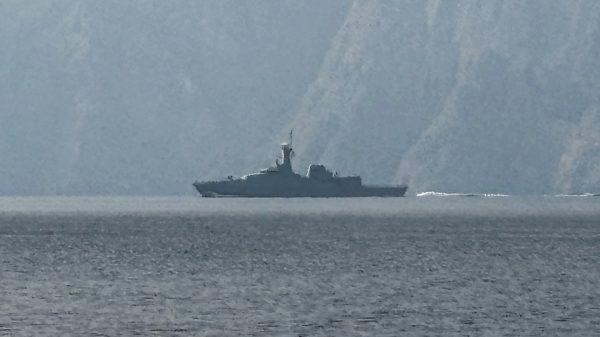
Zhuhai port linked in prior reporting to missile-related chemical exports
Zhuhai’s Gaolan Port has been identified in earlier reporting by The Washington Post as a hub for the export of industrial chemicals that can be used in missile production.
Facilities at the port handle large volumes of liquid chemical materials, including compounds with both commercial and military applications. Shipping data cited in previous reports show that perchlorate compounds have been transported from the port toward Iran in recent years.
Ammonium perchlorate is widely used as an oxidizer in solid-fuel rocket systems. Other related compounds, including sodium perchlorate and sodium chlorate, are commonly used in industries such as paper processing and fireworks manufacturing, but can also be used in propellant production.
Online claims describe cargo linked to missile production
Posts circulating on overseas Chinese-language platforms after the seizure alleged that the Tusca was carrying large quantities of ammonium perchlorate, sodium perchlorate, sodium chlorate, and other related materials.
The claims describe these substances as components associated with missile production. The information has not been independently verified.
Some commentators said shipments of this scale could support the production of a significant number of ballistic missiles, though these assessments remain unconfirmed.

Xi–Trump exchange draws renewed attention after seizure
On April 15, Trump said publicly that he had written to Xi Jinping, the Chinese Communist Party’s general secretary, after reports that China might provide support to Iran.
“I wrote him a letter telling him not to do it,” Trump said. “He wrote back saying he basically wasn’t doing it.”
The exchange has been cited again following the seizure of the Tusca, which had recently departed from a Chinese port before being intercepted by U.S. forces. U.S. officials have not yet released a full inventory of the vessel’s cargo.
China responds without detailing cargo
At a Chinese Foreign Ministry press briefing on April 20, spokesperson Guo Jiakun was asked about the interception and the cargo aboard the vessel.
Guo said China “expresses concern” about the U.S. action but did not provide details regarding the ship’s contents or activities.
Neither the shipping company nor Chinese authorities have publicly explained what the vessel was carrying.
The inspection of the Tusca is ongoing. U.S. officials have indicated that additional information may be released after the cargo has been fully examined.
By Li Deyan