The Federal Reserve announced Wednesday, April 29 that it will keep its benchmark interest rate unchanged at a range of 3.5 percent to 3.75 percent. The decision met market expectations, but the number of dissenting votes reached its highest level since 1992.
According to CNBC, this meeting was widely seen as potentially the final rate decision chaired by Federal Reserve Chair Jerome Powell during his current term. The Federal Open Market Committee (FOMC), responsible for setting monetary policy, ultimately voted 8–4 to maintain rates.
Among the four dissenters, Fed Governor Stephen Miran continued to advocate for a 25-basis-point rate cut. Meanwhile, Cleveland Fed President Beth Hammack, Minneapolis Fed President Neel Kashkari, and Dallas Fed President Lorie Logan supported holding rates steady but opposed language in the policy statement that could signal possible future rate cuts.
The central dispute focused on the statement’s wording that “in considering the extent and timing of additional adjustments to the target range for the federal funds rate, the Committee will carefully assess incoming data, the evolving outlook, and the balance of risks.” Some officials argued that the phrase “additional adjustments” implied a future easing bias inconsistent with current inflation conditions.
In its statement, the Fed noted that inflation remains elevated, partly due to rising global energy prices. Several policymakers believe interest rates may need to remain higher for longer until there is clearer evidence that inflation is returning to target.
Success
You are now signed up for our newsletter
Success
Check your email to complete sign up
Markets broadly expect rates to remain relatively stable through this year and likely into 2027. Based on prior Fed guidance, policymakers still anticipate gradual rate cuts over the coming years, eventually bringing rates closer to a neutral level of around 3.1 percent.
Economic performance remains resilient
The U.S. labor market continues to show strength. In March, nonfarm payrolls increased by 178,000—above expectations—while the unemployment rate fell to 4.3 percent. Although private-sector job growth slowed somewhat in April, overall employment expansion remained positive.
Financial markets declined on the day, pressured by rising oil prices and investor caution ahead of major technology earnings reports. This marked the Fed’s third consecutive meeting without a rate change, following multiple rate cuts over the previous year.
The current policy environment faces multiple challenges, including inflation remaining above the Fed’s 2 percent target, along with pressures from trade policy shifts and energy price increases. While the Fed typically downplays short-term price fluctuations, the prolonged nature of recent increases has heightened concerns over longer-term inflation trends.
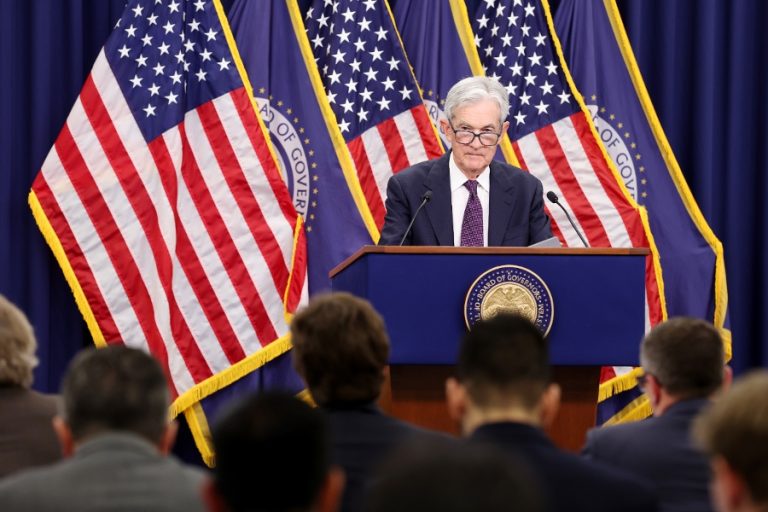
Following the rate announcement, market attention quickly shifted to Powell’s press conference, particularly regarding whether he will remain on the Federal Reserve Board after his term as chair ends in May. Powell stated he intends to remain on the Board until an investigation into the Federal Reserve headquarters renovation project is concluded “fully and transparently.”
Fed chair nominee Warsh advances in Senate
According to CNBC, earlier that day, the U.S. Senate Banking Committee approved President Trump’s nomination of Kevin Warsh as the next Federal Reserve Chair by a narrow 13–11 party-line vote. The nomination is expected to move quickly to the full Senate, and if confirmed, it would mark the Fed’s first leadership change since 2018.
Warsh’s nomination had previously been delayed by Republican Senator Thom Tillis. A breakthrough came last week when the U.S. Department of Justice agreed to temporarily suspend its criminal investigation into cost overruns tied to the Federal Reserve’s Washington headquarters renovation.
Tillis said the investigation was “baseless” and warned it could undermine the Fed’s monetary policy independence. In an interview with Meet the Press, he said he had received assurances that the Justice Department would not reopen the investigation unless the Fed’s inspector general completed a formal review and made a criminal referral.
With committee approval secured, Warsh’s path to becoming the next Fed chair has become significantly clearer. Many observers believe his appointment could usher in a substantial shift in U.S. monetary policy strategy.
During his nomination process, Warsh proposed several reforms, including reducing the Fed’s approximately $6.7 trillion balance sheet, reshaping the inflation management framework, and improving central bank communication with the public. However, specific implementation details remain unclear.
At his press conference, Powell congratulated Warsh on his nomination progress while emphasizing the importance of preserving the Federal Reserve’s independence.