The Argentine government on June 4 issued a preliminary award for a major river dredging contract to a Belgian company and its local partner, which has previously worked with a Chinese state-owned dredging firm. The losing bidder, another Belgian company backed by a U.S. partners, has since challenged the outcome, fueling debate over the geopolitical considerations behind the decision.
President Javier Milei’s administration announced on June 4 that it had selected Belgian dredging company Jan De Nul NV for a 25-year concession contract valued at approximately US$10 billion to maintain the country’s principal inland shipping route.
According to Argentine outlet Todo Noticias, Jan De Nul and its local partner, Servimagnus, maintained the waterway from 1995 to 2021. The three-stage bidding process was conducted using an evaluation system developed with support from the United Nations Conference on Trade and Development (UNCTAD).
A preliminary award report from Argentina’s Ministry of Economy showed that the Jan De Nul-Servimagnus consortium received 66.20 points, compared with 42.14 points for rival bidder DEME NV, another Belgian dredging company.
Following the preliminary award, the government provided a seven-day period for interested parties to file objections before finalizing the tender. No formal challenges have been publicly reported.
Success
You are now signed up for our newsletter
Success
Check your email to complete sign up
However, on June 11, DEME submitted a revised proposal. The company’s general manager and representative, Steven Bouckaert, sent a letter to Economy Minister Luis Caputo emphasizing the “relevance of its offer,” which he said was “backed by the United States.”
According to Datamar News, DEME also proposed a 17.4 percent discount compared with the tariff floor established under the current Vía Navegable Troncal (VNT) tender conditions.
Bouckaert said the revised proposal could generate “nominal savings of at least US$2.5 billion for VNT users over the 25-year concession period.”
The contract has not yet been formally awarded, but the dispute has drawn attention because of growing U.S.-China economic competition in Latin America. DEME’s bid is supported by Great Lakes Dredge & Dock Corp., one of the largest dredging companies in the United States, and investment firm KKR & Co., which has received support from the U.S. International Development Finance Corporation.
‘Vía Navegable Troncal’
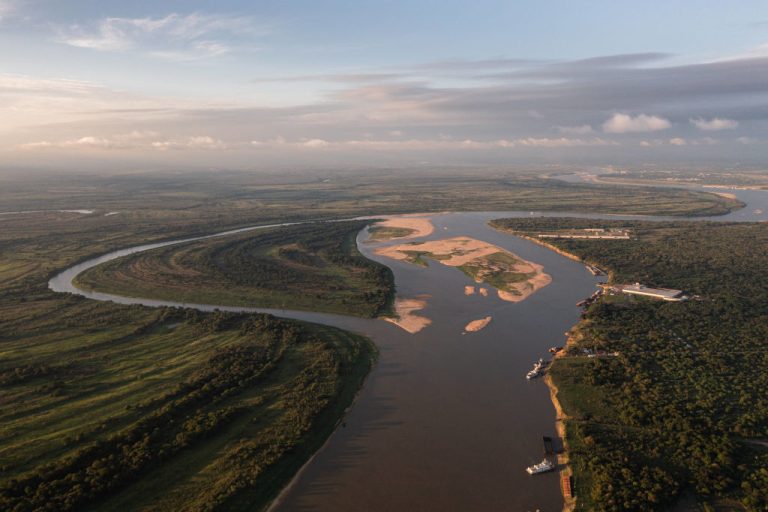
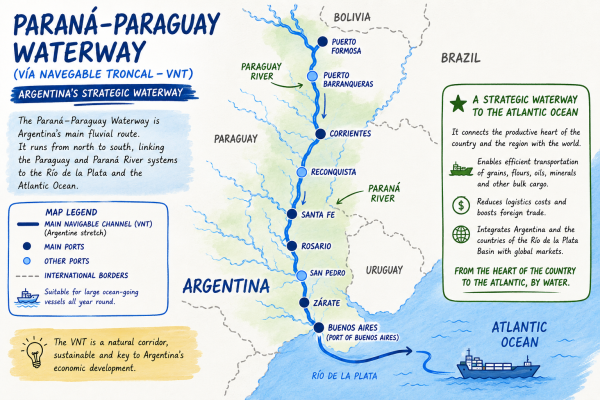
The project covers dredging and navigational buoy maintenance along Argentina’s section of the Hidrovía Paraná-Paraguay waterway, known locally as the Vía Navegable Troncal (VNT).
According to the Buenos Aires Times, the route handles roughly 80 percent of Argentina’s exports and is considered one of the country’s most strategically important trade corridors.
The VNT stretches approximately 932 miles and connects inland ports to the Atlantic Ocean. It also serves as a key export route for neighboring Paraguay, Brazil, Bolivia, and Uruguay, making it one of South America’s most important commercial waterways.
RECENT COVERAGE
- US Targets Chinese Tech Giants, Adding BYD, Alibaba, Baidu to Pentagon List
- EU Fears China’s Growing EV Sector Infrastructure in Morocco Could Circumvent Trade Restrictions
- India-Nordic Summit: $100 Billion Trade Framework to Boost Tech, Green Transition and Arctic Cooperation
The VNT represents roughly one-third of the broader Hidrovía Paraná-Paraguay system, a regional shipping corridor developed through cooperation among five South American countries under the Hidrovía Intergovernmental Commission, with support from the Inter-American Development Bank and the United Nations Development Programme.
The project involved extensive river engineering, including dredging, rock removal, and channel modifications, according to International Rivers.
The June 4 pre-award concerns the Argentine section of the waterway, which is considered the most commercially significant portion of the larger network and requires ongoing dredging and navigational support to allow oceangoing vessels to reach inland ports.
The route extends from the confluence of the Paraguay and Paraná rivers to the Natural Deep Water Zone in the outer Río de la Plata. According to a readout by Argentina’s Ministry of Economy, it connects 79 ports across seven provinces: Buenos Aires, Santa Fe, Entre Ríos, Corrientes, Chaco, Formosa, and Misiones.
Since 2021, when Jan De Nul’s previous concession expired, the waterway has been managed by the national government while authorities prepared a new international tender process.
What’s the geopolitical context?
The economic and strategic importance of the VNT has elevated the project beyond a routine infrastructure contract.
While DEME’s U.S. backing has been openly highlighted by the company, there is no publicly reported direct Chinese participation in the tender itself.
Instead, attention has focused on Jan De Nul’s local partner, Servimagnus SA, which DEME has argued maintains longstanding ties with China’s state-owned CCCC Shanghai Dredging Co., according to Bloomberg.
Before DEME submitted its revised proposal, one of its U.S.-based partners, Great Lakes Dredge & Dock Corp., told Bloomberg it was “disappointed” by the preliminary award and was evaluating its options.
“It is a bad sign toward American investors,” said Chris Gunsten, senior vice president for project services.
Servimagnus told Bloomberg that it has worked with Shanghai Dredging on projects in the Río de la Plata estuary and along Argentina’s Atlantic coast for roughly two decades. However, the company denied any Chinese involvement in operations on the VNT waterway.
The issue has attracted additional attention because China Communications Construction Company (CCCC) Dredging Group, the parent company of CCCC Shanghai Dredging Co., has been subject to U.S. sanctions since 2020 over its role in Beijing’s island-building activities in the South China Sea, CNN reported.
Bouckaert’s letter to Caputo also underscored the broader geopolitical significance attached to the project. According to Datamar News, the letter referenced support from President Donald Trump for the DEME-backed proposal.
“This project is of great importance for Argentina’s competitiveness and investment climate, as well as for the commercial and strategic interests of the United States. A successful award to leading U.S.-based investors would provide strong market validation of President Milei’s reform program and further strengthen the bilateral relationship,” the DEME-supporting companies wrote in their letter to the Argentine government.