Qiu Ying: a professional painter who rose from poverty to the top of Chinese art
Qiu Ying (c. 1494–1552), courtesy name Shifu and sobriquet Shizhou, was born in Taicang, Jiangsu province, and later settled in Suzhou. His family was poor, and as a young man he worked as a house painter and lacquer craftsman before devoting himself entirely to fine art.
Qiu Ying was quick-minded and tireless in his studies. He caught the attention of Wen Zhengming, one of the era’s foremost literati painters, and formally studied under the painter Zhou Chen. He also mixed freely with the artists and scholars of the Wu school, the name given to the circle of painters centered on Suzhou during the middle and late Ming dynasty, sharpening his technique through constant exchange and discussion.
His most formative experience came through commissions. Two of the era’s most important private collectors, Zhou Fengzhi and Xiang Yuanbian, engaged him to live and paint in their residences, where he gained unrestricted access to their holdings of ancient masterworks. He copied them exhaustively. That immersion in classical models gave him a technical foundation few contemporaries could match, and his abilities advanced rapidly. Wen Zhengming called him a man of “extraordinary gifts.” The leading late-Ming critic Dong Qichang ranked him first among recent masters.
Qiu Ying’s style was disciplined and wide-ranging: he excelled in landscape, figure painting, bird-and-flower painting, and architectural rendering. His landscapes favored the blue-and-green color tradition; his figure paintings were executed in meticulous fine-line brushwork with dense, opulent color. He was especially celebrated for his paintings of court ladies, the genre known in Chinese as meiren hua, or “beauty painting.”
His major works include “Spring Morning in the Han Palace,” his own version of the famous Song-dynasty original “Along the River During the Qingming Festival,” “The Imperial Hunt,” “Red Cliff,” “Awaiting the Ferry on an Autumn River,” and “Peach Blossom Spring.” Together with Shen Zhou, Wen Zhengming, and Tang Yin, Qiu Ying is counted among the Four Masters of the Ming dynasty, also known as the Four Masters of the Wu School. He was the only professional painter among the four; the others were gentleman-scholars who painted as a cultivated pursuit rather than a livelihood, and their works typically carry inscribed poems reflecting that literary identity. Qiu Ying’s paintings bear only a signature. Because his work was so widely admired, forgeries and copies multiplied during his lifetime and long afterward. Many works attributed to him in circulation today are later imitations.
Success
You are now signed up for our newsletter
Success
Check your email to complete sign up
Inside the scroll: a morning in the imperial palace, rendered scene by scene
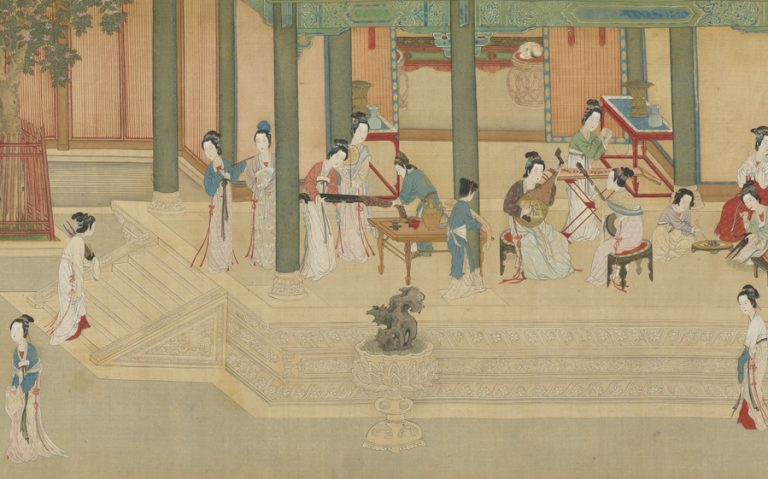
“Spring Morning in the Han Palace” is painted on silk. The scroll measures 30.6 centimeters tall and 574.1 centimeters long, nearly 19 feet, and is now held at the National Palace Museum in Taipei. The entire work is executed in the gongbi technique, one of the two great traditions in Chinese painting: a style of fine-line brushwork that prizes precision and detailed rendering over the spontaneous, gestural quality associated with the other tradition, ink-wash painting. The figures are rendered with striking individuality, and the palette is lush and highly saturated, built on blues and greens, but never garish. Every building, every railing, every gate and terrace was drawn with a straight-edge ruler, producing lines of perfect horizontality and verticality. This technique, called jiehua, served as the architectural draftsmanship of its era. The care required was immense.
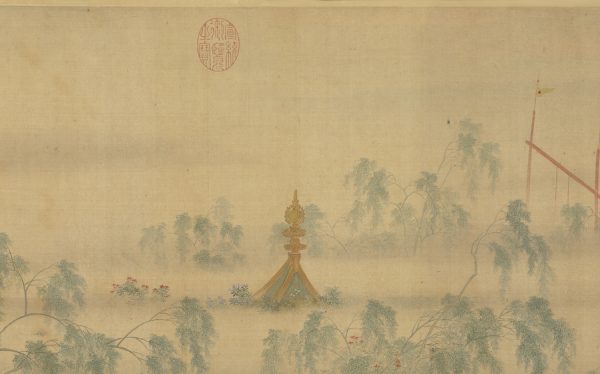
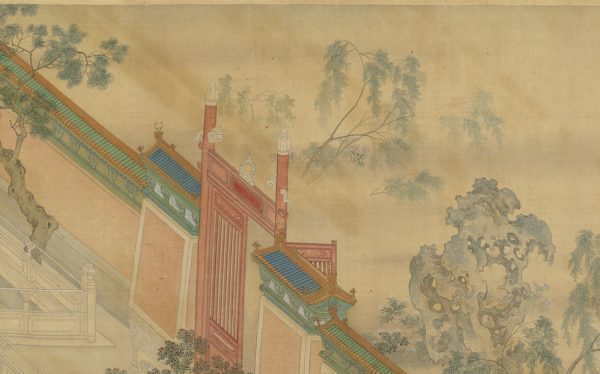
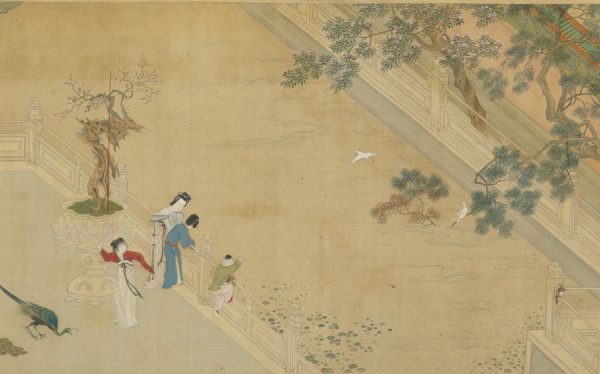
The scroll opens on a distant scene veiled in morning mist. Willows trail their branches, and through the haze a red swing frame rises on tall poles while a gold pavilion catches the light, the whole scene carrying an almost otherworldly calm. A red gate stands open, and the viewer’s gaze follows it into the palace grounds. Pine and cypress stand at attention. By the moat, a court lady fans herself lazily while watching lotus blossoms and birds with a small child, the pair entirely at ease.
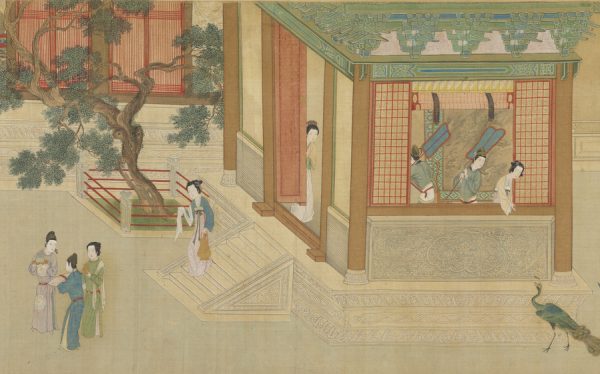
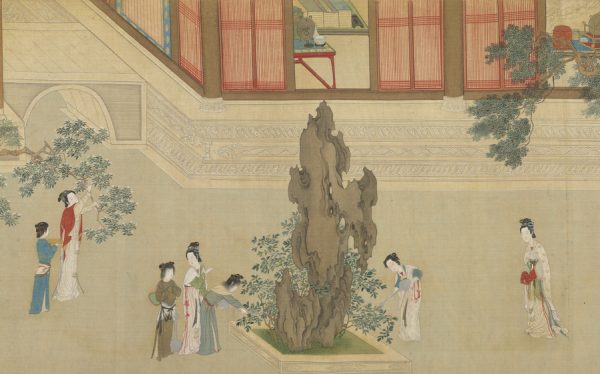
Inside a graceful hall, ladies feed peacocks and carry tall fans. Nearby, another group moves purposefully with pitchers, jars, and bundles, heads bent together in low conversation, apparently coordinating duties at the next station in the palace’s morning routine. The scroll then opens onto a wider courtyard dominated by jagged Taihu rocks, the porous limestone formations prized in classical Chinese garden design for their sculptural quality. Small clusters of ladies water plants, pick sprigs of osmanthus, and arrange flowers in their hair. Through the doorway of the hall beyond, two women face their mirrors, completing their morning dress.
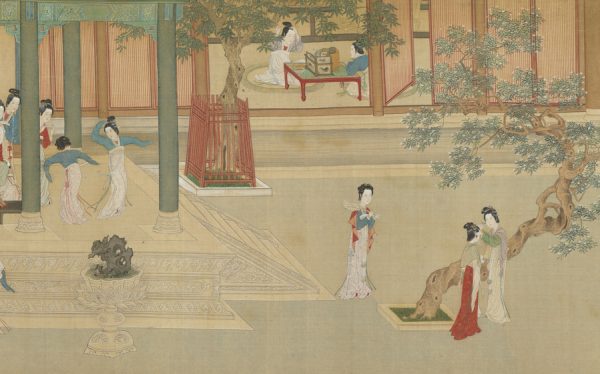
The first visual climax follows. A group of gifted court ladies has gathered in a grand hall: one moves through the sinuous figures of the luyao, a flowing, serpentine dance performed in the Tang-dynasty imperial palace as a formal court entertainment rather than a popular or folk tradition; others play the ruan lute, the xiao vertical flute, the pipa lute, and the guzheng zither, filling the air with layered music.
Outside in the courtyard, ladies crouch in absorbed concentration over a game of douao, or “grass dueling,” in which players match stems of wild plants by intertwining them and pulling, the one whose stem breaks losing the round. Two more women stretch out on a carpet inside a study beyond, reading with evident pleasure.
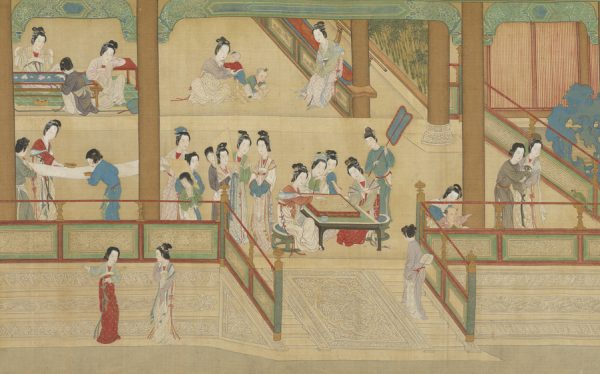
The next great hall is a second visual focal point, dense with simultaneous activity: ladies tease a caged bird, play chess, iron bolts of silk, embroider, study a hanging painting, and, in several tender groupings, coax and comfort small children.
The scroll’s final scene revisits a two-thousand-year-old story of a court beauty betrayed by a corrupt painter
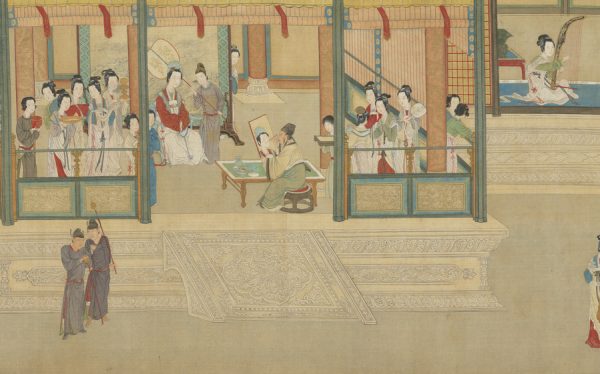
The scroll builds to its narrative climax: a portrait sitting. In the pictorial conventions of classical Chinese painting, figures of high importance were rendered at greater scale than their physical size would warrant, a technique for signaling social rank visually. Following that convention, the largest figure in the scene, a woman seated in red robes and crowned with flowers, is traditionally identified as Wang Zhaojun, one of the four great beauties of ancient China, a classical grouping of legendary women celebrated across Chinese literature, poetry, and painting for centuries. The painter beside her, intent on his work and wearing a tall hat, is identified as Mao Yanshou.
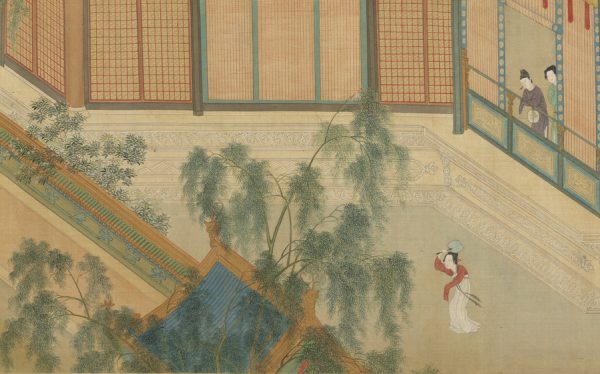
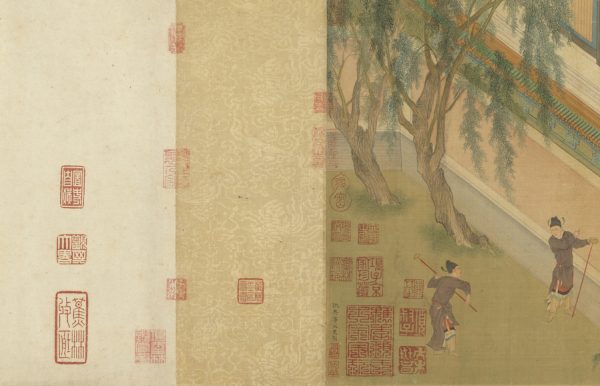
The scroll closes quietly: a lady swats at a butterfly with her fan, two women stand absorbed in private thought, and beyond the palace wall, armed soldiers walk their patrol.
Wang Zhaojun: the court beauty whose arranged marriage to a nomadic chieftain kept the peace for decades
Wang Qiang (c. 51 BC–15 BC), known by her courtesy name Zhaojun, was born in Zigui in Nan Commandery, in what is now Xingshan County, Hubei province. She is counted among the four great beauties of ancient China, alongside Xi Shi, Diaochan, and Yang Guifei, three other women from different periods of Chinese history whose names became bywords for extraordinary beauty and whose stories were retold across two millennia of literature and art. Her role in maintaining decades of peaceful relations between the Han dynasty and the Xiongnu confederation, the powerful nomadic empire to China’s north, secured her a place in history alongside those legends.
The story of how she came to leave China is recorded in a tale titled “The Painter Executed in the Marketplace,” collected in the early Han anthology Xijing Zaji, a miscellany of anecdotes and curiosities compiled by the scholar Liu Xin, roughly analogous to a Western commonplace book or collection of historical odds and ends. According to that account, Wang Zhaojun entered the imperial palace as a lady-in-waiting to Emperor Yuan of Han. Because the inner palace held so many women, the emperor never met most of them personally; instead, he selected whom to summon based on portraits painted by court artists. The other palace ladies bribed the court painter Mao Yanshou, hoping he would flatter their likenesses. Wang Zhaojun refused. In retaliation, Mao Yanshou deliberately rendered her badly, some versions of the story adding that he painted a mole on her face.
When the Xiongnu chieftain Huhanye Chanyu came to the Han court seeking a diplomatic marriage alliance, Emperor Yuan selected a bride from among the palace portraits, and the unflattering portrait of Wang Zhaojun sealed her fate. One tradition holds that she volunteered to go. The emperor summoned her to say farewell and found himself looking at a woman whose beauty surpassed every other woman in the palace. He could not honorably withdraw the promise already given to the chieftain, and so he let her go, stricken with regret. Mao Yanshou was executed and displayed in the street.
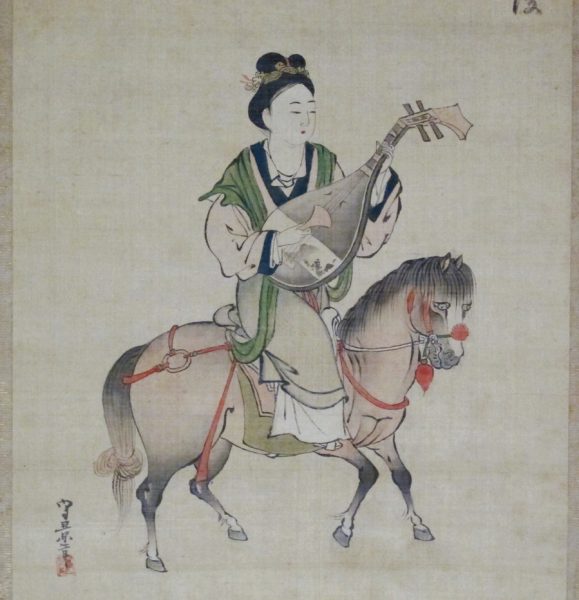
Wang Zhaojun rode north to the steppe, her heart broken. Mounted on horseback, she played a melody of such mournful beauty on her pipa lute that wild geese flying overhead, dazzled by the sight of her, tumbled from the sky. The legend gave rise to the classical Chinese idiom chen yu luo yan, meaning “fish sink and geese fall,” a phrase used to describe a woman of overwhelming beauty. The idiom’s second half, “geese fall,” traces directly to this story. “Zhaojun Crosses the Border” became one of the most retold stories in Chinese literature, inspiring poems, novels, paintings, operas, and ballads across two millennia.
Some art historians contend that the figure sitting for the portrait in “Spring Morning in the Han Palace” is more likely an ordinary court lady than Wang Zhaojun herself. At the time Mao Yanshou painted her, she was an unremarkable palace lady who had never attracted imperial favor, and her rank would not have entitled her to such a formal and prominent portrait session. The identification remains a pleasing tradition rather than a settled fact.
Why ‘Spring Morning in the Han Palace’ stands as the supreme achievement in Chinese figure painting
Qiu Ying built his reputation on caisi meiren, richly colored paintings of court beauties. “Spring Morning in the Han Palace” is the supreme expression of that achievement. The scroll contains more than a hundred figures, and every one reads differently: different posture, different expression, different quality of attention. The observational precision is extraordinary. The brushlines are fluid and unhurried, the costumes brilliant without crudeness, the whole work breathing with a realism that never tips into stiffness.
The compositional command is what sets the scroll apart. Qiu Ying manages the full span of a vast imperial complex, with its soaring halls, open courtyards, and the constant movement of people, some alone, some in pairs, some in crowds, through scene after scene without a single awkward transition. The pacing across the scroll’s nearly 19 feet feels as organic as a piece of music, with passages of hush and passages of density, moments of intimate stillness followed by scenes of collective animation. The whole unrolls like a river, steady and inevitable. Scholars of Chinese art have long placed it at the top of the court beauty painting tradition.
(Reprinted from Kan magazine, issue 276.)