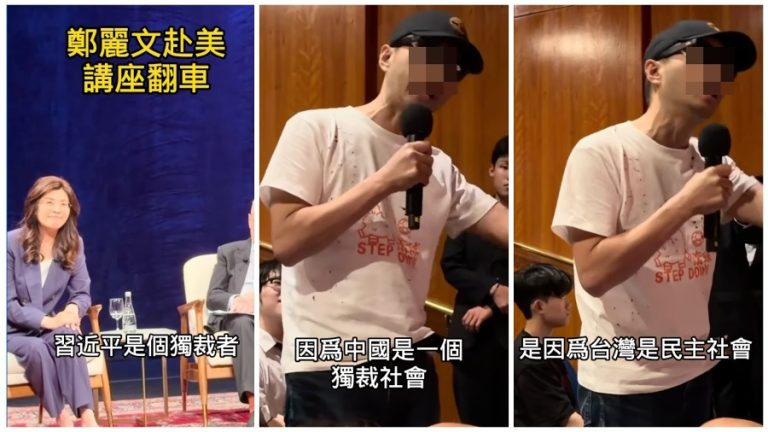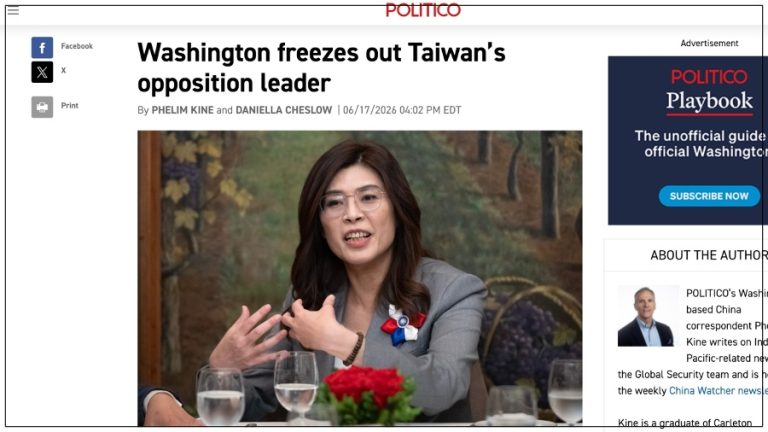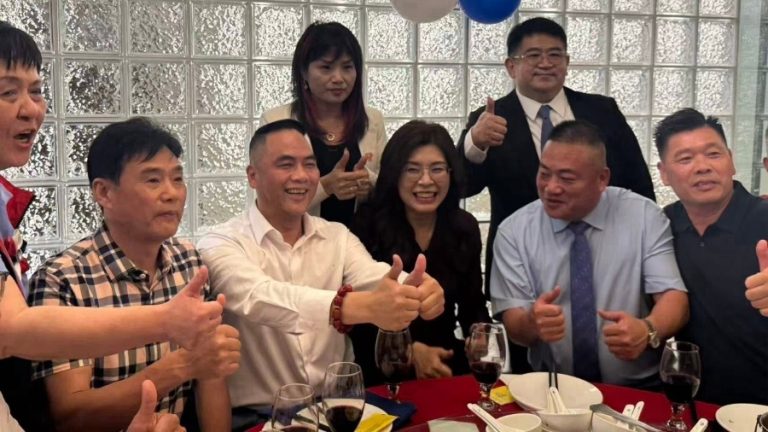
Cheng Li-wen, chairwoman of Taiwan’s Kuomintang (KMT), returned to Taiwan on Tuesday, June 16 after concluding her visit to the United States. Her trip has drawn intense public scrutiny because she appeared on multiple occasions alongside individuals alleged to have ties to the Chinese Communist Party’s United Front system or attended overseas Chinese banquets where such figures were present, Mirror Media reported.
Wu Hsin-tai, chair of the Taiwan Statebuilding Party’s Taipei chapter, said Cheng had held meetings with individuals she described as CCP agents, attracting the attention of U.S. national security authorities. Wu further warned that what she found most alarming was the possibility that sensitive information accessible to senior Taiwanese officials could be passed through KMT legislators to Cheng, creating a potential national security vulnerability.
Cheng Li-wen’s close interactions with Fujian hometown association president Chen Heng
In a Facebook post on June 15, Wu questioned whether Cheng Li-wen’s visit to the United States was, in fact, intended to facilitate meetings with individuals acting on behalf of the CCP.
Wu pointed out that Cheng was seen dining at the same table and interacting closely with Chen Heng, president of the Fujian Hometown Association. She said the incident had not only drawn significant attention from U.S. national security agencies but also deeply concerned her, according to a SET media report.
According to Wu, Chen Heng is “far from being merely a community leader devoted to public service.” She alleged that he is a person of interest to U.S. national security authorities and claimed that the Fujian Hometown Association, under his leadership, has long operated under the direction of China’s Ministry of Public Security, carrying out transnational repression on Beijing’s behalf and mobilizing pro-Beijing members of the overseas Chinese community to harass overseas political figures.
Success
You are now signed up for our newsletter
Success
Check your email to complete sign up
Wu Hsin-tai said that in May of this year, a U.S. federal court convicted Lu Jianwang and Chen Jinping, who had repeatedly worked alongside Chen Heng. They were found guilty of acting as unregistered foreign agents and obstruction of justice. According to Wu, the two men operated an overseas Chinese police service station in Manhattan’s Chinatown on behalf of the Chinese Communist Party (CCP), where they allegedly monitored and harassed dissidents living abroad.
Wu added that although Chen Heng himself has not been indicted, he remains one of the key individuals under scrutiny by U.S. national security authorities.
Wu also noted that in 2023, when then-President Tsai Ing-wen transited through New York, unidentified individuals gathered outside her hotel, shouting slogans and engaging in what she described as deliberate harassment. According to Wu, Chen Heng was among the organizers leading the demonstration. She said that this type of intimidation and harassment is a routine part of the activities carried out by such individuals.

Concerns that senior government officials could be monitored
Wu Hsin-tai emphasized that what she finds most alarming is the potential national security vulnerability behind these events.
She noted that members of Taiwan’s Legislative Yuan have the authority to request briefings and access information regarding the sensitive itineraries and travel arrangements of the president, vice president, and senior executive officials during overseas visits.
She questioned: “Could these sensitive materials concerning the personal security of Taiwan’s top leaders be passed through Kuomintang (KMT) legislators and ultimately end up in Cheng Li-wen’s hands? And could Cheng’s undisguised interactions with individuals already under the scrutiny of national security authorities expose the movements of our head of state to surveillance and threats from hostile actors?”
Wu added that what makes the situation even more difficult to accept is that these overseas trips are funded by taxpayers.
She said that she had already warned the public in April that Cheng’s delegation visit to China—during which Cheng met with Xi Jinping in what Taiwanese media dubbed the “Cheng–Xi meeting”—featured no public protest or criticism of Beijing, but instead included praise for China’s “remarkable achievements.”
According to Wu, that trip received NT$4.8 million (USD$151,940) in funding from the Taiwan Foundation for Democracy, with NT$3.02 million ultimately reimbursed after expenses were verified. She said that following Cheng’s 14-day visit to the United States, Cheng has now applied for an additional NT$5.5 million (USD$174,097) in funding, Liberty Times reported.
Wu asked: “When the chairperson of a political party uses money from the Taiwan Foundation for Democracy—and from Taiwan’s taxpayers—to first visit China and meet Xi Jinping, then travel to the United States and sit at the same table with individuals associated with the CCP’s United Front system, whose diplomacy is she really conducting?”
KMT accused of building a ‘trojan horse bridge’
Wu sharply criticized the Kuomintang, saying that although the party repeatedly claims it wants to serve as a “bridge between different sides, the bridges it has built are Trojan Horse bridges”—ones that enable the CCP’s United Front organizations and transnational repression networks to more easily gain access to Taiwan’s sensitive information and undermine Taiwan’s diplomacy.
She asked whether Taiwanese politicians are now destined to face surveillance, harassment, or even threats to their personal safety from the CCP whenever they travel abroad to advance Taiwan’s democracy and international relations.
Wu concluded: “No one builds a road that allows robbers to walk straight into their own home.”
She added that, in the face of what she described as a political party that treats national security lightly and may even be cooperating, directly or indirectly, with pro-Beijing networks overseas, she will continue to stand on the front lines to safeguard Taiwan’s interests and will never allow politicians who “open the door to robbers” to sell out Taiwan.
US paying attention to whether the KMT is ‘changing its political orientation’
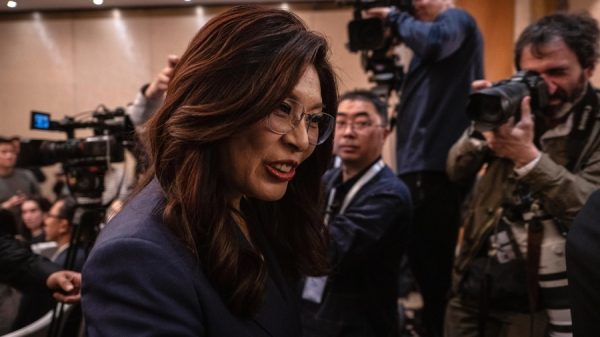
Cheng Li-wen’s U.S. trip has also attracted attention after she was repeatedly seen appearing alongside individuals alleged to have ties to the CCP’s United Front system or attending overseas Chinese community banquets where such figures were present.
At a banquet in Boston, Cheng was photographed with Gary Yu (Yu Guoliang), who has been described as having close ties to organizations associated with the CCP’s United Front system.
The Kuomintang responded that Gary Yu was not on the official guest list and said the two merely posed for a photograph and did not sit at the same table.
At another banquet in New York, Cheng was also photographed with Jiao Sheng’an, a senior official of the New York Chinese Association for Peaceful Reunification, an organization that the article describes as being viewed by U.S. authorities as an extension of the CCP’s United Front network.
According to The Epoch Times, the Democratic Progressive Party (DPP) China Affairs Department and Taiwan’s Mainland Affairs Council (MAC) strongly criticized the situation, arguing that these individuals, who they said have close ties to the Chinese Communist Party’s United Front system, appeared to be “shadowing” Cheng Li-wen throughout her trip. They said this has fueled public speculation over whether Cheng’s visit was intended to convey messages on Beijing’s behalf or advance the CCP’s United Front agenda.
The Kuomintang (KMT) defended Cheng, stating that she “met the people she needed to meet and said what she wanted to say.” The party accused certain media outlets of deliberately manipulating public opinion and distorting the facts, adding that the exchanges were conducted based on mutual understanding between the Taiwanese and American sides and that the details would not be disclosed publicly.
According to a BBC report, the United States has expressed concern over Cheng’s repeated appearances alongside such individuals. Earlier, Raymond Greene, Director of the American Institute in Taiwan (AIT), said in a media interview that U.S. officials are watching closely to determine whether the Kuomintang is “fundamentally changing its political orientation.” He also described Cheng’s U.S. visit as an opportunity to dispel those concerns.