The three communiqués that defined US-China relations were not diplomatic milestones. They were operations. The Chinese Communist Party (CCP) used each one to extract a concrete concession from Washington while making promises it had no intention of honoring. Together, they form a decades-long campaign to isolate Taiwan, neutralize American intervention, and buy time for Beijing to acquire the military and economic power to act unilaterally. The United States, in each case, believed it was managing China. It was being managed.
The 1972 Shanghai Communiqué: Mao exploited Nixon’s desperation for a strategic windfall
Richard Nixon arrived in Beijing in February 1972 carrying two burdens: the Vietnam War and the Soviet threat. Mao Zedong, the CCP’s founding ruler and China’s top leader at the time, saw both as leverage.
According to recollections attributed to senior Party cadres from that period, Mao told colleagues privately that Nixon’s visit meant “the American imperialists have run out of options and come to us begging for peace.” What Nixon believed was a bold act of statesmanship, Mao read as weakness, and exploited accordingly.
The Shanghai Communiqué’s most consequential clause was its studied vagueness on Taiwan. The United States “acknowledges” the position that “all Chinese on either side of the Taiwan Strait maintain there is but one China.” The choice of “acknowledges” was legally deliberate; the Americans rejected both “accepts” and “recognizes,” believing this preserved their freedom of action on Taiwan’s status. Beijing let them believe it. Each side went home and told a different story. Washington told itself it had made no legal concession on Taiwan. Beijing told its domestic audience it had secured American acknowledgment of the “one China” framework, a stepping stone toward eventual reunification.
Internal Party records indicate Mao was explicit about the gap between public text and private intent. He instructed that the communiqué’s language on peaceful resolution was “written for outsiders to read” and that the Party “absolutely does not commit to renouncing the use of force.” The pledge of peaceful intent was a performance, staged for Nixon’s benefit, never intended as policy.
Success
You are now signed up for our newsletter
Success
Check your email to complete sign up
The strategic logic was calculated rather than simple. The CCP dangled anti-Soviet solidarity in front of an American president desperate to extricate the United States from Southeast Asia and contain Soviet expansion. Nixon took the bait. Taiwan was reframed from a territorial dispute between legitimate governments into a secondary “strategic chip,” subordinate to the main game of countering Moscow. Once that framing took hold in Washington, it was never fully dislodged.

The 1979 normalization communiqué: Deng Xiaoping’s reformist costume and the concessions Carter’s team failed to see
By 1979, the CCP’s pitch to Washington had changed. The ideological menace was dressed in the costume of reform.
Deng Xiaoping arrived in the United States projecting self-deprecation. He wore a cowboy hat at a Texas rodeo. He praised American ingenuity. He told Jimmy Carter’s administration that China wanted to learn from the West, that economic modernization was the Party’s consuming ambition. The message was carefully calibrated: recognize us, invest in us, and watch us liberalize.
Carter’s team believed it. The normalization communiqué that established formal diplomatic relations was sold to the American public as engagement theory made policy, the assumption that trade and recognition would nudge the CCP toward openness.
What Deng said behind closed doors was different. At an internal Party meeting in late 1978, he described normalization with Washington as a means to “use American capital and American technology to save the Party.” In remarks attributed to him before senior leadership, he was more direct: “We are now lying low and biding our time. Putting on a Western suit is preparation for taking it off later. As long as the Americans give us money and technology, we can sign whatever communiqué they want. We can always disavow it.”
A 1982 internal report from the CCP’s Foreign Ministry made the same point in institutional language: “As long as the communiqué limits American arms sales to Taiwan, we can say ‘peace’ a hundred times with no cost. Once we are strong enough, we will decide whether there is peace.”
The normalization communiqué allowed Washington to maintain “unofficial relations” with Taiwan, a face-saving formula that the Carter administration framed as protecting Taiwan’s interests. Beijing accepted this clause in public and declared victory in private, running domestic propaganda describing the agreement as “America’s total capitulation.” The Party had secured diplomatic recognition, an economic opening, and the implicit downgrading of Taiwan’s international status, all while letting Washington believe the concessions ran the other way.
The 1982 August 17th Communiqué: Beijing trapped Reagan into limiting Taiwan arms sales, and Reagan’s secret countermove
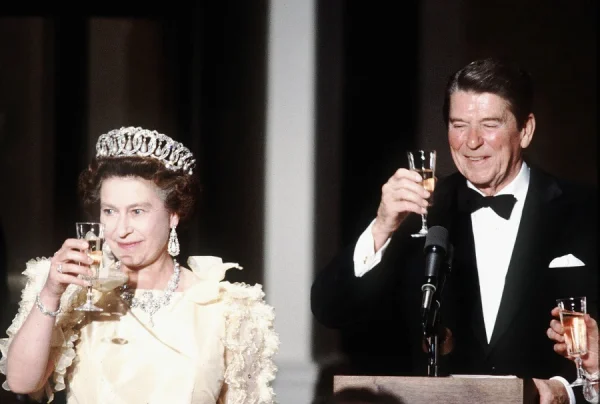
Ronald Reagan came to office as Taiwan’s most committed defender in decades. He had criticized normalization, championed the Taiwan Relations Act, and signaled he intended to reverse the steady erosion of American support for Taipei. Beijing saw this as a threat to be neutralized before it hardened into policy.
The instrument was the August 17th Communiqué of 1982. Its central clause committed the United States to a gradual reduction of arms sales to Taiwan, with language pointing toward an eventual “final resolution.” CCP senior officials, among them Liao Chengzhi, who led the Party’s Taiwan affairs portfolio at the time, told colleagues that inserting the phrase “pursuit of peaceful reunification” into the communiqué text would effectively lock Reagan’s hands. A 1982 Foreign Ministry internal report later described the outcome as successfully having “secured” the United States.
Beijing’s leverage was familiar: Washington still needed Chinese cooperation to balance Soviet power in Asia. The CCP presented itself as indispensable to that balance, and the price of Chinese cooperation was American restraint on Taiwan. Reagan, under pressure from his own national security establishment, signed.
He did not sign quietly. Reagan understood that Beijing was playing a word game, that the communiqué was a trap dressed as a framework, and that he had made a commitment conflicting with his long-standing obligations to Taiwan. The morning the communiqué was released, he wrote a private memorandum documenting his reservations and his intent not to be bound by the document’s most expansive interpretation.
More consequentially, Reagan directed James Lilley, then director of the American Institute in Taiwan (AIT), the de facto United States diplomatic mission in Taipei, to convey six secret assurances to the Taiwan government. These became known as the Six Assurances. Reagan’s six commitments were unambiguous:
The United States had not agreed to set a date for ending arms sales to Taiwan. It had not agreed to consult with Beijing before conducting such sales. It would not play a mediating role between Taipei and Beijing. It had not agreed to revise the Taiwan Relations Act. It had not changed its position on Taiwan’s sovereignty. It would not pressure Taiwan to negotiate with the CCP.
The Six Assurances were Reagan’s explicit repudiation of Beijing’s interpretation of what he had just signed. They were not publicized for decades. Taiwan held them as a private guarantee; Washington treated them as a legal off-ramp. Together, the communiqué and the Six Assurances created a deliberate ambiguity that has structured United States-Taiwan policy ever since, with Beijing citing the communiqué and Taipei citing the assurances whenever the other side pushes too hard.

How the CCP exploited American strategic paranoia across three successive administrations
The three communiqués were successive moves in a single long game, each one building on the concessions extracted by the last.
The CCP’s consistent method was to present itself as the solution to whatever problem preoccupied Washington at the time. For Nixon, it was Vietnam and the Soviet threat. For Carter, it was economic engagement and the promise of Chinese liberalization. For Reagan, it was Soviet containment in Asia. In every case, Beijing offered the appearance of partnership while extracting material concessions on Taiwan. The Americans were playing chess; the CCP was playing weiqi, the Chinese board game built on encirclement and positional advantage, where the prize is not the capture of a single piece but the slow suffocation of the opponent’s strategic space.
Ming Juzheng, a Taiwan-based scholar specializing in cross-strait relations, has described the CCP’s method as a dialectical united-front strategy: identify the principal enemy, then co-opt the secondary enemy against it. In all three communiqués, the CCP successfully persuaded Washington that Taiwan was the secondary issue while the Soviet Union was the primary one. Once that hierarchy was established, American concessions on Taiwan became easier to extract with each successive round.
The linguistic dimension of the deception was equally deliberate. Miles Yu, a senior fellow at the Hudson Institute and former principal China policy adviser to the United States State Department, has argued that the CCP’s most effective weapon was its transformation of “one China” from a vague aspiration into a binding legal concept. English and Chinese versions of each communiqué used subtly different phrasing, creating interpretive gaps the CCP could later exploit. Beijing never intended these documents as legal contracts in the Western sense. They were instruments of political warfare, designed to constrain American freedom of action while placing no reciprocal constraint on Beijing.
Cheng Xiaonong, an economist and former policy adviser to Zhao Ziyang, the reformist CCP general secretary purged after the 1989 Tiananmen Square crackdown, has analyzed the structural logic of the Party’s negotiating method: establish broad principles first, get the Americans to commit to the framework, then haggle over details while reneging on specifics. The Party’s senior strategists in the 1970s and 1980s, Cheng argues, understood that American elites were too confident in their own ability to manage China to recognize they were being systematically outmaneuvered.
The cumulative cost: how three diplomatic defeats built the conditions for today’s Taiwan crisis
The cumulative effect of the three communiqués was a legal and diplomatic architecture that served Beijing’s interests at every turn. Taiwan was progressively isolated from formal international recognition. American arms sales to Taipei were placed under a framework that implied eventual termination. The “one China” formula, however ambiguous in its original construction, hardened over decades into something that functioned as a de facto acceptance of Beijing’s territorial claim.
What makes this history particularly damaging is the mechanism the CCP exploited. Beijing understood that democratic societies operate under the rule of law, that American governments feel bound by the texts they sign, and that this commitment could be weaponized. The CCP signed what it needed to sign, extracted what it came to extract, and treated its own obligations as optional. Party loyalty and strategic interest were always the operative norms; the communiqués were useful fictions.
Western strategic elites of that era believed that engaging the CCP through formal agreements would produce a manageable, gradually liberalizing China. What they produced instead was a Party that used their capital, their technology, and their diplomatic cover to build the economic and military capacity for coercion, while insulating itself from accountability through the very legal frameworks that constrained its adversaries. The crisis now unfolding in the Taiwan Strait is a direct consequence of those three agreements and the assumptions that produced them.