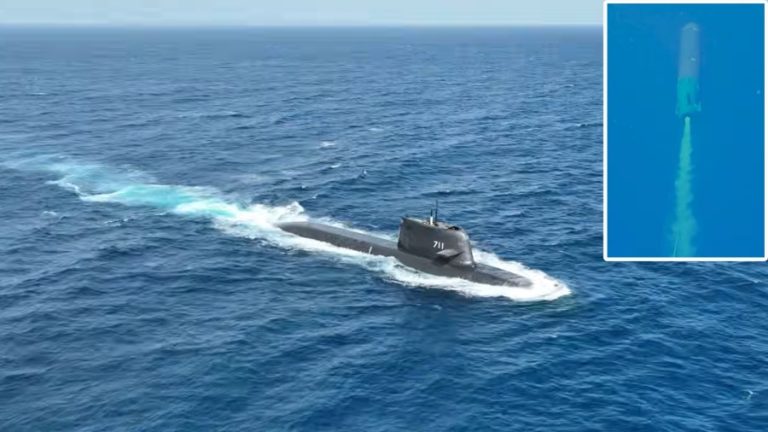
Taiwan’s first domestically built submarine, the “Hai Kun” (SS-711), successfully completed a firing test of two exercise torpedoes on May 6, verifying the combat system’s capabilities in detection, calculation, launch, and torpedo guidance and control.
According to the Central News Agency (CNA), the Hai Kun submarine departed from Kaohsiung Harbor for sea trials on the mornings of May 5 and May 6. A video released by Taiwan International Shipbuilding Corporation (CSBC) showed the submarine leaving the Kaohsiung port testing area, sailing to the designated test zone, and conducting weapons launch verification.
The test successfully verified that the Hai Kun’s torpedo tubes could launch two exercise torpedoes. After the torpedoes’ positions were identified and marked, the Navy’s new rescue vessel, the “Da Wu,” recovered them using a crane. The submarine then safely returned to port that evening. The video concluded with the caption: “Test completed successfully, safely returned to port.”
In a press release issued on the afternoon of May 7, CSBC stated that during the sea trials on May 6, the Hai Kun successfully completed exercise torpedo firing tests, verifying the combat system’s operational capabilities in surveillance, targeting calculations, launch procedures, and torpedo guidance control.
The company added that it would continue working with the Navy, prioritizing “safety” and “quality,” to carry out equipment adjustments and dock preparations for subsequent testing phases.
Success
You are now signed up for our newsletter
Success
Check your email to complete sign up
According to the Liberty Times, unlike combat torpedoes used in actual warfare, exercise torpedoes do not contain high explosives. Instead, they are filled with weighted materials equivalent to the weight of the explosives, ensuring that their speed, depth, and propulsion performance are identical to live torpedoes.
In addition, exercise torpedoes are recoverable. After completing their planned course, they surface and are retrieved by support vessels for reuse.
Equipment borrowed from US
Military sources revealed that the exercise torpedo equipment used in this Hai Kun submarine test was borrowed from the United States and was intended to verify the compatibility between the submarine’s onboard systems and the future U.S.-made MK-48 Mod 6 AT heavyweight torpedoes to be officially equipped.
The MK-48 series torpedoes are currently developed by Lockheed Martin and RTX (Raytheon).
Military sources confirmed that this successful firing test verified the submarine’s “wire-guided” technology. By deploying guidance wires, operators aboard the Hai Kun submarine were able to transmit real-time correction commands to guide the torpedo accurately toward its intended target, while simultaneously receiving sonar data from the torpedo for interpretation by the combat system.
This technology can effectively improve a submarine’s resistance to interference and target recognition capabilities in complex underwater environments.
“The Hai Kun submarine will continue carrying out various dynamic tests to ensure its combat performance meets military requirements, demonstrating Taiwan’s determination to achieve defense self-reliance and safeguard its maritime territory,” the Liberty Times reported.
Necessary submerged operations followed
Taiwan Defense Minister Wellington Koo stated during an interview at the Legislative Yuan on May 6 that the related tests were being conducted step by step according to established procedures for necessary submerged operations.
He said that Taiwan International Shipbuilding Corporation and the Navy would continue equipment inspections and adjustments while ensuring safety and quality standards. Because there are many testing items, he declined to explain each one individually, adding that CSBC would appropriately announce any concrete progress.
Democratic Progressive Party legislator Wang Ting-yu posted on Threads that this was the Hai Kun’s 14th sea trial and 8th diving test. After 12 hours of highly precise operations, the submarine finally completed this most important exercise torpedo firing test, making the timeline for its official delivery much clearer.