Guan Qing, an anchor at Henan Broadcasting and Television, a regional state broadcaster in central China’s Henan province, posted a short video this week under the title Life Action Guide. Dressed in a pink blazer and speaking with cheerful ease, she laid out a case for radical inactivity: “The most extreme boredom is the highest form of happiness. A whole day where nothing happens, lying around at a slow pace, eating eight meals whenever you feel like it, lying there until you can’t tell morning from evening — that is the greatest happiness imaginable. Boredom is stability. It is calm. No accidents, no internal drain. Live like a non-stick pan: nothing trivial clings to you, no trouble sticks to you. Drifting through time in peace. If you can have that kind of boredom, it is the greatest happiness there is.”
The video spread rapidly across Chinese social media and ignited discussion in overseas Chinese-language communities, particularly on X. Responses ranged from admiring to sardonic. “Brave Henan,” one user wrote. “After the Spring Festival gala, defying the CCP again — reminding people that lying flat is how you stop getting stuck to them.” Another wrote: “This is an official anchor personally demonstrating lying flat.” A third: “Henan TV’s move here looks like handing a knife to the central authorities.” And a fourth: “The spiritual lying-flat guide came before the lying-flat currency.”
The phrase ‘lying flat’ and why the CCP finds it threatening
“Lying flat,” tǎng píng in Chinese, entered the national conversation in 2021 when an anonymous user published a post on Baidu Tieba, a Chinese social platform, titled Lying Flat Is Justice. The author described having gone without formal employment for more than two years and feeling entirely at ease with it. The post spread widely because it named something many young Chinese had felt but rarely said in public: that the system’s promise of reward for effort had been broken, and that opting out was the rational response.
The “lying flat” philosophy is a studied refusal to participate in China’s hyper-competitive work culture. Its practitioners reject long working hours, marriage, home ownership, and conspicuous consumption. The lifestyle is an answer to, and a rejection of, a system that Chinese internet users dubbed “996,” referring to the standard tech-industry schedule of 9 a.m. to 9 p.m., six days a week.
The Beijing authorities have tried to suppress the term and the concept for years, but the effort has now escalated into outright securitization. On April 28, China’s Ministry of State Security, the Party’s domestic and foreign intelligence apparatus, released a short propaganda video claiming that foreign-backed hostile media and social media influencers had been mass-producing “lying flat” and bǎi làn (“letting it rot”) short videos as a systematic campaign of ideological subversion. The ministry framed youth disengagement as a national security matter driven by enemy infiltration.
Success
You are now signed up for our newsletter
Success
Check your email to complete sign up
The reaction from Chinese internet users was immediate and contemptuous. “Can’t solve the problem, so blame a foreign organization,” one commenter wrote. “Now lying flat is also anti-China,” said another. Others pushed the point further: “I don’t want to lie flat, but the economic environment is this bad. Who dares start a business? The harder you work, the more you lose.” And: “Can’t find work, can’t buy housing, can’t afford children, can’t afford to get married — is that also caused by overseas forces?”
Henan broadcaster’s second act of quiet defiance in three months
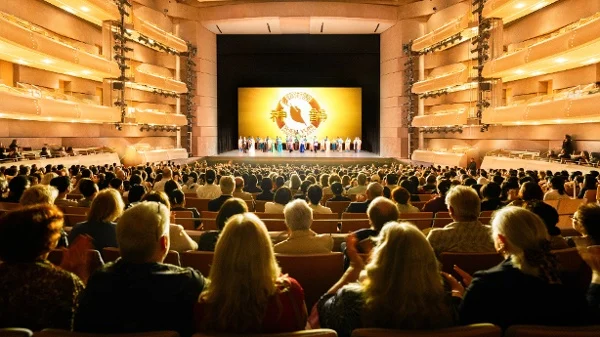
The Henan Broadcasting and Television incident on Feb. 14 is the backdrop against which Guan’s video has been read. That evening, the Henan satellite channel’s Spring Festival gala, the annual prime-time variety spectacular that Chinese broadcasters produce as a patriotic showcase, was cut from the air less than an hour into the broadcast and subsequently scrubbed from every online platform in the country.
The broadcast had been heavy with traditional Han-style costumes and cultural imagery associated with China’s pre-communist heritage. Program titles and lyrics including The Long Night Finally Ends and Mountains, Rivers, Moonlight were read by outside observers as carrying double meanings: the darkness of authoritarian rule lifting, a call to reclaim the country. The content crossed what the Party regards as inviolable lines, and the broadcaster faced an investigation and pressure campaign in the weeks that followed.
In that context, an anchor from the same broadcaster now publicly promoting lying flat as the highest good has struck many observers as a sequel. “From the gala getting cut to the anchor teaching you to lie flat — Henan is relentless,” one commenter wrote. “Spring Festival gala axed, anchor goes straight to lying flat — that sequence is too clean.”
Analysts say the problem is structural, not foreign
Several commentators with expertise in Chinese politics have pushed back on the Ministry of State Security’s framing.
Dong Liwen, executive director of the Asia Pacific Peace Research Foundation, a Taiwan-based think tank focused on cross-strait and regional affairs, and a commentator on CTV News, a Taiwanese current affairs broadcaster, argued on May 3 that the roots of “lying flat” are entirely domestic and traceable to a specific timeline. China’s economy began contracting in 2017, he noted, and young people initially responded by working harder, producing the “involution” culture the “996” label described. But years of that produced a dawning recognition: resources are distributed unfairly, the wealth gap is widening, and hard work leads to exploitation rather than advancement. Effort came to seem pointless; ambition, a trap. The downstream effects include what Chinese social commentary calls the “six nos”: no dating, no marriage, no children, no home purchase, no consumption, and no ambition — a generational withdrawal from the social contract that has nothing to do with foreign influence operations, Dong said. The simplest fix available to the Party, he argued, would be to help young people find jobs that pay enough, after mandatory social insurance deductions, to leave them with at least 6,000 yuan per month to spend. That has proved beyond the Party’s reach, and the foreign-forces narrative papers over that failure.
Wang Dan, the veteran democracy activist and 1989 Tiananmen Square student leader who now runs a commentary channel on YouTube, offered a comparative frame. In Japan, he noted, the same phenomenon produced what sociologists called “herbivore men,” young males who retreated from competition and conventional ambition. In Taiwan, a similar disengagement became associated with the pursuit of xiǎo quèxìng, a phrase meaning small, reliable pleasures. Both are voluntary lifestyle choices made in societies where opting out carries real costs but remains a genuine option.
The Chinese version is categorically different, Wang argued. Young people on the mainland are lying flat because they cannot change their circumstances, and the choice carries an undertone of despair rather than contentment. To then accuse them of being manipulated by foreign enemies, and to elevate that accusation to a national security matter, is a symptom of a broken social order. In a functioning system, Wang said, people whose economic interests have been damaged can find other outlets: voting in elections, at minimum being able to speak about their difficulties. In China, even the ability to complain is being closed off. “Lying flat is not the problem,” he said. “Banning commentary is.”
Wang’s broader point is that youth disengagement on this scale signals a collapse of trust in the government and a widespread loss of confidence in the future. Young people are not spending, and the resulting drag on domestic consumption is a real economic problem for the Party. Welfare reform and structural intervention are the tools a government in that position would reach for. Treating disengagement as a foreign plot and commanding people to want more is a response that addresses neither the cause nor the consequence.