The Sui dynasty’s collapse, foreseen but ignored
In the final years of the Sui dynasty, Emperor Yang, a ruler consumed by vanity and military ambition, drove his empire to ruin. He mobilized the population to dig the Grand Canal connecting north and south China, then launched three catastrophic invasions of the Korean Peninsula, each one draining the treasury and costing hundreds of thousands of lives. Tax burdens rose without limit. Farmland went untended. Men of military age had been conscripted into labor gangs or armies, leaving their families destitute. The people rose in rebellion.
Li Jing, then serving as a local official in Mayi, in what is now Shanxi province, saw the collapse coming before most. He resigned his post and rode through the night to the capital to seek an audience with Yang Su, the Duke of Yue and the most powerful figure in the Sui government. Li Jing laid out the scale of the crisis and pressed Yang Su for a plan to stabilize the empire. Yang Su dismissed his diagnosis. Li Jing left without a remedy to offer and without confidence that one would come from above. He resigned his office and returned home.
Studying war while the empire burned
Li Jing’s uncle, Han Qinhu, was one of the Sui dynasty’s founding generals and a serious student of Sun Tzu’s The Art of War, the ancient Chinese treatise on strategy that had shaped military thinking for over a millennium. During the years Li Jing spent at home watching the country unravel, he studied military texts alongside Han every day. After each session the two would work through what they had read, testing ideas against each other. Han consistently praised his nephew’s grasp of the material and the originality of his thinking.
When the Sui fell and rebellion swept the country, Li Jing traveled to Taiyuan in Shanxi and joined the forces of Li Yuan, the general consolidating power across the north. Li Yuan would go on to found the Tang dynasty. His son, Li Shimin, would reign as Emperor Taizong, one of the most celebrated rulers in Chinese history. Li Jing would become his most indispensable commander.
More than a hundred engagements secured the Tang frontier
After Li Yuan established the Tang dynasty and abdicated in favor of his son, Taizong inherited a frontier under constant threat. The Turkic confederation to the northwest and the Tuyuhun people to the west repeatedly raided Tang territory, driving off livestock, burning settlements, and killing civilians.
Success
You are now signed up for our newsletter
Success
Check your email to complete sign up
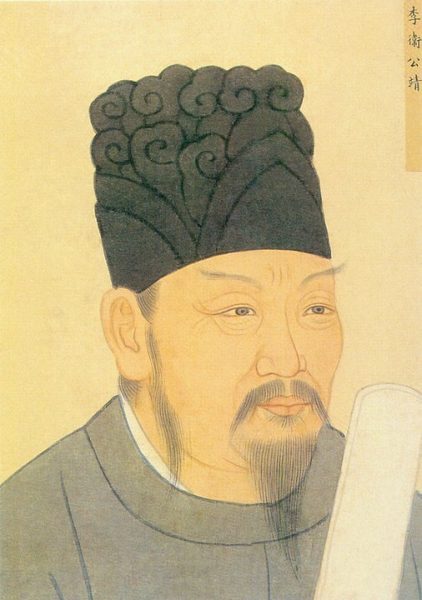
Taizong appointed Li Jing to command the campaign forces and sent him north and west. In one engagement that entered the records of his generalship, Li Jing led a force of just three thousand cavalry in a surprise assault that drove the Turks out of Tang territory. When the Turks regrouped, Li Jing returned to the field. Over more than a hundred engagements, large and small, he and his armies wore down both the Turkic confederation and the Tuyuhun until neither could mount another serious incursion. For this record, he was elevated to Shangshu Puye, effectively the second-highest civil administrative post in the empire, a distinction rarely conferred on a soldier.
Li Jing retired at his peak; the emperor approved
When peace finally settled over the frontiers, Li Jing took stock of his position. He was a soldier; the court in peacetime had limited use for what he did best, and he had no appetite for drawing a salary in a senior post he had not earned in peacetime terms. He began preparing to step down.
When Taizong asked him to undertake an inspection tour of the provinces, Li Jing declined. “I am old,” he told the emperor, “and I fear I would fail your trust. Please send someone else. Besides, the young men need heavy responsibilities placed on their shoulders. That is the only way to build them.”
He submitted a formal memorial requesting retirement. Taizong read it and approved.
The following day, the emperor dispatched a senior palace official to Li Jing’s home with a formal commendation. The message read: “I have observed, from ancient times to the present, that men who reach high office and yet know when they have enough are very rare. Whether wise or foolish, most cannot stop themselves from wanting more. And there are those who have no real ability at all, yet cling to power and refuse to step aside. Your conduct moves me deeply. I approve your retirement, and I do this to honor your wishes. But the more important reason is that I want to hold you up as a model for all generations to follow.”
Li Jing’s retirement produced a military classic
Li Jing did not simply rest. He turned to writing, setting down in systematic form everything he had learned across decades of campaigning. The resulting work, known as the Li Wei Gong Bingfa, or The Military Treatise of Duke Wei of Li, entered the canon of Chinese military thought and was read by strategists and scholars for centuries after his death. Imperial officials, as a rule, died in post or were removed by force; voluntary retirement at the height of one’s reputation was nearly unheard of. Li Jing left on his own terms, cleared the way for younger men, and spent his remaining years putting hard-won knowledge on paper. Taizong, who had relied on him more than any other commander, recorded his approval in writing and sent it to Li Jing’s door.
By Lin Ling, Vision Times