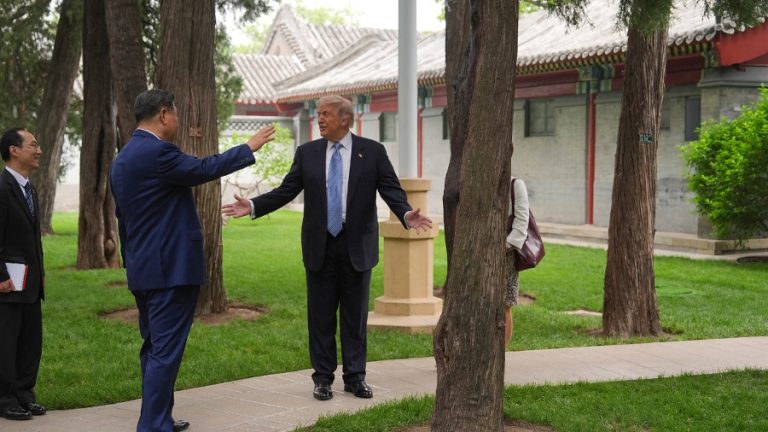
As U.S. President Donald Trump departed Washington aboard Air Force One on May 12 for his highly anticipated state visit to China, much of the attention online shifted away from Trump himself and toward Secretary of State Marco Rubio — and the outfit he wore while boarding the aircraft.
Rubio, long regarded as one of Washington’s most outspoken critics of the Chinese Communist Party (CCP), has twice been sanctioned by Beijing and formally barred from entering China during his years in the U.S. Senate over his criticism of the CCP’s human rights record in Xinjiang and Hong Kong.
RELATED: Trump-Xi Summit Looms as Sino-US Tensions Simmer Beneath Fragile Stability
A controversial outfit choice
Yet despite those sanctions, Rubio joined Trump on the trip to Beijing. What drew even greater attention was his choice of clothing: a gray Nike tracksuit that many online observers claimed closely resembled attire reportedly worn recently by Venezuelan leader Nicolás Maduro, one of Beijing’s closest authoritarian allies in Latin America.
On Jan. 3, U.S. forces conducted a nighttime raid on Caracas, Venezuela’s capital, that resulted in the capture of Maduro and his wife, Cilia Flores. The pair now remain in federal custody in New York.
Success
You are now signed up for our newsletter
Success
Check your email to complete sign up
The comparison rapidly spread across social media, fueling speculation that Rubio’s wardrobe choice may have carried symbolic political messaging aimed at Beijing. The discussion intensified after White House Communications Director Steven Cheung posted on social media: “Secretary Rubio rocking the Nike Tech ‘Venezuela’ on Air Force One!”
The White House’s official account also shared a video mocking Maduro’s recent detention alongside the caption: “Full circle.” Online commentators interpreted Rubio’s appearance as a deliberate visual gesture directed at authoritarian governments aligned with Beijing. Some viewed it as a subtle warning about the political fate of dictators who maintain close ties with the CCP.
While there is no official confirmation that Rubio intentionally selected the outfit for political symbolism, the timing and White House social media activity fueled a slurry of speculation among users.
Past sanctions on Rubio
The trip also revived international attention surrounding Beijing’s sanctions against Rubio. While serving in the Senate, Rubio was twice sanctioned by Chinese authorities over his criticism of Beijing’s policies toward Xinjiang, Hong Kong, and broader human rights issues. In fact, Chinese officials had previously announced that Rubio was barred from entering the country.
Now, with Rubio traveling openly to Beijing as America’s top diplomat, online critics began questioning how Chinese authorities would reconcile the apparent contradiction.
According to reports from multiple outlets, Chinese state media quietly began altering the Chinese-language rendering of Rubio’s surname after he was appointed secretary of state in early 2025. Previously, Chinese government documents used the surname “卢” (Lú) for Rubio. Later reports began using the alternate character “鲁” (Lǔ), despite both being pronounced similarly in Mandarin.
RELATED: Bessent to Visit Japan and South Korea Ahead of Trump–Xi Summit in Beijing
The move quickly became the subject of online ridicule, with critics joking that Beijing was attempting to argue that the person it sanctioned was technically a different “Rubio.” Commentators described the situation as an embarrassing example of the CCP attempting to avoid acknowledging the contradiction created by its own sanctions policy.
The episode also drew broader criticism of Beijing’s so-called “wolf warrior diplomacy,” which some analysts say has increasingly created political complications for Chinese officials when confrontational rhetoric later collides with diplomatic realities.
Taiwan remains a central issue
Beyond the symbolic controversy surrounding Rubio’s appearance, Taiwan remains one of the most sensitive issues looming over Trump’s visit to Beijing. Rubio has repeatedly emphasized that the United States should not use Taiwan as a bargaining chip in trade negotiations with China.
Rubio publicly stated in multiple interviews that the Trump administration would not sacrifice Taiwan’s future in exchange for economic concessions or trade agreements with Beijing. Analysts say that position significantly limits Beijing’s ability to use economic incentives to push Washington toward concessions on Taiwan during the summit.
The issue remains especially sensitive as China continues to increase military pressure around Taiwan while Washington maintains military and political support for the island under its longstanding policy framework. Some observers believe Rubio’s presence on the trip itself sends a signal that the administration intends to maintain a hardline posture toward Beijing on both human rights and Taiwan-related issues.
A high-stakes summit
Trump’s China visit comes at a time of heightened geopolitical tension between Washington and Beijing, with disputes continuing over trade, technology, Taiwan, and broader strategic competition. As such, Rubio’s highly publicized appearance aboard Air Force One quickly became one of the most discussed moments leading into the summit.
While much of the online reaction has been fueled by political commentary and social media speculation, the incident underscored how symbolism and optics continue to play an increasingly important role in modern geopolitical rivalry.
Whether intentional or not, Rubio’s outfit transformed a routine boarding moment into a widely debated political statement before the summit had even officially begun.
Editorial note: Views expressed in this article are the opinions of the author and do not necessarily reflect the views of Vision Times.