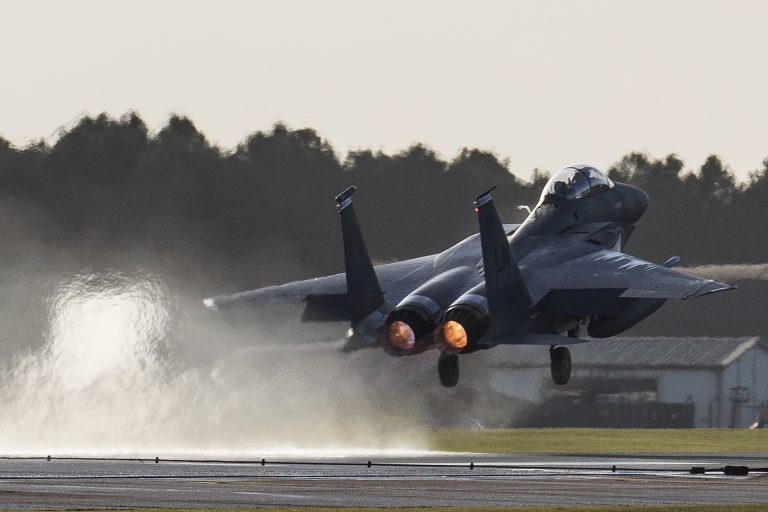
According to an exclusive report by CNN, in the chaotic final moments before ejecting from a stricken F-15 fighter jet over Iran in April 2026, a U.S. Air Force pilot witnessed a sight he says he will never forget: a massive formation of Iranian drones moving in perfect synchronization, resembling a giant jellyfish floating through the sky.
According to the report published on June 23, the pilot described seeing several large drones operating in tight coordination, with smaller unmanned vehicles hanging beneath them like swaying tentacles. The entire swarm appeared to move as a single entity, creating what he called an “airborne drone minefield.”
The account, shared with U.S. intelligence debriefers shortly after his rescue, has triggered intense debate within the American intelligence community. If accurate, the sighting could signal a significant breakthrough in Iranian drone technology, potentially a “one-to-many meshed networking” capability that allows swarms to share data and operate with high autonomy even under fire.
The incident marked the first time a U.S. manned fighter jet was shot down inside Iranian airspace. Both the pilot and his weapons systems officer were successfully rescued after a high-risk search-and-rescue operation, but the pilot’s extraordinary description has left analysts divided: revolutionary Iranian tactics or a stress-induced hallucination from concussion and combat trauma?
Battlefield halluciantion or ‘meshed networking’ in action?
Meshed networking is an emerging technology that enables coordinated communication across distributed systems, representing a significant advancement in drone swarm capabilities.
Success
You are now signed up for our newsletter
Success
Check your email to complete sign up
Simply put, meshed networking allows multiple drones to communicate directly with one another in a decentralized, resilient web rather than relying on a single controller or vulnerable central link.
Each drone acts as both a user and a relay node: if one is destroyed or jammed, the others automatically reroute data through alternative paths. This creates a self-healing, highly survivable network where drones can share real-time sensor data, coordinate movements, and execute complex maneuvers as a unified system.
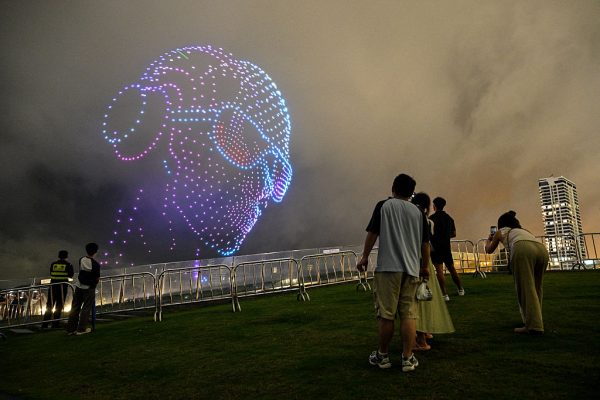
China’s largest drone light shows almost certainly use a combination of mesh networking, clustered networking, RTK positioning, and pre-programmed flight paths, rather than relying on a single radio link to every drone.
Experts compare the technology to a school of fish or a flock of birds. In the “jellyfish” formation reportedly seen by the pilot, larger drones likely served as command or sensor nodes, while smaller ones acted as effectors or decoys, all moving in tight synchronization.
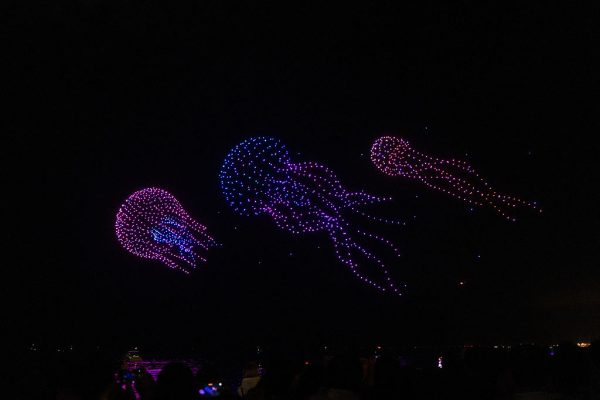
(Image: ALEJANDRO MARTINEZ GONZALEZ/Hans Lucas/AFP via Getty Images)
US intelligence officials split over drone swarm theory
According to CNN, experts remain divided over how to interpret the F-15 pilot’s account and have questioned whether he was in any condition to accurately perceive and describe what he witnessed.
This was the second time the pilot had been shot down during the Iran war. Earlier in the conflict, he was among several pilots downed in a friendly-fire incident involving Kuwaiti forces.
Analysts differ on what the pilot could have observed — whether it was technology U.S. intelligence agencies are unaware of, a beta test, or simply a desert mirage.
It is known that Iran has employed attack drones as an asymmetric weapon throughout the conflict, using them against U.S., Israeli, and Gulf state forces.
As U.S. and Iranian negotiators continue delicate talks in Switzerland, the reported “jellyfish” drone formation, whether a genuine technological leap or a product of combat stress, highlights the rapidly evolving nature of modern aerial warfare.
“They are adapting faster than us,” drone expert Brett Velicovich, founder of Powerus and a former U.S. Army drone operator, told the New York Post. “Iran has spent years developing capabilities designed to offset the overwhelmingly conventional advantages of the United States and its allies.”
Velicovich added that such mothership-style or meshed systems are “within the art of the possible” for Iran, noting they are already commonplace in conflicts like Ukraine, where larger unamanned platforms relay commands to smaller drones.
He said that the unpredictability of these capabilities potentially employed by Iran, China, and Russia poses one of the greatest concerns for future military planners.