When I was a child my family would frequent a pristine lake called Mansar, lying in the western Shivalik ranges of the Himalaya mountains. For us, this was not only a religious place but a beautiful picnic spot where Himalayan nomadic tribes would camp during winters because it was enroute an ancient path.
Ancient paths and the Himalayas have a deep historical connection, something which the modern Western world began to discover only in the 19th century, with many explorations made across the “roof of the world” to Central Asia and Tibet. They were all travelling on ancient routes with local guides trying to discover routes to the unknown worlds beyond — often routes to the origin of high glacial rivers. At such altitudes, these were typically high mountain passes and river pathways.
These explorations were deeply entwined with the “Great Game” at the time; the British were colonizing India, while the Russian empire was expanding into the lands of Central Asia. They would meet during the Great Game period somewhere in the extreme frontier regions of the kingdom of Jammu and Kashmir then–roughly the territory that’s now contested between India, Pakistan, and China.
But what the modern Western world started discovering in the 19th century wasn’t unknown to the ancient western world. Alexander of Macedonia (356–323 BC) — more popularly known to us as Alexander the Great — had travelled all the way during his conquest to these northwestern regions of the Indian subcontinent.
He or soldiers from his army had probably come to Mansar as well, because Alexandrine parakeets from the mountain ranges around this lake were transported by Alexander to the Mediterranean countries and beyond, where they were valued as prized possessions by royalty and warlords. Hence this parrot, locally called mansariya tota (in Hindi meaning a parrot from the region of Mansar), was named after Alexander.
Ancient routes and ancient kingdoms
Success
You are now signed up for our newsletter
Success
Check your email to complete sign up
What starts with the discovery of routes, usually follows with establishment of kingdoms and territories marked by military force and political calculation. This region has witnessed much of it but in the times that followed the retrace of Alexander’s armies to Macedonia from this region, two main things happened in history — first the establishment of several Hellenistic settlements by Alexander’s generals in the region that first were Greco-Bactrian, then gradually metamorphosed into Indo-Greek kingdoms, ports and cities in Bactria and along the Indus river.
These kingdoms became the greater space for a cultural amalgamation, particularly bearing impact on urban spaces, architecture, language and governance. Remains of some of these Alexandrian cities still exist in Ai-Khanoum in Afghanistan; Alexandria in the Caucasus, a Hellenistic city north of Kabul; Alexandria in Arachosia (Modern Kandahar) — all existing as the linkage between India, Central Asia, and the Mediterranean.
The second historical development of this Indo-Greek space was the spread of Buddhism and how it impacted learning and knowledge systems including art traditions that from here travelled along with religion and trade to both the west and the east along the silk route.
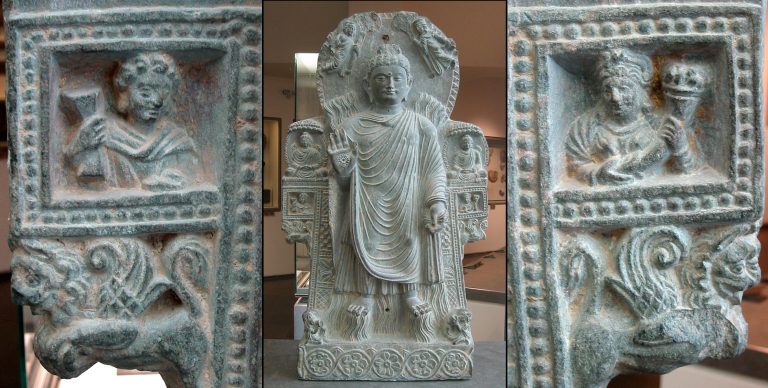
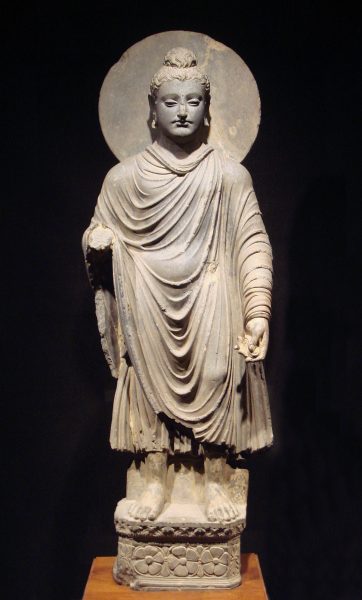
One such school of art was the Gandhara School of Art ot the Greco-Bactrian art that flourished as a distinct tradition of art and culture centered around the ancient region of Gandhara from roughly the 1st century BC to the 5th century AD in what’s today’s north western Pakistan and eastern Afghanistan. The Gandhara school of art was basically Buddhist religious themes depicted in Greek-styled naturalistic human figures, that is, utilization of Hellenistic artistic techniques.
Buddhism in the Indo-Greek sphere
Something phenomenal happened in this Indo-Greek space witnessing the amalgamation of cultures when Buddhism started to spread from India around the world. These routes and settlements which had borne the onslaught of armies and had subsequently evolved into Hellenistic urban spaces became the launchpads for King Ashoka’s Buddhist missionaries.
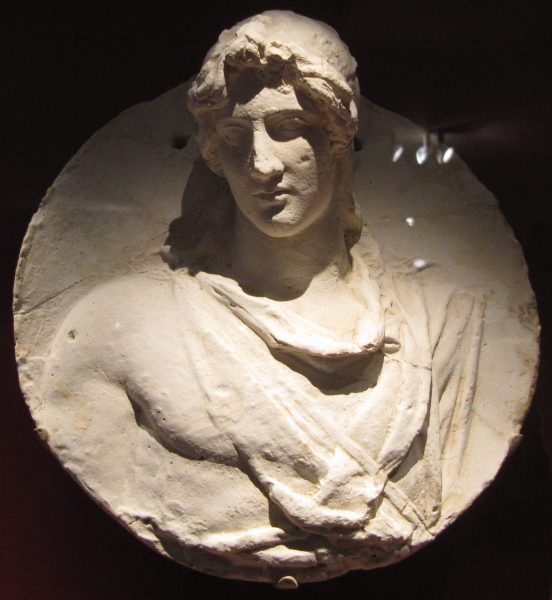
The political vacuum left in the aftermath of the onslaught by Alexandrian armies in the region was filled by a ruler called Chandragupta Maurya who consolidated almost the whole of the Indian subcontinent into the Mauryan empire.
King Ashoka (304-232 BC) was Chandragupta’s grandson, who converted to Buddhism after his moral horror at witnessing the bloody consequences of his wartime triumph. Ashoka’s place in global history arose from his Buddhist missionaries, who went through land as well as sea routes to spread the teachings of Shakyamuni.
After the third Buddhist council was held in central India in 250 BC, Ashoka sent nine major Buddhist missions around the world including one to the Hellenistic world or what the Indians called “Yavana.” The Hellenistic mission was led by the Buddhist monk Maharakkhita. He most likely travelled to the Greek settlements that came up to the west of Indus in those days’ Afghanistan and Central Asia, as well as Alexandria in the Caucasus and other settlements around it.
In 1860 in an excavation, an edict by Ashoka carved in stone was found in Kalsi in central Himalayas in today’s Uttrakhand state of India. The stele promotes Ashoka’s principles of Dhamma (righteousness and non-violence) and gives the names of five Greek kings who adopted this moral code, which was inspired by Ashoka’s faith in the Buddha.
These kings mentioned on the stele were Antiochus II Theos of the Seleucid Empire (Syria), Ptolemy II Philadelphus of Egypt, Antigonus II Gonatas of Macedon, Magas of Cyrene (modern-day Libya), and Alexander II of Epirus (or Corinth in Greece).
In 1963, a fragment of an Ashoka stone inscription was found at the site of Alexandria Arachosia in Kandahar and its language was not Prakrit in which Ashoka’s edicts were generally written but Greek — this was dated around 258 BC — over 70 years after the death of Alexander. Earlier in 1958 another Buddhist inscription was found in Kandahar whose language was Greek and Aramaic.
Greek and Indo-Greek Buddhist kings
After the Greco-Bactrian kingdoms set up by the descendants of Alexander withered, they were replaced by Indo-Greek kings who ruled parts of present-day northwestern India, Pakistan, and Afghanistan while maintaining connections with the rest of the Hellenistic world.
Some of these rulers further helped to spread Buddhism in the region and beyond further enriching this cross-cultural space. The most important among them who’s given a lot of space in the Buddhist literature is King Menander I (c. 165–130 BC) who accepted Buddhist teachings after an engagement with the Buddhist monk, Nagasena in the ancient city of Sakala (today’s Sialkot) in today’s Pakistan, right on today’s India-Pakistan border.
Menander ruled over a kingdom comprising some parts of modern Afghanistan, Pakistan, India’s Punjab, and some regions south from there. Menander’s interaction with the monk Nagasena is documented in the Buddhist text Milinda Panha (The Question of Menander). It revolves around questions about the nature of self: karma and rebirth, ethical conduct and meditation, and nirvana.
I feel inclined to share a famous analogy from this conversation where Menander asked Nagasena, “Who is Nagasena?”
In reply, the monk said, “Nagasena is just a name.”
Explaining himself, Nagasena compared the person to an operating, conditional entity, giving the example of the chariot.
“Let’s look at a chariot. Is it just its wheels? Is it merely its axle? Is it just the seat or some other individual part?” The human being — be it the monk Nagasena, or anyone else — is, like the chariot, just a convenient label for a functioning entity composed of many parts which are connected in a certain functional way.
The analogy of the chariot serves as an example of
The chariot and ancient Sakala have other important connections with history. A local historian in north India told me that in ancient times chariots plied between Sakala and Akhnoor — a town on what now is the India-Pakistan border on the ancient Mughal route in today’s India. It connected the Indian Punjab with Kashmir and from there further to Central Asia. Akhnoor is also known for an important Buddhist site of Ambaran from the Kushan period that followed the Indo-Greeks in the region.
For that matter Chariot riding (御, yù) was considered as one of the six arts expected from an educated man in traditions associated with Confucius in ancient China. No wonder, Nagasena as an intellectual found it convenient to use the chariot analogy to explain such philosophical concepts to Menander, an Indo-Greek king.
While they tried to talk on some complex existential questions, they left behind a rare window into how Greeks and Indians of the Buddhist sphere engaged to build a new worldview.
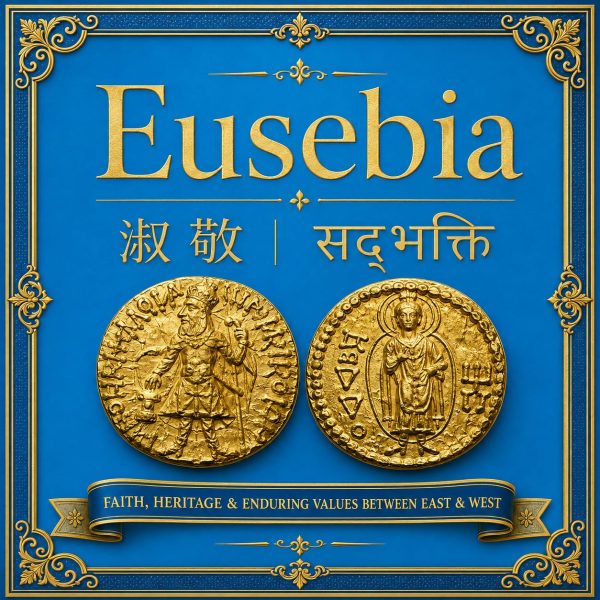
Despite being born into an Indian family, I bear a Greek name. Until recently, that was my only connection to Greece. Then I began exploring the history of my region, a history that spans centuries across the Indus River basin—from Ladakh, Jammu and Kashmir, Punjab, and Himachal Pradesh to present-day Pakistan and eastern Afghanistan.
In the process, I discovered not only place names with Greek connections but also deep links between Greek and Indian culture, religion, spirituality, history, and archaeology, particularly in northern India. When the Buddhist Dhamma (Dharma) reached the Greeks, it was rendered as Eusebeia (“piety” or “reverence”). Thus, Eusebeia (सद्भक्ति in Sanskrit; 淑敬 in Chinese) is an attempt to explore that connection seriously and share it with the world—hopefully in ways that illuminate the enduring ties between East and West.