On Thursday, June 4 U.S. lawmakers warned the Trump administration that evidence suggests the Chinese Communist Party (CCP) and other foreign adversaries may be quietly supporting efforts to oppose data center construction in the United States, potentially undermining America’s leadership in artificial intelligence (AI).
According to the New York Post, House Energy and Commerce Committee Chairman Brett Guthrie, Oversight and Investigations Subcommittee Chairman John Joyce, and Energy Subcommittee Chairman Bob Latta jointly sent a letter to the White House urging an investigation into whether foreign actors are influencing U.S. public opinion and policymaking to obstruct the development of AI-related infrastructure.
Guthrie said the United States is engaged in an intense competition with China for AI innovation and global technological leadership. He warned that CCP-backed entities and other foreign adversaries may be attempting to influence decisions related to U.S. data center construction, highlighting the growing severity of the technological rivalry between the two countries.
In their letter, the lawmakers cited recent reports by the Bitcoin Policy Institute (BPI) and Power the Future. The reports argue that certain international actors may be shaping AI-related policy discussions and public perceptions in the United States through state-run media, networks of nonprofit organizations, and anonymous funding channels.

Neville Roy Singham
One individual highlighted in the reports is Neville Roy Singham, an American businessman who has long resided in Shanghai. Singham is married to Jodie Evans, co-founder of the anti-war organization Code Pink. He has previously drawn attention from U.S. authorities over allegations that his activities may have harmed U.S. interests, and congressional Republicans have continued investigating his influence network in recent years.
Success
You are now signed up for our newsletter
Success
Check your email to complete sign up
According to an analysis cited by BPI, Singham provided approximately $278 million in funding to six U.S. nonprofit organizations between 2017 and 2023. The report argues that these financial flows warrant further scrutiny to determine whether they are connected to anti-data center or anti-AI activism.
The House Energy and Commerce Committee has also sent inquiries to the President’s Council of Advisors on Science and Technology and the Federal Bureau of Investigation, requesting information regarding foreign influence operations and efforts to impede U.S. AI development.
Guthrie said Americans deserve to know who is funding campaigns targeting critical infrastructure projects. He emphasized that data centers are essential infrastructure for both the modern economy and AI development—and that America’s strategic competitors understand this well.
Republican lawmakers also criticized the proposed AI Data Center Moratorium Act, introduced by Senator Bernie Sanders and Representative Alexandria Ocasio-Cortez. The legislation would halt the construction of new data centers nationwide and suspend the expansion or renovation of existing facilities. Critics argue that such measures could further slow U.S. progress in AI.
Some Trump administration officials have voiced similar concerns. Last month, U.S. Interior Secretary Doug Burgum told Fox Business that foreign actors were using propaganda campaigns to block data center projects across the country, describing the effort as an attack on American competitiveness.
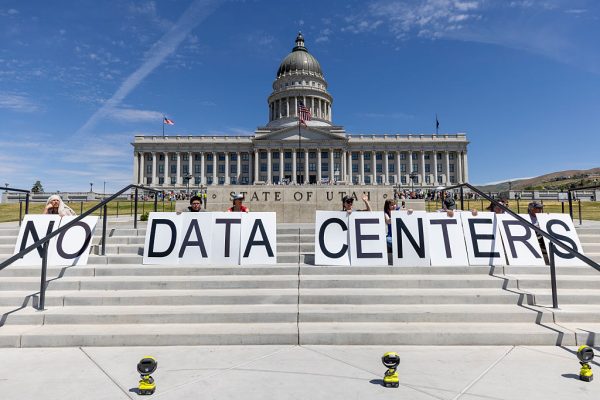
AI data centers are critical infrastructure
Data centers are widely regarded as critical infrastructure for AI development, providing the vast computing power needed to train and operate large AI models. However, as their numbers grow rapidly, some environmental and community groups have raised concerns that their heavy electricity consumption could increase residential power costs and place additional strain on local resources.
Despite those concerns, many AI experts argue that the United States will struggle to maintain its technological lead without sufficient data center capacity.
Public support for new data center construction has also declined. A poll conducted jointly by The Washington Post and the Schar School of Policy and Government found that support among Virginia residents for new data centers fell from 69 percent in 2023 to 35 percent in April 2026.
Republican lawmakers contend that this trend, combined with potential foreign influence operations, has become serious enough to warrant federal investigation. They have asked the Trump administration to provide a briefing by June 18 detailing measures currently being taken to counter foreign influence campaigns targeting the U.S. AI industry.
In their letter, the lawmakers stressed that the United States is at a pivotal moment in the race for technological leadership. Falling behind in AI, they argued, would not only weaken economic growth but also pose significant national security risks.
Previously, The Hill reported that on May 21, Senators Jim Banks of Indiana and Tom Cotton of Arkansas sent a joint letter to senior U.S. intelligence officials urging greater intelligence resources be devoted to monitoring China’s AI development.
Recipients included Director of National Intelligence Tulsi Gabbard, CIA Director John Ratcliffe, National Cyber Director Sean Cairncross, and NSA Director General Joshua Rudd.
The senators called on intelligence agencies to closely track leading Chinese AI researchers, monitor the expansion of Chinese data centers, and investigate how China obtains advanced U.S. semiconductors and chipmaking equipment.
They also urged the intelligence community to conduct a comprehensive assessment of China’s current AI computing capacity and technological capabilities, identify key breakthroughs that the United States must achieve first, and determine which critical technologies must be protected from acquisition or theft by the CCP.