A brief Party announcement opens the final phase of the purge
On June 2, 2026, the Party’s Central Commission for Discipline Inspection published a brief notice on its website stating that Li Xiaohong, the former director of the Central Inspection Work Leadership Group Office, a body that coordinated the deployment of Party investigators across all provinces and ministries, was under investigation for “serious violations of discipline and law.” That phrase is the Party’s standard formula for impending criminal prosecution. Two months earlier, on March 24, Zhou Liang, a vice chairman of the National Financial Regulatory Administration, China’s banking and insurance oversight body, had fallen under the same formula.
With Li Xiaohong’s detention, the roll call of Wang Qishan’s destroyed inner circle is complete: Dong Hong, Tian Huiyu, Fan Yifei, Zhou Liang, and Li Xiaohong.
Thirteen years ago, when Wang Qishan stood at Xi’s side and wielded the disciplinary system as a weapon to cut down their shared rivals, he could not have anticipated that the machine he built and perfected would eventually turn on the advisers and loyalists who had followed him for decades.
A friendship forged during Mao’s Cultural Revolution
Mao Zedong’s Cultural Revolution, a decade-long campaign of mass political violence that began in 1966, sent millions of urban youth to the countryside for forced manual labor under the slogan of “re-education.” In 1969, two young men from Beijing had been assigned to the Yan’an region of Shaanxi Province, an area of steep ravines and cave homes that had served as the Communist Party’s wartime headquarters decades earlier.
One was Xi Jinping, then a teenager whose father, the senior Party official Xi Zhongxun, had been purged and imprisoned, leaving the family publicly disgraced. Xi had been sent to Liangjiahe village. The other was Wang Qishan, already displaying an unusual talent for organization. On one occasion, returning from a long journey, Xi spent the night at Wang’s quarters. The two young men lay side by side on the same clay sleeping platform that functions as both bed and heating surface in traditional northern Chinese homes, sharing a single cotton quilt through the night, and talked until dawn. Wang lent Xi books on economics that he treasured.
Success
You are now signed up for our newsletter
Success
Check your email to complete sign up
Wang Qishan’s political ascent drew additional fuel from his marriage to Yao Mingshan, daughter of Yao Yilin, a former vice prime minister with deep networks across finance and foreign trade. Through his father-in-law’s connections, Wang embedded himself in the 1980s reform circles around the State Council’s rural policy research apparatus, a think-tank cluster that operated out of a compound known informally as “Courtyard No. 9,” becoming one of four celebrated young economists nicknamed the “Four Gentlemen of Rural Institutional Reform.” From there his bureaucratic ascent was assured.
Through the 1990s, as then-prime minister Zhu Rongji drove aggressive economic restructuring, Wang became the regime’s go-to crisis manager. When the 1997 Asian financial crisis triggered systemic insolvency in Guangdong Province’s financial sector, Wang was parachuted in as executive vice governor. Facing Western creditors who expected Beijing to absorb the losses of state-backed investment vehicles, Wang declared the Guangdong International Trust and Investment Corporation bankrupt and made clear the central government would cover none of the debts. The decision forced foreign investors to absorb the losses but quarantined the central government’s balance sheet from the contagion. In 2003, when the SARS outbreak spiraled out of control in Beijing and the city’s mayor was removed for suppressing case numbers, Wang was again called in to take command. He reportedly told subordinate officials that even a single concealed case was unacceptable. His rapid response earned international recognition, and Henry Paulson, then U.S. Treasury secretary, spoke of him with admiration as a man who understood the nature of negotiation. Wang was subsequently promoted to vice prime minister overseeing finance and trade.
Xi deployed Wang to destroy his rivals, then turned on his network
At the 18th Party Congress in November 2012, Xi assigned Wang Qishan, whose professional background was in economics and finance, to run the Central Commission for Discipline Inspection rather than any economic portfolio. The reassignment was a calculated deployment despite its appearance as a mismatch.
Xi faced enormous threats from entrenched networks built by his predecessors. Zhou Yongkang, who had run the Party’s vast political and legal security apparatus, had turned it into a personal fiefdom and was widely suspected of backing a coup attempt with the disgraced Chongqing Party secretary Bo Xilai. Xu Caihou and Guo Boxiong, the two generals who had jointly commanded China’s military, had built a market in which officers paid for promotions. Rival factions from the Jiang Zemin and Hu Jintao eras surrounded Xi on every side. He needed the most ruthless, unconditionally loyal instrument he could find. Wang’s personal circumstances reinforced his suitability: having no children, he had no family hostages to rival factions and no soft flank that enemies could exploit.
Wang delivered. He recruited Li Xiaohong, through a connection to the brother-in-law of a former discipline chief, to head the inspection office, and through him inherited the vast network of disciplinary officials built up over years by retired Party secretaries Wei Jianxing and Qiao Shi. Wang then institutionalized the “central inspection team” system, under which Party investigators could descend on any province or ministry without advance notice or local approval. He shattered the unwritten rule that members of the Politburo Standing Committee were beyond investigation, then prosecuted a list of officials that would have been unthinkable under any previous Party leader: Zhou Yongkang, Bo Xilai, Ling Jihua, Xu Caihou, Guo Boxiong, Sun Zhengcai. Every provincial minister in China understood that Wang’s investigators could arrive at any moment.
Before the 19th Party Congress in October 2017, Wang could read the arithmetic of his own position. At a private dinner gathering more than twenty of his closest associates, including Dong Hong, Tian Huiyu, Zhou Liang, and Li Xiaohong, he reportedly told those present that the gathering might be their last, that he was too old to provide them protection any longer, and that each of them would have to find their own way forward. Xi was by then pushing through constitutional amendments to abolish presidential term limits and secure indefinite rule. Wang’s stature with Western governments and business leaders, combined with his formidable domestic network of disciplinary officials who owed their careers to him, made him precisely the kind of second power center that a consolidating autocrat cannot tolerate. Wang tried to make himself invisible. After being appointed vice president in 2018, he publicly described himself as merely “someone who announces the program,” a theatrical self-diminishment that signaled his awareness of how dangerous his own prestige had become. Xi was unmoved.
In 2020, Wang’s old school friend Ren Zhiqiang, a prominent property developer who had written a scathing public essay comparing Xi to a clown preening before a ruined stage, was sentenced to 18 years in prison, demonstrating that Wang could no longer shield even his personal friends. Dong Hong, who had served as Wang’s shadow secretary and chief of staff for three decades, received a death sentence with a two-year reprieve, a penalty that in Chinese judicial practice is almost always commuted to life imprisonment. Tian Huiyu, formerly the president of China Merchants Bank and a key node in Wang’s financial network, received the same sentence in 2024. Zhou Liang, a senior official at the banking regulator, fell in March 2026. In June 2026, Li Xiaohong was detained.
READ MORE:
- China’s Military Command Body Issues Rules That Sideline Xi Jinping’s Authority
- Xi Jinping’s Purge Hits Inner Circle As Zhejiang Network Loyalists Face Corruption Charges
- Xi Jinping’s Expansionism Has Unified the Democratic World Against Beijing
A classical Chinese prophecy that encodes Xi’s political name in its imagery
The completion of the purge has revived discussion among overseas Chinese commentators of an obscure classical text known as the “Iron Plate Diagram,” or Tieban Tu. Attributed to the Tang dynasty scholar Yuan Tiangang and his student Li Chunfeng, who lived in the seventh century CE, the text presents a series of illustrated panels said to predict the fate of Chinese dynasties. The work circulates widely among overseas Chinese communities and has been a persistent reference point in dissident commentary for decades. The CCP actively suppresses its circulation inside China.
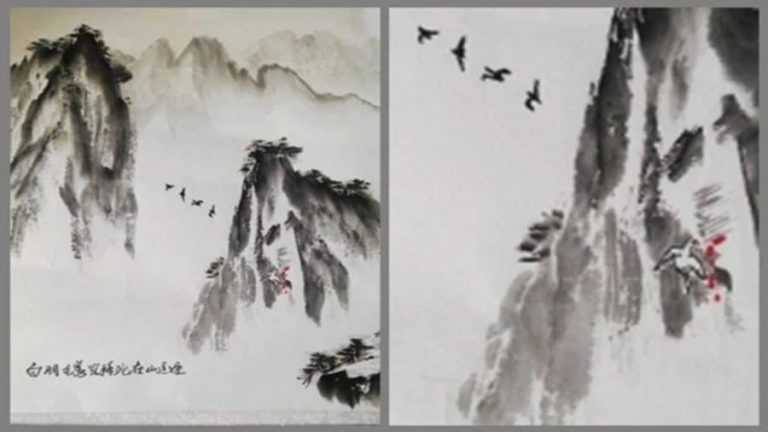
The final panel depicts five birds flying over a mountain range. Four dark-feathered birds pass over safely. The fifth, carrying white feathers, crashes directly into the cliff face. The character for Xi (習 in traditional Chinese script), when broken into its component parts, combines the character for “feathers” (羽) above the character for “white” (白). The “white-feathered bird” thus corresponds directly to Xi Jinping. In this reading, the prophecy predicts that the CCP will survive five generations of leadership, from Mao Zedong through Deng Xiaoping, Jiang Zemin, and Hu Jintao to Xi, and that the fifth will be the one to crash and bring the dynasty down.
The mountain the bird crashes into is named, in the prophecy, “Qishan,” the same two characters that compose Wang Qishan’s given name. By relentlessly purging the man who built his disciplinary machine and who holds more compromising knowledge about Xi’s personal and family affairs than perhaps anyone else in the Party, Xi has been flying straight into “Qishan” all along. Xi is widely reported among dissident circles to be deeply superstitious about such prophecies and to suppress their circulation actively. His own political paranoia, his inability to tolerate even a loyal and neutralized Wang Qishan, has driven him to act in precisely the pattern the prophecy describes.

Xi has broken every norm of elite CCP politics
Wang Qishan, approaching eighty years old, sits in a heavily guarded Beijing courtyard. All his trusted associates are imprisoned or under investigation. He has no children. His wife’s family network, the political infrastructure of an earlier era, is long dispersed. Wang is one of the very few people alive who possesses detailed knowledge of the most sensitive material gathered during years of anti-corruption investigations: information about Xi Jinping’s personal conduct, his family’s overseas financial holdings, and the private transactions and vulnerabilities of everyone at the apex of Chinese power. That knowledge was accumulated precisely because Wang ran the machinery that gathered it. Arresting his subordinates cannot erase what Wang himself knows. CCP insiders once called him the “living King of Hell,” borrowing an image from Chinese folk religion in which the King of Hell presides over the judgment of the dead and dispatches punishment with absolute authority.
Whether Wang Qishan has the means or the will to strike back, and what form any such strike might take, remains open. In Chinese political culture, the maxim holds: the truly dangerous man does not act in haste, but when he moves, the blow is fatal.