China has three major traditional festivals. Do you know which three they are? They are the Duanwu Festival (Dragon Boat Festival), Chinese New Year, and the Mid-Autumn Festival.
Let’s talk about the Duanwu Festival. You may wonder: what does “Duanwu” mean?
The term may sound difficult to understand. In ancient Chinese, “duan” (端) means “beginning” or “opening,” while “wu” (午) has a special meaning.
You might think the “wu” in Duanwu refers to the character for “noon.” In fact, it does. Ancient China used the Twelve Earthly Branches (子、丑、寅、卯、辰、巳、午、未、申、酉、戌、亥) to represent time. For example:
- 11 p.m.–1 a.m. = Zi hour (子时)
- 1 a.m.–3 a.m. = Chou hour (丑时)
Following this system, 11 a.m.–1 p.m. is the Wu hour (午时). Before 11 a.m. we say “morning” (上午), and after 1 p.m. we say “afternoon” (下午).
Success
You are now signed up for our newsletter
Success
Check your email to complete sign up
The Twelve Earthly Branches were also used to represent months in the traditional lunar calendar. The fifth lunar month corresponds to the branch “Wu” (午). Since the Dragon Boat Festival falls on the fifth day of the fifth lunar month, the name “Duanwu” is connected to this “Wu” month and “Wu” hour.
Now you know where the name comes from.
Health and protection during the fifth lunar month
In ancient times, the fifth lunar month was also called the “Poison Month” or “Evil Month.” A traditional saying goes:
“During the Dragon Boat Festival, the weather turns hot, and the ‘five poisons’ awaken.”
The “five poisons” traditionally refer to creatures such as snakes, scorpions, centipedes, lizards, and toads.
Because of this belief, one of the most important themes of the Dragon Boat Festival was warding off illness, harmful influences, and misfortune while maintaining health and safety.
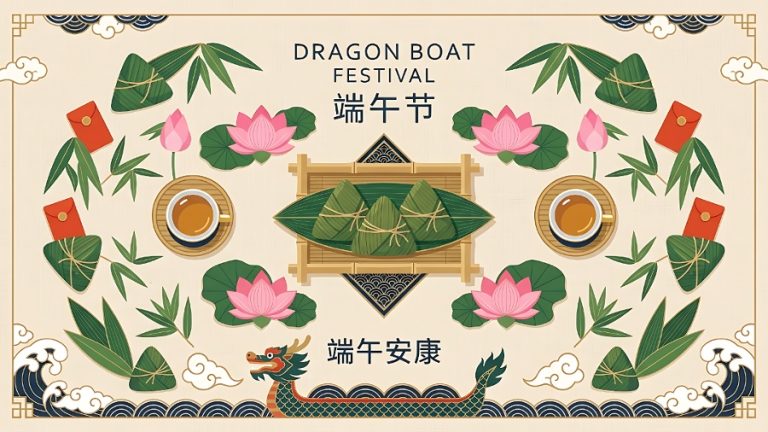
Even today, people often say “Duanwu Ankang” (Peace and Good Health on the Dragon Boat Festival) rather than simply “Happy Dragon Boat Festival.”
Tradition 1: Hanging mugwort and calamus
Before sunrise on the festival day, people would gather mugwort (艾草) and hang it above their doors. Families also hung calamus (菖蒲) on doorways, windows, and eaves.
People believed the strong fragrance of these plants could drive away disease and negative influences.
According to traditional Chinese medicine, mugwort is considered a warming herb that helps dispel dampness and support the body’s energy.
Traditional Chinese medicine also teaches:
“When righteous energy exists within, harmful influences cannot invade.”
In other words, maintaining strong positive energy and good health helps protect a person from illness and adversity.
Tradition 2: Drinking realgar wine
Mentioning realgar wine (雄黄酒) may remind people of the famous legend of the White Snake.
In the story, a monk tells Xu Xian that his wife Bai Suzhen is actually a thousand-year-old snake spirit. To reveal her true form, he persuades Xu Xian to give her realgar wine during the Dragon Boat Festival. After drinking it, she transforms back into a giant white snake, terrifying Xu Xian.
Historically, many regions of China had the custom of drinking realgar wine during the festival.
Realgar is a mineral that was traditionally used in Chinese medicine and believed to repel insects and harmful creatures. Adults would drink small amounts of realgar wine, while children would have a little applied to their foreheads, ears, or noses, often with the character “王” (king) painted on the forehead for protection.
Tradition 3: Wearing five-colored silk threads
On Dragon Boat Festival morning, mothers would tie colorful threads around their children’s wrists, ankles, or necks.
These five-colored threads symbolized blessings, protection, and good fortune.
The colors represent the traditional Five Elements:
- Green/Blue = Wood (East)
- Red = Fire (South)
- White = Metal (West)
- Black = Water (North)
- Yellow = Earth (Center)
Because the Five Elements were believed to balance and support one another, the threads were thought to provide protection and attract good luck.
Many people still remember wearing colorful strings and small decorative ornaments as children during the festival.
Tradition 4: Wearing fragrant sachets
Mothers also sewed fragrant sachets (香囊) for children.
These small cloth pouches contained aromatic herbs and medicinal powders. They were worn around the neck or attached to clothing.
Besides being decorative and pleasantly scented, people believed the herbs inside helped repel disease and negative influences.
Ancient emperors even presented sachets as gifts to officials.
Over time, sachets became both a health-related custom and a beautiful cultural accessory.
Tradition 5: Bathing in calamus water
Another ancient Dragon Boat Festival custom was bathing in calamus-infused water, sometimes called “orchid bath” (兰汤).
Calamus was believed to possess cleansing and protective qualities. Since noon on the Dragon Boat Festival was considered a time of strong yang energy, bathing with calamus was thought to purify the body and ward off harmful influences.
This tradition spread beyond China to the Korean Peninsula. Some customs in Korea include bathing with calamus water, drinking calamus beverages, and using calamus-based cosmetics.
In some regions of China, people still bathe or wash their hair with water collected at noon on the festival day.

Balancing eggs at noon
One of the most enjoyable Dragon Boat Festival traditions for children is balancing eggs upright.
Normally this is difficult, but many people believe eggs are easier to balance at noon on Dragon Boat Festival.
Traditional folklore explains that the day is filled with strong yang energy, which helps the egg stand upright. Some people also believe balancing an egg on this day brings good luck.
Whether or not the belief is true, it remains a fun activity for both children and adults.
Many traditional Dragon Boat Festival customs revolve around a common theme: promoting health, preventing illness, and seeking peace and protection.
From hanging mugwort and calamus to wearing sachets, tying five-colored threads, bathing in herbal water, and balancing eggs, these traditions reflect centuries of cultural wisdom and wishes for well-being.
Duanwu Ankang — wishing you peace, health, and safety during the Dragon Boat Festival.