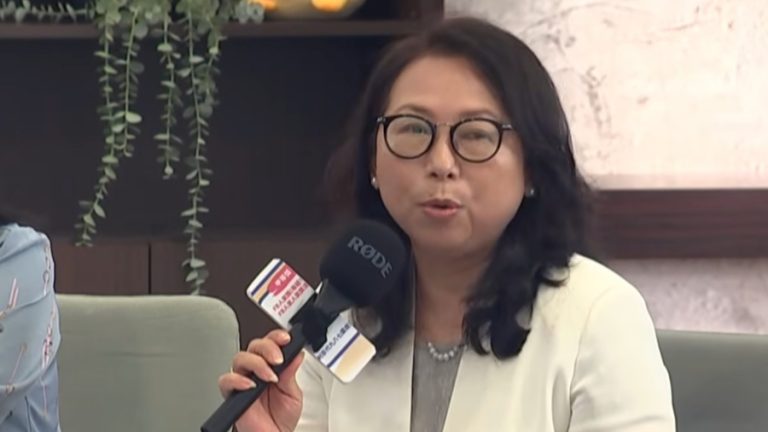
The New Taipei District Court on June 9 concluded arguments in the case against Xu Chunying, a Chinese-born spouse living in Taiwan, who is accused of violating Taiwan’s Anti-Infiltration Act and other laws, the Taipei Times reported.
After an extended trial, prosecutors argued that Xu had maintained long-term contacts with individuals associated with the Chinese Communist Party’s united front system and had allegedly accepted instructions to intervene in Taiwanese elections and political activities. Prosecutors also accused her of involvement in underground money transfers and fraudulent loan schemes, Focus Taiwan reported.
As a result, prosecutors requested prison terms ranging from four years to four years and ten months on five separate charges. Combined, the requested sentences exceed 20 years in prison, along with fines totaling NT$23 million.
Three other defendants were also charged in the case: Chung Chin-ming (钟锦明): prosecutors requested combined sentences totaling 8 years and 6 months, plus fines totaling NT$9 million. Luo Ying (罗颖), for whom prosecutors requested a sentence of 4 years and 10 months and Pu Chi-cheng (卜启正), Xu’s daughter for whom prosecutors requested a sentence of 2 years and 6 months.
Now 64 years old, Xu moved to Taipei in 1993 as a spouse from mainland China and obtained a Republic of China (Taiwan) national identification card in 2000.
Success
You are now signed up for our newsletter
Success
Check your email to complete sign up
Since 2016, she has served as chairperson of the Taiwan New Residents Development Association, participating in cross-strait exchange activities. She was once considered by the Taiwan People’s Party (TPP) as a potential candidate for its 2024 party-list legislative nominations.
However, controversy arose over allegations that she had not renounced her Chinese nationality, after which she voluntarily withdrew from consideration.
Prosecutors’ allegations
According to prosecutors, Xu and cross-strait marriage association figure Chung Chin-ming maintained long-standing relationships with individuals connected to China’s united front system.
These contacts allegedly included personnel affiliated with the Cross-Strait Marriage and Family Service Center under China’s Ministry of Civil Affairs, as well as members of pro-unification organizations, CNA reported.
Prosecutors contend that the two sides communicated frequently over many years, discussing topics including: Taiwan’s political situation, election strategies and information related to specific political candidates.
The prosecution argues that these exchanges went beyond ordinary private conversations and instead constituted activities involving the receipt of instructions and the reporting of information.
Prosecutors stated that assistance provided by foreign forces does not necessarily take the form of direct financial payments. Instead, influence and infiltration may also be carried out through means such as sponsored visits and hospitality, allocation of resources, cultivation of personal networks and the development of social and community influence.
According to prosecutors, such resources helped individuals such as Xu Chunying maintain their influence within specific social groups and communities, thereby advancing what the prosecution characterized as the objectives of the Chinese Communist Party’s united front efforts.
The prosecution argued that these forms of support can be just as effective as monetary compensation in building influence and expanding political or social outreach.
During court proceedings, Xu Chunying admitted only to offenses related to fraudulent loans and underground money-exchange operations. She denied allegations that she violated Taiwan’s Anti-Infiltration Act or assisted Chinese national Sun Xian in entering Taiwan.
Xu Chunying case: co-defendants, bail and court ruling
Co-defendant Chung Chin-ming likewise denied all criminal charges.
However, Xu’s daughter Pu Chi-cheng and her associate Luo Ying pleaded guilty to certain charges, including violations of Taiwan’s Banking Act.
Prosecutors further alleged that Xu and Chung accepted various forms of assistance from Yang Wentao and Sun Xian, including local reception and hospitality arrangements, distribution of COVID-19 rapid-test kits and assistance with emergency relief fund applications.
According to the prosecution, these resources helped the two maintain their influence and standing within Taiwan’s mainland-spouse community.
Prosecutors argued that although Xu and Chung have lived in Taiwan for many years and benefited from Taiwan’s democratic system and legal protections, they allegedly became instruments through which foreign hostile forces sought to interfere in Taiwan’s elections.
The prosecution contended that their actions harmed Taiwan’s democratic electoral system
While the proceedings unfolded, Xu Chunying was held in detention without visitation rights since November 2025.
After concluding arguments on June 9, the New Taipei District Court determined that the case had entered the judgment phase and ordered her release on NT$2 million (approximately US$67,000) bail. The court also imposed restrictions on her residence, overseas travel, and sea travel. Without prior approval, she is not permitted to leave Taipei City or New Taipei City.
The court had originally ordered electronic monitoring. However, according to reports, the monitoring center was unable to provide an electronic ankle bracelet or mobile monitoring equipment. As a result, the court modified the conditions and ordered Xu to report to her local police station every Monday, Wednesday, and Friday morning.
After completing the bail procedures that evening, Xu left the courthouse. When approached by reporters, she offered only a brief: “Thank you.”
She declined to comment further on the case.
High-profile national security case
The case has attracted significant political and public attention because it touches on sensitive issues including alleged Chinese Communist Party united front activities toward Taiwan, political participation rights of Chinese spouses in Taiwan and Taiwan’s national security.
According to media reports, prosecutors and defense lawyers hold sharply different views regarding the boundary between legitimate cross-strait exchanges and improper political involvement by foreign actors.
As a result, the case has become one of the most closely watched tests of Taiwan’s Anti-Infiltration Act in recent years.
Arguments have concluded, and the three-judge panel is scheduled to deliver its verdict on August 11, 2026, at 11:00 a.m.