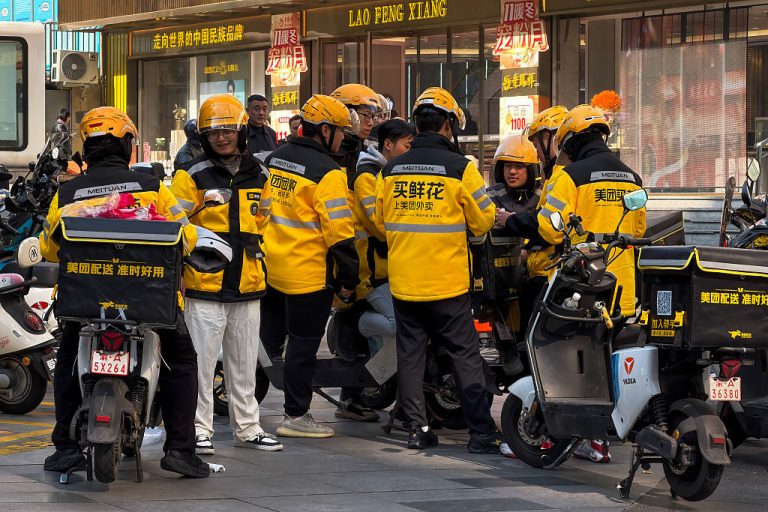
The International Labour Organization (ILO) adopted the world’s first convention on decent work in the platform economy, also called the gig economy on June 12. The Chinese delegation voted in favor of the measure. Human rights organizations however note that whether China’s hundreds of millions of gig workers will actually gain meaningful protections depends not on official promises, but on whether they possess the rights to organize, express their views, and hold employers and authorities accountable.
Interviewees said that amid employment pressures and weak consumer demand, growing numbers of young people are entering platform-based industries such as food delivery and ride-hailing, yet workers continue to bear the burden of low pay, fines, and accident risks.
Human Rights Watch published an article on June 17 by Wang Songlian (Maya Wang), Associate Director for China at the organization’s Asia Division. The article stated that China’s flexible workforce—primarily consisting of workers who receive jobs through online platforms, dispatch systems, and digital labor platforms—is estimated at 320 million people. It argued that commitments made on paper have limited significance unless workers are able to organize themselves, make their voices heard, and hold both gig-economy platforms and the government accountable.
Lu Jun, co-founder of the Beijing-based civil society organization Yirenping Center, said that it was not surprising that the Chinese government voted in favor of the ILO convention. According to Lu, the Chinese government has long adopted a differentiated approach toward human rights issues: it strictly guards against political and civil rights, while leaving some room for certain economic rights.
He explained: “The main reason is that the government is also concerned that if workers are pushed too hard and exploited too heavily, they might rise up as Poland’s Solidarity trade union once did, posing a threat to its rule.”
Success
You are now signed up for our newsletter
Success
Check your email to complete sign up
Lu Jun believes that if workers sought to establish independent trade unions or engage in collective bargaining with employers, such activities would be absolutely prohibited in China.
Falling delivery fees and the transfer of platform risks to workers
In recent years, pressure on youth employment in China has continued to draw attention. Officially reported youth unemployment surpassed 21 percent in mid-2023 before authorities later revised the statistical methodology. According to the Human Rights Watch article, weakness in the formal labor market has pushed more young people into gig-economy work. Food delivery riders, ride-hailing drivers, couriers, and online freelance workers have become an integral part of the employment structure in Chinese cities.
According to Radio Free Asia, Mr. Zhou, who operates a clothing wholesale business in Wenzhou, said that the effects of the economic slowdown have gone beyond corporate balance sheets and are reshaping the life plans of young people.
He said: “The biggest problem now isn’t U.S. tariffs or exports. We sell mainly to the domestic market, and what we fear most is that people aren’t buying things. During holidays, our shop used to be crowded. Now many young people just come in, look around, ask a few questions, and leave without purchasing anything.”
“A lot of people are simplifying their weddings and cutting costs wherever possible. Several of my employees born in the 1990s had planned to buy homes and get married, but they’ve postponed those plans, saying they need to secure their jobs first. Some graduates have moved back to their hometowns or continue living with their parents because they simply can’t afford to rent a place on their own in the city.”
Weak domestic demand becomes the main pressure on businesses
Mr. Zhang, head of a machinery-parts company in Suzhou, said that while declining export orders have affected businesses, the more noticeable pressure comes from the domestic market.
He said: “In the past, downstream companies would stock up in advance. Now they only produce when orders come in, keeping inventories very low. Many customers tell us that their products aren’t selling, so they don’t dare purchase additional inventory.”
“What worries us most now is that everyone seems to be lying flat—neither spending nor investing. If that continues, how can the economy function? How can anyone talk about boosting domestic demand?”
Platform work becomes a temporary lifeline amid employment pressure and weak consumption
As employment pressures and sluggish consumer spending occur simultaneously, the platform economy has become a temporary refuge for many young people.
Mr. Chen, a food delivery rider in Shanghai, told the broadcaster that delivery workers are most concerned about fines, late deliveries, and traffic accidents.
He said: “It may look like we’re choosing our own orders, but in reality all the timing is calculated by the platform. If you’re too slow, customers complain and the platform deducts money from your pay. If you’re too fast, the risks on the road increase. During rainy days or typhoons, the pay per order is sometimes a little higher, but when accidents happen, nobody really takes responsibility. Many people don’t dare stop working, because once they stop, they have no income.”
Mr. Chen said riders’ earnings have continued to decline in recent years.
“Since last year, the payment per delivery for part-time riders has fallen from seven or eight yuan per order two years ago to five or six yuan now, and sometimes only around four yuan. Some people drive against traffic or run red lights to save time. Then they get fined, which makes their losses even greater.”
The recently released documentary 《2026中国外卖员生存报告》 (2026 China Food Delivery Workers Survival Report) portrays conditions similar to those described by Chen.
The documentary was published on April 17 by Sanlian Life Lab, a channel affiliated with the magazine Sanlian Life Weekly. Archived information indicates that the film can no longer be found on the video platform Bilibili. In the documentary, delivery workers state that a single order once paid around 10 yuan, whereas most orders now pay only 3 to 5 yuan.
On June 18, a video circulating online showed a delivery rider in Baoding, suffering an emotional breakdown and repeatedly striking his own head. According to online reports, the rider had been fined 50 yuan by the platform after a customer complaint. Industry data indicate that the number of food delivery riders in China has surpassed 14 million, and platform penalties, customer complaints, and algorithmic dispatching rules have become part of riders’ daily pressures.
Restrictions on organizing rights and shrinking space for labor NGOs
The Human Rights Watch article notes that, like their counterparts in other countries, Chinese gig workers face low pay, unstable incomes, unsafe working conditions, and inadequate protection for workplace injuries. However, Chinese workers face an additional challenge: they are unable to freely establish independent trade unions.
The article states that Chinese workers lack the right to organize unions independently, and individuals who attempt to organize labor-rights activities may face arrest and imprisonment.
Yan Hua (a pseudonym), a scholar from Zhejiang who studies labor issues in China, said that in recent years Chinese authorities have incorporated groups such as delivery riders, couriers, and ride-hailing drivers into grassroots governance systems. This serves both to manage labor disputes and to prevent collective action.
She explained: “The number of platform workers is enormous, and they are highly mobile. If they were able to organize independently, their bargaining power would rise very quickly. The current approach is to incorporate them into official trade unions, community organizations, Party organizations, and industry associations. These organizations are not created by workers themselves and are not accountable to workers. In many cases, they suppress workers’ demands.”
Lu Jun further stated that Chinese authorities have long maintained a harsh stance toward worker-led initiatives such as collective bargaining and independent trade unions. In recent years, the operating space for domestic labor NGOs has continued to shrink, and only a handful of grassroots organizations remain active.
He said: “Over the past several years, labor NGOs in China have been almost completely dismantled through government repression. Even grassroots organizations that previously only provided legal aid, vocational training, or cultural and educational services for workers are now, for the most part, no longer allowed to operate.”
New ILO convention and the question of implementation
The new convention adopted by the International Labour Organization (ILO) requires that workers in the platform economy be guaranteed decent work protections, including:
- Fair and reasonable remuneration
- Occupational health and safety protections
- Social security coverage
- Transparency in data and algorithmic management
- The rights to organize and engage in collective bargaining
Human Rights Watch argues that China’s support for the convention is only the first step. The country would still need to formally ratify and implement the agreement. The real measure of success, according to the organization, will be whether workers are granted rights that are enforceable in practice rather than merely recognized on paper.
The article represents only the author’s personal views and opinions and does not necessarily reflect the views of Vision Times.