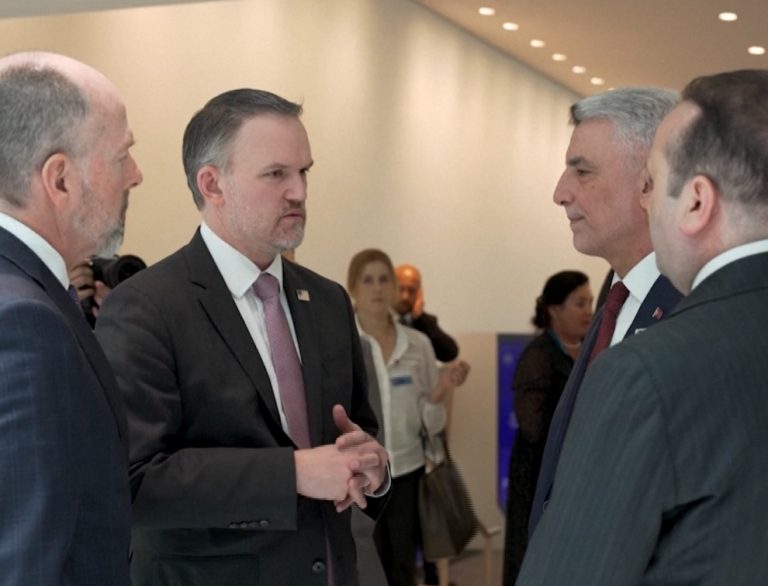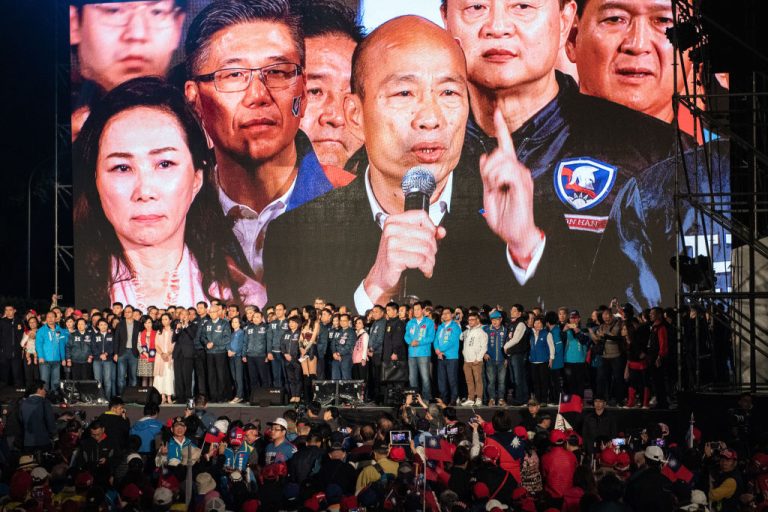
Han Kuo-yu, a senior Kuomintang (KMT) politician and former Legislative Yuan Speaker, left Taiwan on June 21 leading a cross-party delegation of Taiwanese lawmakers on a six-day visit to the United States.
The delegation is scheduled to visit Arizona and Washington, D.C. for exchanges aimed at deepening parliamentary cooperation between Taiwan and the United States, congratulating the U.S. on its 250th anniversary, and examining the development of TSMC’s (Taiwan Semiconductor Manufacturing Company) operations in the United States.
Taiwanese lawmakers expressed hope that the parliamentary diplomacy mission would be successful in strengthening Taiwan–U.S. ties, enhancing exchanges and cooperation in industries such as chips and semiconductors, and improving the economic prospects of both Taiwan and Taichung.
Han Kuo-yu leads cross-party delegation to the US
According to a report by the Central News Agency, Han Kuo-yu is visiting the United States at the invitation of the U.S. side, leading a seven-member bipartisan delegation of lawmakers to conduct parliamentary diplomacy.
The delegation includes Kuomintang (KMT) legislators Lin Szu-ming, Lai Shyh-bao, and Yang Chiung-ying; Democratic Progressive Party (DPP) legislators Chen Kuan-ting, Lee Po-yi, and Kuo Yu-ching; Taiwan People’s Party (TPP) legislator Hung Yu-hsiang.
Success
You are now signed up for our newsletter
Success
Check your email to complete sign up
Before passing through immigration at Taipei’s Terminal 2’s departure hall, Han addressed reporters. He said that he and lawmakers from all three political parties were invited by the Taiwan friendship caucuses in both the U.S. Senate and House of Representatives. The purpose of the bipartisan visit is to promote parliamentary diplomacy.
Han stated that the delegation hopes to exchange views with U.S. legislators on issues including national security, constituency governance, and whether Taiwan and the United States can further deepen cooperation, contacts, and exchanges between their legislatures, thereby strengthening parliamentary ties between the two sides.
Han Kuo-yu noted that this year marks the 250th anniversary of the United States. As the Legislative Yuan is the highest representative body of the Republic of China (Taiwan), the cross-party delegation of legislators is representing the Taiwanese people in extending their highest congratulations to the U.S. government, wishing America a happy National Day and a happy birthday.
Han also stated that TSMC has been investing in the U.S. state of Arizona for nearly five years. Both domestic and overseas Taiwanese communities have been closely following the company’s development. In addition to visiting TSMC, the delegation will meet with its employees, expressing hope that TSMC staff can enjoy smooth working and living conditions in the United States.

Cheng Chao-hsin sees delegation off — is a ‘Han-Lu alliance’ taking shape?
Meanwhile, Taichung Deputy Mayor Cheng Chao-hsin went to the airport to see off Han Kuo-yu and his delegation. This was interpreted by some observers as a sign that a “Han-Lu alliance” may be taking shape.
On the morning of June 22, Taichung Mayor Lu Shiow-yen attended the inauguration ceremony for the first phase of the new campus buildings at Nanxing Junior High School and Nanxing Elementary School in Beitun district of the county, as well as the groundbreaking ceremony for the second phase of construction. Speaking to reporters afterward, Lu said that she had met with Han Kuo-yu on the morning of June 21, and later that evening asked Deputy Mayor Cheng Chao-hsin to see him off at the airport.
She expressed hope that the parliamentary diplomacy mission would be successful and would help consolidate Taiwan–U.S. friendship. She added that the trip could strengthen exchanges and cooperation related to TSMC, Taiwan’s chip and semiconductor industries, as well as the drone industry.
Lu added that Taichung is home to industries including semiconductors, drones, precision machinery, optics, and aerospace. The development of these sectors brings significant economic benefits to the city. She expressed hope that both Taiwan’s national economy and Taichung’s local economy would continue to improve.
Foreign Minister Lin Chia-lung: Visit helps erase impression left by Cheng Li-wen’s US trip
According to a report by the newspaper Liberty Times, Foreign Minister Lin Chia-lung said on June 20 that he believes the U.S. invitation to Han Kuo-yu was, to some extent, intended to counter the impression left by KMT Chairwoman, Cheng Li-wen’s visit to the United States—namely, the perception that Taiwan supports “One China,” the “1992 Consensus,” and opposition to Taiwan independence.
Lin argued that the visit would allow what he described as Taiwan’s mainstream public opinion to be more accurately reflected in American public discourse and would have a positive impact on future Taiwan–U.S. relations.
He further stated that the United States understands Taiwanese public opinion well. According to Lin, the special national defense bill suffered setbacks because Cheng Li-wun and a small group of legislators opposed it, resulting in the removal of funding for items such as drones.
As a result, he said, the U.S. Congress invited Han Kuo-yu to lead a bipartisan delegation during its legislative session. Although Han belongs to the Kuomintang (KMT), his leadership of a cross-party delegation allows him to present what Lin described as a moderate position representing the views of the majority of Taiwanese people.
Han faced pressure during defense procurement debate
Earlier, Chuang Jui-hsiung, secretary-general of the Democratic Progressive Party caucus in the Legislative Yuan, told reporters that the U.S. invitation was of a very high level.
He said that during negotiations over the defense procurement bill, Han Kuo-yu found himself in a difficult position between his responsibilities as Legislative Yuan Speaker and pressure from the KMT leadership. According to Chuang, Han believed that strengthening Taiwan’s defense capabilities was not an issue to be treated lightly.
Chuang quoted Han as saying: “Overseas Taiwanese and all sectors of society are watching and waiting. The media discuss this every day. Can any political party really fail to feel that pressure?”
Chuang added that the United States had likely taken note of Han’s stance on defense procurement issues and that this had provided significant momentum for parliamentary diplomacy. He expressed hope that Han’s visit would yield substantial results.
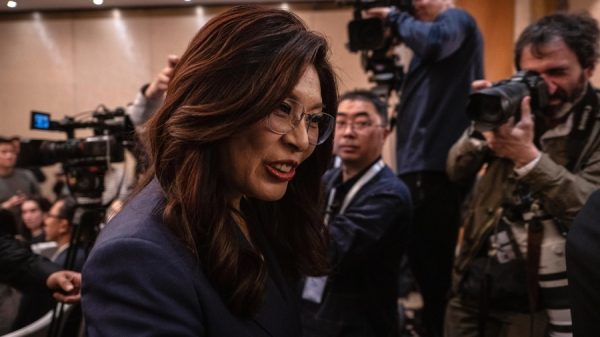
Cheng Li-wen has lost support from both Washington and Beijing
Separately, according to a report by NOWnews, Democratic Progressive Party Taipei City Councilor Hung Chien-yi said on June 22 during the political talk show Toujia Lai Kaijiang that Cheng Li-wen has become increasingly marginalized.
He argued that American policymakers are now more interested in Han Kuo-yu than in Cheng. According to Hung, Cheng’s political influence and strategic value are being questioned by both the United States and China. As attention shifts toward Taiwan’s 2028 presidential election, he suggested that Cheng may find herself in a significantly weakened political position.
Hung also discussed what he described as a shift in Cheng’s standing with both Washington and Beijing. He noted that Cheng had previously ranked highly on Chinese internet search trends and had taken pride in that visibility. However, he claimed that she is now largely absent from trending searches and keyword rankings in China.
Hung argued that this indicates growing skepticism in China regarding Cheng’s political value and position, suggesting that Beijing’s assessment of her may have fundamentally changed.
Hung Chien-yi further argued that Cheng Li-wen initially approached scientific and technical issues from a political perspective, and when that line of argument no longer gained traction, she turned to what he described as “metaphysical” or “mystical” arguments. As a result, he claimed that even Taiwan’s National Security Bureau and the U.S. Department of State no longer know how to assess her position.
Hung said that, in his personal view, Cheng is already in a weak position in the emerging political landscape ahead of Taiwan’s 2028 elections, adding: “She is almost at the point of being abandoned by China and abandoned by the United States.”