On June 19, 2026, China’s state news agency Xinhua published a lengthy celebratory article titled “The Three Great Transformations: A Profound Social Transformation Without Precedent.” Two more followed in rapid succession: the People’s Daily ran “Records of Socialist Transformation” on June 20, and “Records of the Exploration of the Socialist Construction Path” on June 21.
The articles praise the Party’s forced nationalization of private agriculture, handicrafts, and capitalist industry and commerce between 1953 and 1956. They quote Xi Jinping, the CCP’s general secretary and China’s top leader, describing the seizure of private property under the state’s name as “a historic leap from socialist revolution to socialist construction,” and the foundation of what Xi now calls “Chinese-path modernization.” The publication date was not incidental: June 19 marked both China’s traditional Dragon Boat Festival and Xi’s birthday.
Forced collectivization, famine, and the terror behind the Party’s euphemism
The “transformation” of agriculture worked as follows. During the land reform campaign of the late 1940s and early 1950s, the Party had redistributed farmland to peasants under the slogan “land to the tiller.” Many peasants believed they had finally secured something of their own. Within a few years, the Party reorganized them into “mutual aid teams,” then “elementary cooperatives,” then “advanced cooperatives.” By 1956, 96 percent of rural households had been absorbed. Their land, tools, and livestock had reverted to collective ownership. The Party then imposed a system of mandatory grain quotas, setting both prices and quantities. Farmers could neither sell their own grain freely nor leave their villages for city work. They had become, as one commentator put it, “second-class citizens bound to the soil.”
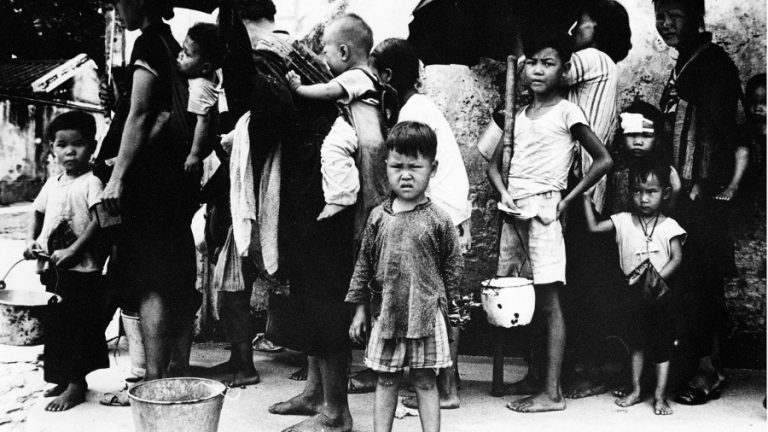
The forced collectivization fed directly into the Great Leap Forward of 1958, which intensified collective farming under wildly inflated production targets, and then into the Great Famine of 1959 to 1961, in which between 30 million and 55 million people died. Survivors in some regions resorted to eating bark and clay. There were documented cases of cannibalism.
Before the nationalization campaign could proceed, the Party needed to destroy the social and financial credibility of China’s capitalist class. It did so through the Five-Anti Campaign of 1952, which targeted business owners on charges of bribery, tax evasion, theft of state property, fraud, and theft of state economic intelligence.
Success
You are now signed up for our newsletter
Success
Check your email to complete sign up
In Shanghai alone, from Jan. 25 to April 1, 1952, 876 people died by suicide as a direct result of the campaign’s pressure. Business owners were subjected to forced confessions, public denunciations, and ruinous fines. Many faced criminal prosecution. Families were broken apart.
Investigators routinely exploited family members and personal vulnerabilities to extract confessions, and the psychological pressure was compounded by public denunciation sessions, blaring loudspeakers on city streets broadcasting the names of those who had not yet confessed, and teams of workers mobilized to report on their employers.
It was under these conditions that Rong Yiren, then a prominent Shanghai textile and flour magnate and later one of the first businessmen the Party would publicly rehabilitate as a showcase of its economic opening, began confessing to fabricated crimes. According to accounts of the campaign, he initially admitted to illegal gains of 28 billion yuan in old currency, then raised that figure, and ultimately, under duress, declared an astronomical sum running into the trillions in old yuan. Those figures were so far beyond any realistic valuation of his assets that they reflected the coercive logic of the campaign rather than any genuine accounting.
Having no realistic means to pay, he told a senior Party official he had no assets left other than one house on Meiling Road, and offered to surrender his factories to the state outright. If no other resolution could be found, he indicated, he saw no way forward but to take his own life. In the end, with the intervention of senior officials including Bo Yibo and Chen Yi, the Rong family was classified as “completely law-abiding” and spared the worst consequences. Many of their peers were not.

How a business dynasty was destroyed by trusting the Party’s promises
In 1949, as the Communists swept to power, China’s capitalist class faced a stark choice: leave or stay. The Rong family split. One branch chose to go. Rong Hongyuan moved to Hong Kong, dismantled machinery from several factories and shipped it to Taiwan and Hong Kong, sold off warehouse receipts, and established a new textile company in Hong Kong.
Rong Desheng, the family patriarch and the father of Rong Yiren, chose to stay. He had not, he reasoned, committed any crimes. He had no cause to flee. He was also reassured by explicit Party promises. In 1945, as the civil war entered its final phase, Mao Zedong told American visitors that the Party had no intention of imposing collectivization, that it welcomed private enterprise, and that it encouraged competition. The Party’s 1949 interim constitution, the Common Program, pledged in plain language to protect the economic interests and private property of workers, peasants, petty bourgeoisie, and the national bourgeoisie.
The Chinese Communist Party’s own founding charter, adopted at its first congress in July 1921, had stated its intention to abolish capitalist private ownership and confiscate the means of production, including machinery, land, factories, and semi-finished products, for public ownership. As the historian Gao Hua, one of the most rigorous scholars of the Mao era, argued, that earlier document reflected the Party’s actual intentions far more accurately than any of its subsequent assurances.
Xi’s economic diagnosis: more state control as the cure for crisis
Zhang Tianliang, a US-based political commentator, argued that Xi operates from a premise that the Party’s history must be treated as an internally consistent whole. The socialist transformations of the 1950s cannot be condemned without implicitly questioning the legitimacy of everything that followed. Equally, the subsequent decades of market liberalization cannot be used to discredit the original nationalizations. For Xi, both periods were correct expressions of the same Party line, differently applied to different circumstances.
China’s economy is in serious difficulty: local government finances are exhausted, the property sector has collapsed, banks are under stress, private businesses are failing in large numbers, and youth unemployment has reached crisis levels. Xi’s diagnosis is that these problems result from insufficient Party control, insufficient concentration of resources in state hands. The cure is more control, more centralization.
“If he gets even a 5 percent chance of pulling this off,” Zhang said, “that means all the private capital in China could be taken away under the banner of ‘public-private cooperation.’ And even if he fails, the announcement alone will trigger a massive capital flight by wealthy Chinese, which will make the economic crisis far worse.”

The gradualist nationalization already years underway
Li Muyang, another U.S.-based analyst, argued that the Party has, in practice, already been implementing a gradualist version of the “transformation” for years, without deploying the phrase. Private companies have been required to establish internal Party committees with formal authority over business decisions. Tech giants including Alibaba, Ant Group, and Tencent have been subjected to multi-year regulatory crackdowns that resulted in large fines, forced restructuring, and, in some cases, state-appointed board members. Xi has repeatedly declared that state-owned enterprises are “the political foundation of the Party’s governance” and directed that they be made “bigger, stronger, and better.” State firms enjoy preferential access to bank loans, land, and government contracts; private firms face financing barriers and a heavier tax burden. A program of “mixed ownership reform” has, in practice, typically meant state enterprises acquiring stakes in private ones, with state entities taking effective control.
In rural areas, programs promoted as “rural revitalization” and “agricultural modernization” have encouraged land consolidation and the expansion of collective economic entities, reversing the household farming arrangements that had prevailed since the early 1980s.
State media’s explicit historical endorsement marks a new escalation
A blogger on the Chinese platform NetEase wrote that “the foundations of those 1950s campaigns have never been dismantled. If the root is not changed, history will repeat itself.” A commentator on the platform X, writing under the handle “New Highland,” argued that the Xinhua article “is unambiguously a political signal, releasing cover for a new round of large-scale confiscation of civilian capital and the reassertion of Party control over social resources.” The commentator added that what the Party now calls a “brilliant achievement” was, in the original, “backed by high pressure, coercion, and complete nationalization.”
Chinese internet users responded with comments ranging from dark humor to open alarm: “The grasping hand has never stopped swinging.” “The historical truth cannot be buried easily.” “The crisis is already here.”
The economist Yang Xiaokai recorded in his memoir an encounter with a Shanghai merchant who described the absurdity of the system in stark terms: a government trading company buying cheap and selling high at a hundred percent markup was practicing socialism, perfectly legal; a private citizen doing the exact same thing was guilty of speculation and profiteering, a capitalist crime. The merchant said he could have three rifles pointed at his head and still would not call that logic the truth.
Xi Jinping has not called for an overnight nationalization. He has not held a press conference announcing a new “transformation.” He has instructed state media to spend three consecutive days telling Chinese readers that the last time the Party did exactly that, it was a glorious achievement. For those who know the history, that is the announcement.