China’s widening diaper safety scandal has intensified after laboratory reports circulating online indicated that two additional domestic baby diaper brands contained formamide, a chemical classified by the European Union as a Category 1B reproductive toxin. The latest findings come as regulators investigate the industry, consumer confidence continues to erode, and mainland Chinese parents increasingly travel to Hong Kong and elsewhere to buy imported products.
According to a June 25 report by New Yellow River (新黄河), republished by Sina Finance, laboratory reports issued by Lianxin Testing (Jiangsu) Co., Ltd. showed that diapers sold under the Mu Zhi Tian Shi brand and Babycare’s Camellia line contained detectable levels of formamide, a substance linked to reproductive harm in animal studies.
The Mu Zhi Tian Shi sample, received on June 22 and tested on June 24–25, contained 384 milligrams of formamide per kilogram. The Babycare Camellia sample, received on June 21 and tested on June 23–24, measured 414 milligrams per kilogram. Both analyses were conducted using gas chromatography-mass spectrometry, a standard laboratory testing method.
After the reports spread online, a Lianxin Testing spokesperson confirmed their authenticity but said the Mu Zhi Tian Shi report had been withdrawn on the morning of June 25 for re-testing. No updated results had been released, while the Babycare report remained publicly available.
“Whatever a client asks us to test, that is what we test,” the spokesperson said.
The diaper controversy expands
Success
You are now signed up for our newsletter
Success
Check your email to complete sign up
The current diaper controversy has again raised questions about product safety oversight and regulatory enforcement in China’s consumer goods sector.
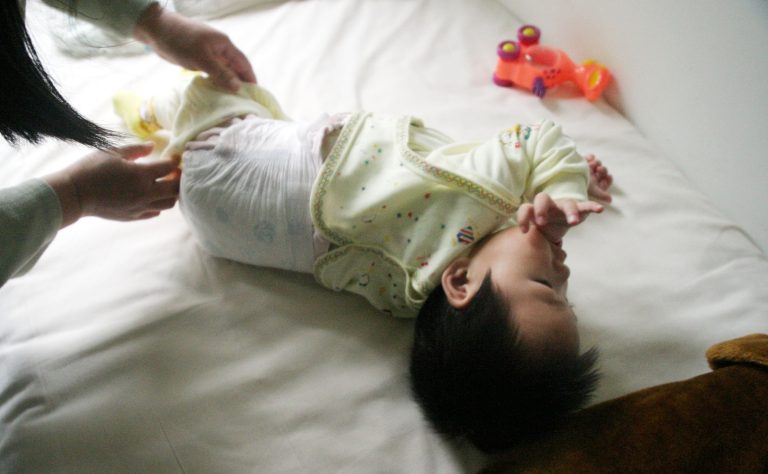
Concerns first emerged in early June, when parents reported online that their infants developed severe skin irritation after wearing certain domestic diaper brands, with symptoms disappearing once the products were no longer used.
The allegations gained national attention after Economic Information Daily, a newspaper published under China’s state-run Xinhua News Agency, commissioned an independent laboratory to test several products. Results published on June 18 found formamide in multiple diaper lines from Huggies China, Babycare, and Bibababy (碧芭宝贝).
In a widely discussed experiment, one of the newspaper’s journalists wore a diaper from one of the tested batches overnight and reported that his blood formamide concentration nearly doubled between pre- and post-test samples.
Formamide is an industrial solvent classified by the European Union as a Substance of Very High Concern because of its reproductive toxicity. China also prohibits its use in cosmetics, making its reported presence in products worn against infants’ skin particularly alarming.
Industry rejects allegations as sales plunge
A day after the Economic Information Daily investigation, the Sanitary Products Professional Committee of the China Paper Association said the newspaper’s testing methods, data disclosure and conclusions contained “obvious flaws,” adding that products currently on the market were “safe and under control.”
The three manufacturers later released laboratory reports they had commissioned, each claiming that “authoritative third-party testing” had found no detectable formamide. Babycare also announced it had filed a police complaint against social media users it accused of spreading false information.
Lead investigative reporter Wang Wenzhi rejected those claims in an online rebuttal, arguing the companies had submitted selected samples rather than products purchased from retailers. He called for an independent national investigation into the source of the chemical contamination.
On June 22, HUGGIES Hong Kong, which operates independently from Huggies China despite sharing the same parent company, released third-party test results showing no detectable formamide in three diaper products sold in Hong Kong.
Later that day, four Chinese government agencies, including the State Administration for Market Regulation and the National Health Commission, announced a joint investigation into the allegations, weeks after the controversy first surfaced and had stirred up a wave of public anger.
Consumer confidence has deteriorated rapidly. According to e-commerce analytics cited by Langjing News, daily sales at Bibababy’s flagship online store have fallen to roughly 4 percent of pre-crisis levels, while Huggies China has dropped to about 10 percent. Babycare has fared somewhat better but has still seen daily sales fall to roughly one-fifth of previous levels.
The loss of confidence has also driven mainland parents to Hong Kong, where demand for imported diapers has emptied shelves in districts including Sheung Shui, Tuen Mun and Sha Tin. Some retailers near border crossings have imposed temporary purchase limits of two to four packs per customer.
The rush recalls the 2008 melamine milk powder disaster, when dairy products from China’s Sanlu Group were found to contain melamine, an industrial chemical added to artificially inflate protein readings during quality tests. The contamination caused kidney stones and organ failure in hundreds of thousands of Chinese infants and killed at least six children.
The Sanlu scandal, which prompted mainland consumers to purchase baby products in Hong Kong, eventually led the city to impose restrictions on cross-border exports of infant formula.
Warning signs accumulate. Consumers complain. Investigative journalists document the harm. The implicated industry attacks the reporting, enlists industry-aligned trade bodies to provide institutional cover, and releases its own tests. Regulators remain largely passive. Only when public anger and economic damage reach a scale that threatens political stability do authorities announce formal investigations. By that point, some damage is already irreversible.
For the families whose infants have been wearing contaminated diapers for months or years, a belated investigation committee offers cold comfort.