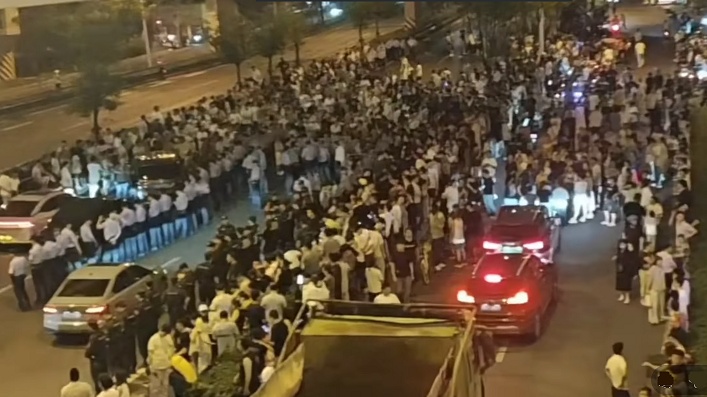
According to the BBC, on the night of June 27, residents of Hefei, the capital of Anhui province in eastern China, poured into the streets to stop construction of a massive waste transfer facility planned within walking distance of schools and apartment blocks housing 100,000 people. By midnight, facing a sit-in that had paralyzed one of the city’s main arteries for two hours, district officials arrived and scrapped the project on the spot. The victory is rare in China, where local governments seldomly retreat from infrastructure decisions once announced, and it has spread across Chinese social media as proof that collective pressure can still force the authorities to back down.
Protesters blocked a major road for two hours
Hefei’s Bureau of Natural Resources and Planning had announced plans to build a 4.2-hectare waste transfer station at the northwest corner of the intersection of North Second Ring Road and Banqiao River in the Luyang District of the city. The site sits only a few hundred meters from the nearest residential blocks. Within a one-kilometer radius, there are three primary schools and nearly twenty residential communities. Approximately 100,000 people live in the immediate vicinity.
Residents concluded the project would cause severe environmental contamination and pose lasting risks to public health.
On the evening of June 27, more than a hundred people assembled near the north gate of Haotianyuan residential compound, along North Second Ring Road, to express their objection. The crowd grew steadily throughout the night. Protesters moved into the road and began chanting slogans, facing off against a line of uniformed police officers and plainclothes security personnel who formed a human wall across the carriageway. Protesters then sat down in the road, bringing traffic on North Second Ring Road to a standstill for at least two hours.
Police attempted to disperse the crowd. Physical altercations broke out. People were shoved to the ground. Several were detained. Bystanders shouted, “The police are beating people! The police are beating people!”
Success
You are now signed up for our newsletter
Success
Check your email to complete sign up
Facing a sit-in protest, the district’s top officials cancelled the project
Late that night, the district chief and Party secretary of Luyang District arrived at the scene and announced that the waste transfer station project had been cancelled. They asked residents to go home.
The announcement did not fully satisfy the crowd. Many residents refused to leave without a formal written document confirming the cancellation. A verbal promise at midnight, they knew, was worth nothing.
Video of the confrontation spread across Chinese social media. Comments flooded in from users across the country. “The people of Hefei are incredible. So many of them, all with fire in their blood.” “Support the residents.” “Thank you to the people who fought for everyone.” “The people’s movement, justice crushing every force of evil.”
Wuhan residents also took to the streets against a hazardous waste laboratory built 27 meters from their homes
The Hefei protest is one of several that have erupted across China in recent weeks over infrastructure projects imposed on residential areas without notifying or consulting residents.
According to Radio Free Asia, in Wuhan, residents of Wuchang District mounted a week-long campaign in June against the construction of a hazardous waste laboratory project formally known as the Central China Regional Hazardous Waste Environmental Risk Prevention and Control Technology Center. Between June 10 and 16, residents gathered at the construction site each evening in protest and traveled to the Hubei Provincial Department of Ecology and Environment to petition for a halt to the project. They were blocked at the entrance by auxiliary police.
Video circulating online from the evening of June 12 showed several hundred protesters at the site, with large numbers of regular police and auxiliary officers standing in formation. In the footage, a man in a white shirt is seen being escorted away by two officers. A woman falls to the ground during a confrontation with police. One person collapsed and was carried to an ambulance.
A leaflet circulated among residents near Gongjing Road in Wuchang District detailed the project’s proximity to homes: the nearest complex sat just 27 meters away, with several other communities within a few hundred meters. The leaflet noted that the project would involve hazardous waste identification, toxicology experiments, sample management, and pollution control activities, and called on residents to demand that authorities disclose what they were building and where.
Hubei-based environmental advocate Chen, who asked to be identified by surname only, said: “You cannot simply say a project passed an environmental impact assessment and proceed to build. If something goes wrong, who is responsible? Why weren’t residents consulted in advance? Authorities handle these matters without ever genuinely engaging with local people, no one addresses residents’ concerns, and protests are what you get in the end.”
“This has happened in Guangdong, Shandong, and many other provinces — chemical plants, fertilizer factories, waste incineration facilities. They build without consulting residents, large-scale protests break out, and the project gets forced to a stop.”
In Shanxi province, homeowners armed themselves with bricks to defend a wall the government tried to demolish twice
On May 1, residents of the Fuze Garden residential compound in Yuncheng’s Yanhu District surrounded excavators sent by local authorities to tear down a perimeter wall.
The wall had been built when the compound opened in 2011 and was described as part of the residential boundary in the purchase contracts signed by more than 500 homeowners. For those residents, it was part of what they had paid for.
Local authorities later claimed the wall illegally occupied planned public land, after construction on an adjacent development began. In April of this year, without notifying homeowners or seeking their consent, officials ordered the wall demolished and sent crews to carry it out.
Residents rebuilt the wall themselves. Construction crews returned on May 1 with a loader, intending to knock it down again. Residents who learned of the plan rushed to the site and physically blocked the equipment.
Video from the confrontation showed dust rising across the site and residents climbing onto the wall with bricks in hand to prevent the machinery from advancing. Others hurled bricks at the loader. The loader’s cab windows were smashed. The driver, shaken, stopped the machine. The crowd then called for him to come down from the cab, and when he did, the throwing stopped.
Shortly after, a project supervisor arrived and called off the demolition. All the excavators and loaders withdrew.
Why these protests keep happening, and why they keep winning
The collusion between local governments and property developers that produces these confrontations is not new. Local governments have long depended on land transactions for a large share of their revenues, giving them every reason to clear the way for developers. Environmental impact assessments get treated as formalities, public consultation rarely happens, and residents learn about major construction projects only when groundbreaking begins.
Forced demolitions are rarely reversed in mainland China. The Fuze Garden case was unusual. Hefei went further: district officials cancelled the project within hours, an unusually swift and public retreat for a Chinese local government.
The residents’ insistence on written confirmation — and their refusal to leave on the strength of a verbal promise — reflected hard-earned experience. Officials have often announced concessions under pressure, only to quietly reverse them once the crowds disperse.
That distrust was voiced openly, on a blocked highway at midnight and in front of cameras — suggesting that intimidation no longer carried the weight it once did.