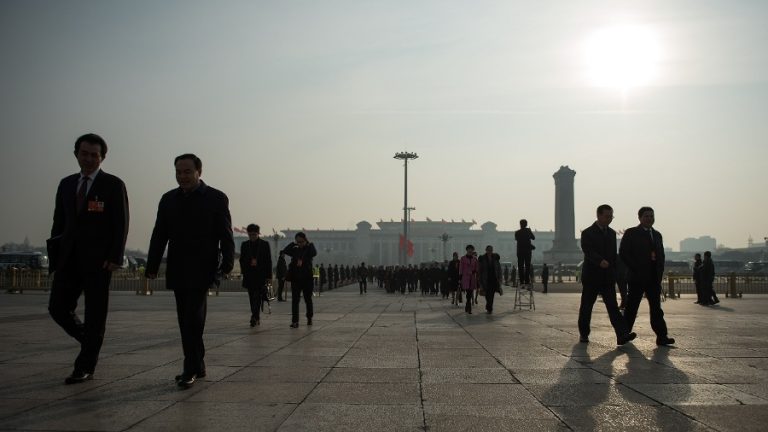
China’s legislature stripped 14 officials of their seats in a single late-night notice on June 26, 2026. The Standing Committee of the National People’s Congress, the permanent body of China’s rubber-stamp legislature, closed its 23rd session that afternoon, and at 11:12 p.m. the Party’s official news agency, Xinhua, issued the committee’s eighteenth public notice, ending the delegate status of all 14.
They were Fei Gaoyun, Guo Yonghang, Li Yunze, Hu Henghua, Hou Jianguo, Huang Wei, Ma Xingrui, Xu Xueqiang, Li Fengbiao, Wang Kangping, Yin Hongxing, Guo Puxiao, Zhang Minghua, and Li Lanxiang.
Five had been placed under investigation between March and May 2026. Hu Henghua, Chongqing’s mayor and deputy Party secretary, was investigated on March 20, and Guo Yonghang, a vice chair of Guangdong’s political advisory body, a week later. Ma Xingrui, a member of the Party’s Politburo and former Party chief of the Xinjiang region, was placed under investigation on April 3. That same month, reports emerged that Li Yunze, head of the National Financial Regulatory Administration, had been demoted over suspected disciplinary violations. On May 6, Fei Gaoyun, a member of Anhui’s Party leadership and Party secretary of Hefei, was investigated.

Six senior generals were removed, part of a military purge that has felled 42 since 2023
Six of the 14 removed lawmakers were senior military officers, a sign that Xi Jinping’s purge of the armed forces is still widening. They were Xu Xueqiang, an Air Force general who headed the Equipment Development Department of the Central Military Commission, China’s top military command body, and who also led the country’s crewed space program; Wang Kangping, an Air Force lieutenant general and former commander of the Joint Logistics Support Force; Li Fengbiao, an Army general and former political commissar of the Western Theater Command; Yin Hongxing, an Army lieutenant general and former political commissar of the Southern Theater Command’s ground forces; Guo Puxiao, an Air Force general and its former political commissar; and Zhang Minghua, an Army lieutenant general who commanded the Cyberspace Force.
Three of them, Xu Xueqiang, Li Fengbiao, and Guo Puxiao, had already missed the military delegation’s meetings at the Two Sessions, the annual gatherings of China’s legislature and its top advisory body, in March 2026, months before their removal.
Success
You are now signed up for our newsletter
Success
Check your email to complete sign up
The military purge has escalated steadily since 2023. By now, 42 senior officers have been publicly removed as delegates to the 14th National People’s Congress, among them 19 full generals, 17 lieutenant generals, and six major generals.

Why Zhang Youxia and Liu Zhenli kept their seats while 14 others were removed
Zhang Youxia and Liu Zhenli, the two most senior military figures investigated this year, kept their seats on China’s legislature even as 14 other officials lost theirs. On Jan. 24, 2026, the Party announced that the two men had fallen: Zhang Youxia, a member of the Politburo and a vice chairman of the Central Military Commission who ranks among the most powerful figures in the armed forces, and Liu Zhenli, a member of the commission and chief of the Joint Staff Department, the military’s top operational command. The Standing Committee has met four times since then, around Feb. 4, Feb. 25 to 26, April 27 to 30, and June 23 to 26, and each session removed delegates. Zhang and Liu kept their seats throughout, and their names still appear on the 237-member list of military and armed-police delegates on the legislature’s website.
The U.S.-based commentator Zhang Tianliang argued on his online program that the two men may still hold their delegate status because the investigation into them is ongoing. If Xi wanted to let them off lightly, Zhang said, he could close the inquiry now, settle on a pair of relatively minor charges, and announce a verdict, which would trigger the loss of their seats. That this has not happened, in Zhang’s reading, shows that their cases are severe and that investigators are still digging, perhaps in ways that will pull in others.

Why analysts link Xi Jinping’s purge to the Party’s 2027 congress
Analysts link the scale of Xi Jinping’s purge to the jockeying ahead of the Chinese Communist Party’s 21st National Congress, expected in 2027. At a forum in Taiwan on June 27, reported by the island’s Central News Agency, Wu Guoguang, a senior fellow at Stanford University’s Center on China’s Economy and Institutions, gave his reading of why Xi has moved so aggressively against officials in local government, finance, and the military. The event, hosted by the Changfeng Cultural and Educational Foundation, marked 60 years since the Cultural Revolution and examined its echoes in China’s present leadership.
Wu said the force of Xi’s campaign was surprising, reaching well beyond what he needed in his first term, when he was still consolidating power. In Wu’s view, the purges are closely tied to preparations for the 21st Congress. As that meeting nears, he said, the Party’s factions will compete harder to install their own people, and with so many lucrative posts in play, younger officials will need to attach themselves to a patron to win promotion, which threatens to sharpen the infighting among the factions as the purge runs on.