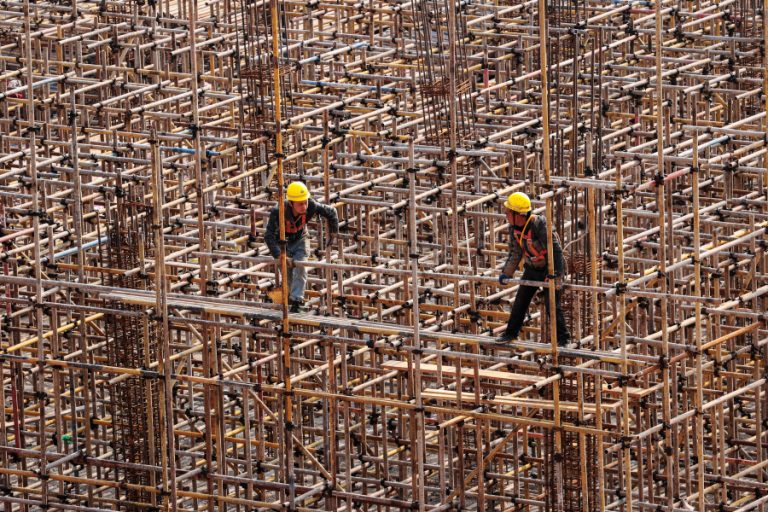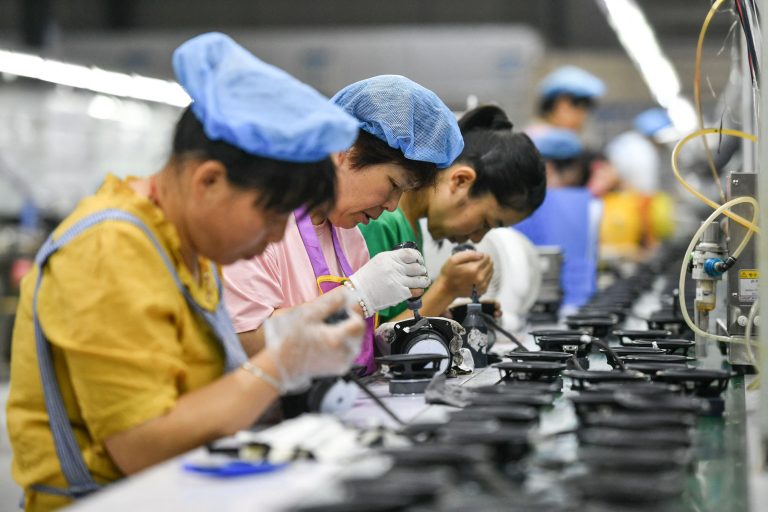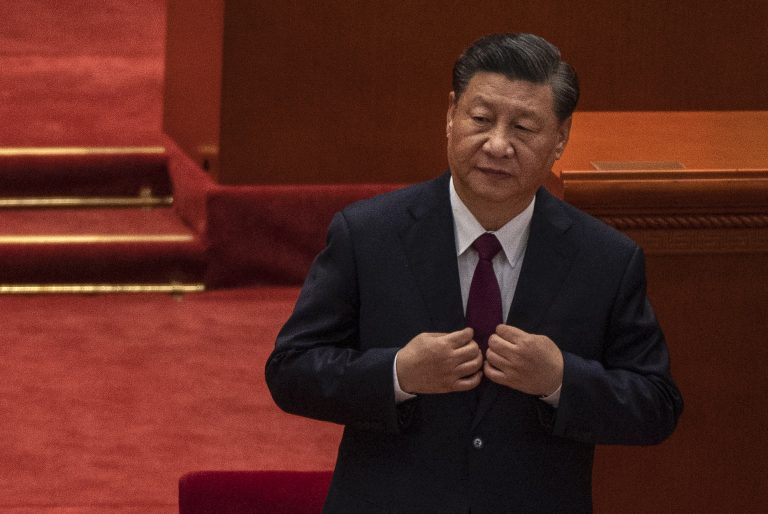
The Chinese Communist Party’s leading theoretical journal, Qiushi, devoted its latest issue to nearly a decade of Xi Jinping’s speeches on manufacturing and what Beijing calls the “real economy.” The collection offers an unusually clear window into Xi’s economic priorities. Manufacturing is presented not simply as an engine of prosperity, but as the foundation of China’s long-term security, technological self-sufficiency, and geopolitical resilience.
That interpretation is echoed by many outside analysts. Writing for the Hudson Institute in June, former U.S. Deputy National Security Adviser for Strategy Nadia Schadlow argued that Beijing increasingly treats advanced manufacturing as a strategic asset rather than a purely commercial sector. In her view, China has shown a willingness to accept lower financial returns in exchange for long-term technological and industrial advantage.
Manufacturing occupies a central place in Xi’s economic vision
The tenth issue of Qiushi for 2026 republishes Xi’s remarks on industrial development spanning December 2016 through December 2025 under the title “Building a Stronger, Better, Bigger Real Economy.”
Throughout the collection, Xi repeatedly calls for China to “accelerate the development of advanced manufacturing,” deepen the integration of artificial intelligence, big data and the internet with industry, and raise the technological sophistication of Chinese manufacturing. Manufacturing, he says, is “the foundation on which the nation stands and the basis on which it grows strong,” while reaffirming the goal of turning China into a global manufacturing powerhouse.
The collection closes on a note that is as much geopolitical as economic. Xi argues that strengthening manufacturing will allow China to remain “undefeated amid the wind and waves” — a familiar phrase in Party rhetoric referring to an increasingly uncertain international environment.
Success
You are now signed up for our newsletter
Success
Check your email to complete sign up
That emphasis reflects a broader pattern in Xi’s speeches over the past decade. Economic development is not primarily about prosperity but serves as a prerequisite for national security and the long-term stability of Communist Party rule.
The real target is regime stability, not people’s livelihoods
Xi’s invocation of unspecified dangers reveals the campaign’s real motive: not the welfare of Chinese citizens, but the durability of CCP rule. The Party has long claimed that hostile foreign powers are bent on its destruction — a fear it has carried since its founding.
The Nine Commentaries on the Communist Party, a series of essays published by the Epoch Times cataloging the Party’s history of violence and deception, describes this directly: “From the day of its founding, the Communist Party has struggled from one crisis to the next. Its greatest crisis has always been a crisis of survival. To exist is to fear, an eternal sense of crisis. Fear born of crisis has become the Communist Party’s highest interest: the difficult task of preserving the Party’s existence and power as a ruling clique.”
Why Beijing will accept losses that American investors won’t
In a June 2026 Hudson Institute essay, “Don’t Let China Buy Into America’s Industrial Future,” Nadia Schadlow — former deputy national security adviser for strategy and a co-author of the 2017 National Security Strategy — wrote that modern manufacturing is no longer a matter of building more factories. A new industrial ecosystem is taking shape that fuses materials science, chemistry, hardware, software, robotics, artificial intelligence, and enormous flows of data. The factories of the future will not simply produce goods. They will generate information, shape supply chains, and determine military and economic advantage — at once production facilities and data systems.
The national security implications, she writes, are direct: Chinese companies continue acquiring firms across America’s industrial base while Beijing’s authoritarian system gives its own capital inherent advantages.
Schadlow cites research from the Rhodium Group showing that Beijing increasingly factors “non-market considerations” into investment decisions, often ranking strategic objectives above profitability. She writes, China, however, has demonstrated a willingness to tolerate lower returns in pursuit of strategic objectives. According to the Rhodium Group, Beijing has increasingly inserted ‘non-market considerations’ into investment decisions, prioritizing strategic goals at the expense of profitability. That creates an uneven playing field for American capital, which still largely operates under market expectations for returns and efficiency. Competing against a state-backed system willing to absorb losses could make it more difficult to sustain private investment in U.S. manufacturing.
Xi’s manufacturing push has nothing to do with raising living standards. The CCP can sustain money-losing industrial strategies because it has conscripted the entire Chinese population to cover the bill — those losses land on ordinary citizens. The Party has a phrase it repeats constantly in propaganda: “the people are the greatest source of confidence behind our rule.”
In slang that has spread across Chinese internet forums in recent years, ordinary citizens call themselves “leeks,” cut down again and again by those who profit from them; “oxen and horses,” beasts of burden worked without complaint; “slaves”; “cannon fodder”; “organ donors,” people whose entire value to the system lies in what can be extracted from them. The Party’s claim that the people are its “greatest source of confidence” is not reassurance. It is a description of the arrangement.
China is already the world’s largest market for industrial robots. Its latest five-year plan designates advanced manufacturing as the primary engine for raising productivity, built around what the Party calls “new quality productive forces”: growth driven by robotics, artificial intelligence, and intelligent manufacturing systems. A parallel “AI plus manufacturing” initiative aims to embed autonomous AI agent systems throughout production lines and supply chains. Beijing has set a target of integrating artificial intelligence into 90 percent of national economic activity by 2030.The Chinese Communist Party treats advanced manufacturing as a strategic asset, not a commercial industry. China is not a commercial competitor. It is a state. Any market it enters can be neither free nor fair.