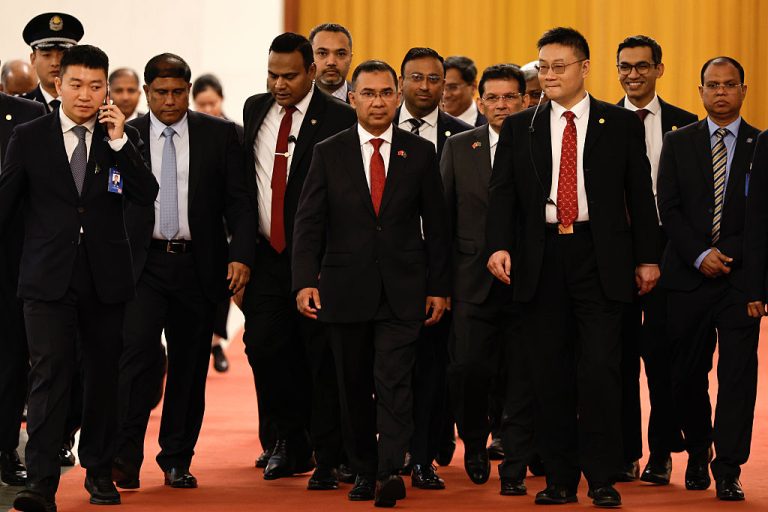
Bangladeshi Prime Minister Tarique Rahman met Chinese leader Xi Jinping on Tuesday, June 24, during a four-day visit to Beijing that began on Sunday. The two leaders jointly announced the creation of a “China-Bangladesh community with a shared future in the new era” while signing a series of agreements on river water management, flood mitigation, and cooperation in the green and digital economy.
“The vision of building a community with a shared future for humanity and the four global initiatives put forward by President Xi are important to maintaining world peace, development and international fairness and justice,” Rahman said, according to a Xinhua report released by China’s State Council. “Bangladesh fully supports them.”
Xi’s “Community With a Shared Future for Humanity” began as a foreign policy concept in 2013 before evolving into a core doctrine of Xi Jinping Thought, becoming embedded in both Chinese Communist Party ideology and China’s constitution. It serves as the overarching framework for Xi’s four signature initiatives — the Global Development Initiative (GDI), Global Security Initiative (GSI), Global Civilization Initiative (GCI), and Global AI Governance Initiative (GAIG). China’s Belt and Road Initiative (BRI) remains a separate program.
Tanbirul Islam, a Dhaka-based geopolitical analyst, told Vision Times that the announcement of a “China-Bangladesh community with a shared future in the new era” carries geopolitical significance, particularly under the new Rahman administration.
Rahman became Bangladesh’s 11th prime minister on Feb. 17 following nearly two years of political upheaval after Sheikh Hasina was forced from office in February 2024. An interim government subsequently oversaw electoral reforms before organizing the 2026 election, in which Rahman’s Bangladesh National Party (BNP) came power.
Success
You are now signed up for our newsletter
Success
Check your email to complete sign up
Islam noted that “‘China-Bangladesh Community with a Shared Future in the New Era’ is a diplomatic expression that China uses in its foreign policy,” adding that Bangladesh continues to maintain strong bilateral partnerships with India.
Dhaka also participates in regional organizations such as the South Asian Association for Regional Cooperation (SAARC) and the Association of Southeast Asian Nations (ASEAN).
“China certainly will try to take advantage of the new government [in Bangladesh] when the US- Israel-Iran war has already made a different dimension in world politics and economy,” Islam said.
Bibhu Prasad Routray, former deputy director of India’s National Security Council Secretariat and current director of the Mantraya Institute for Strategic Studies (MISS), told Vision Times that the “Community With a Shared Future” framework has previously been emphasized in China’s relationship with Pakistan.
“This terminology signifies a significant elevation from the previous ‘strategic partnership’ with Dhaka, indicating a move toward a deeper political and security alignment,” Routray said, adding that it also sends an important geopolitical signal to India.
“The post-Hasina government in Dhaka is intentionally diversifying its alliances away from New Delhi.”
One-China policy and Taiwan
Rahman also reaffirmed Bangladesh’s support for the CCP’s one-China policy, stating that Dhaka recognizes Taiwan as an “integral” part of China.
According to Islam, Islam said the statement reflects the foreign policy direction of Bangladesh’s new government, while Routray argued that it also serves Rahman’s broader political objectives in strengthening ties with Beijing.
“Bangladesh reaffirmed its strong commitment to the one-China principle, and recognized that there is but one China in the world, Taiwan is an inalienable part of the territory of the People’s Republic of China, and the Government of the People’s Republic of China is the sole legal government representing the whole of China,” the joint statement released on Thursday, June 26, said.
The statement added that Bangladesh is “resolutely opposed” to any form of “Taiwan independence” and firmly supports the efforts of the “Chinese government in achieving national reunification.”
Islam said Bangladesh is not adopting the one-China policy for the first time. Rather, the Rahman-Xi meeting reaffirmed a position Dhaka has maintained for decades whileBRI
expanding economic cooperation with Beijing through trade, investment, and BRI-linked infrastructure projects.
He noted that a previous BNP-led government allowed Taiwan to establish a commercial and economic representative office in Dhaka between 2001 and 2006. The office was intended to facilitate trade rather than diplomatic relations. Since then, Bangladesh has maintained official relations with Beijing while allowing limited commercial and people-to-people exchanges with Taiwan.
“But that decision created a huge misunderstanding and gap with the BNP led government and now after 25 years the BNP government is trying to bring China in confidence with the reaffirmation of One China policy,” Islam said.
Routray said describing Taiwan as an “integral” part of China is standard language in joint statements issued by many countries that maintain diplomatic relations with Beijing. What makes the latest declaration noteworthy, he said, is the broader geopolitical context.
“It is part of a broader package that includes improved relations, exploration of defence dialogue, and infrastructure agreements. This context suggests that the statement is less of a diplomatic formality and more of a signal of comprehensive alignment,” he said.
From Beijing’s perspective, Routray argued, the statement represents a low-cost but high-value diplomatic gain. Bangladesh’s position on Taiwan carries little domestic political cost while delivering a symbolic victory for China.
“However, from India’s security standpoint, this indicates that Dhaka is adjusting its foreign policy to align more closely with Chinese preferences across various areas, not only in connectivity and defence purchases,” he said.
Deepening Belt and Road cooperation
Rahman and Xi agreed on multiple other sectors for cooperation, including infrastructural connectivity under the Belt and Road Initiative; trade, e-commerce, industrial and supply chains, and investment. Other areas for collaboration included scientific and technological innovation, information and communications, green energy, photovoltaic technology, disaster prevention and mitigation, and addressing climate change.
Among the proposals discussed was the China-Myanmar-Bangladesh Economic Corridor (CMBEC), a long-standing connectivity project under the BRI framework. According to The Business Standard, a Bangladeshi newspaper, Dhaka has responded positively to the proposal and is currently reviewing it.
Tanbirul Islam said the project could offer significant economic benefits for Bangladesh but cautioned that Rahman’s government is unlikely to approve it without carefully weighing its strategic implications. The Business Standard quoted Bangladeshi Foreign Ministry Adviser Humayun Kabir as saying on Friday, July 3, that the government would proceed only if they determine the project serves Bangladesh’s national interests.
“Direct Bus/ rail communication with China will increase huge business opportunities for both the countries. But there is a question of sovereignty and on top of that [there are] regional issues. Certainly the Bangladeshi Prime Minister will visit India and I would like to wait till then,” Islam said.
Routray said the concept for the corridor originated in the 1990s as a proposed China-Bangladesh connectivity route before evolving into the current China-Myanmar-Bangladesh Economic Corridor. The initiative later stalled amid India’s objections to BRI-related projects.
“For Bangladesh, this project could position Chittagong and Mongla ports as the coastal terminus of a transit route connecting Yunnan to the Bay of Bengal, potentially attracting Chinese investment and manufacturing supply chains,” Routray said.
Chittagong and Mongla are Bangladesh’s two principal seaports. Chittagong, the largest, handles nearly 70 percent of the country’s maritime trade, while Mongla has undergone significant infrastructure upgrades in recent years.
The ports occupy a strategically important position on the Bay of Bengal, which connects to the Strait of Malacca — one of the world’s busiest maritime chokepoints linking the Indian Ocean with the South China Sea and the Pacific Ocean. According to the Center for Strategic and International Studies (CSIS), roughly 25 to 30 percent of global maritime trade passes through the strait each year, including about 21 percent of China’s imports and 14 percent of its exports in 2024.
Routray, however, believes that India’s concerns about the project don’t primarily arise from the economic perspective, but from its proximity with India’s northeastern region, which borders heavily on Bangladesh and Myanmar, as well as China.
“When combined with existing initiatives, the CMBEC contributes to what Delhi perceives as an expanding Chinese logistics presence from Yunnan to the Bay of Bengal,” he said.
‘Comprehensive management’ of the Teesta River
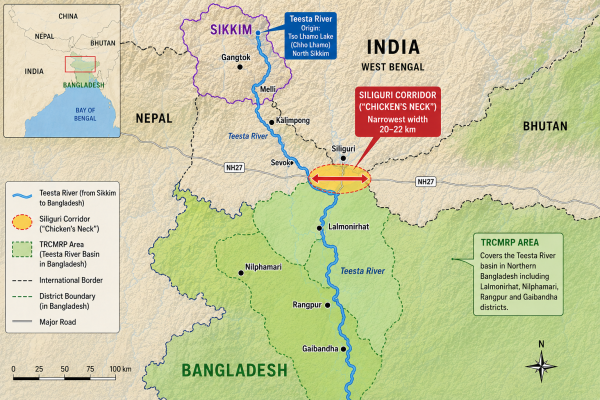
Another area of cooperation that drew significant attention was the Teesta River Comprehensive Management and Restoration Project (TRCMRP). The Teesta is one of Bangladesh’s most important transboundary rivers, originating in the Indian state of Sikkim in the Himalayas. Analysts say the project carries strategic implications for India because of its location in northern Bangladesh near the country’s northeastern border.
Priyajit Deb Sarkar, a London-based geopolitical analyst and author specializing in Bangladesh, told Vision Times that the Teesta project is particularly sensitive for India because of its proximity to the Siliguri Corridor — often referred to as the “Chicken’s Neck” — that connects mainland India with its northeastern states.
However, during a press briefing in Dhaka on July 2, Chinese Ambassador to Bangladesh Yao Wen described the initiative as a “livelihood cooperation” project. According to The Business Standard, Yao said China would work with Bangladesh’s Economic Relations Division (ERD) to conduct a comprehensive scientific feasibility study.
“China is committed to working with Bangladesh by sending top experts so that we can carry out a scientific feasibility study. You will see tangible progress very soon regarding this feasibility study,” Yao said.
Routray said the project also comes as Bangladesh and India remain deadlocked over a long-delayed bilateral agreement on sharing Teesta River water, an issue that has remained unresolved for more than a decade because of opposition from India’s West Bengal state government.
“The green-economy, digital, and MoU-heavy cooperation pieces are fairly standard BRI-era instruments. But the Teesta piece specifically converts a domestic river-management gap into a strategic opening for a third country near a defence chokepoint, which is why it is bound to concern New Delhi regardless of the stated humanitarian and engineering purpose,” he said.