Sixty years after Mao Zedong launched the Cultural Revolution, the Chinese Communist Party still discourages citizens from openly memorializing or debating the campaign. Independent historian Fu Guoyong argues that the era’s true moral witnesses were a handful of little-known people who spoke the truth as it was happening, while the powerful officials around them stayed silent.
In September 1966, a 19-year-old university student sat down and wrote a letter to Mao Zedong telling him his revolution was a lie. Then she swallowed four bottles of pesticide, certain she would not live to see what came next.
That year, a political storm broke out of Zhongnanhai, the walled compound in Beijing that houses China’s top leadership, and swept across the country. Cunning party officials, decorated generals and powerful regional strongmen alike lost, almost overnight, their capacity for ordinary judgment. They bowed their heads and submitted to fate. Liu Shaoqi, the head of state whom the campaign would soon destroy, is remembered for one line, spoken to his wife as guards led them away to be separated for the last time: “At least history is written by the people.”
Most senior officials caught up in the Cultural Revolution’s opening months had no idea what Mao was actually trying to accomplish, let alone the will to challenge a movement that would consume the entire nation. History records only a few people, all of them obscure at the time, who said plainly what was happening and pointed at the emperor’s bare skin. Some were imprisoned. Others were shot. Their names deserve to be remembered: Wang Rongfen, Liu Wenhui, Yu Luoke, and Lu Hong’en.
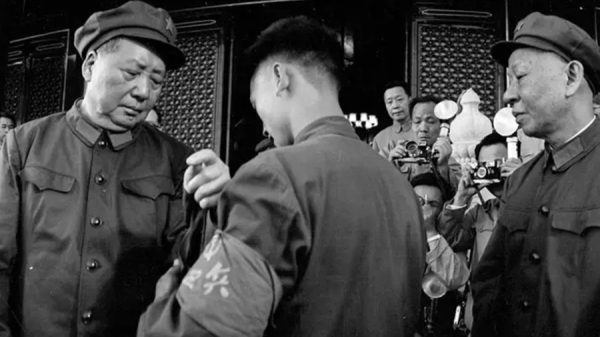
A 19-year-old student wrote to Mao Zedong to reject the Cultural Revolution
Wang Rongfen was a fourth-year German-language student in the Eastern European Languages department at the Beijing Foreign Studies Institute. On Sept. 24, 1966, she wrote Mao a short letter stating plainly that “the Cultural Revolution is not a mass movement; it is one man using the barrel of a gun to move the masses.” In the same letter, she formally announced she was quitting the Communist Youth League.
Success
You are now signed up for our newsletter
Success
Check your email to complete sign up
A month earlier, she had attended the Aug. 18 rally at Tiananmen Square, the mass gathering at which Mao made his first public appearance reviewing the newly formed Red Guards and effectively launched their nationwide rise. Listening to Defense Minister Lin Biao address the crowd that day, Wang found herself thinking of a recording she had heard of a Hitler speech. She later said she saw almost no difference between the two. Walking away from Tiananmen Square, she felt with total certainty that the country was finished and that the world had become too filthy to keep living in.
She mailed her letter to the party’s Central Committee, to the Communist Youth League leadership, to her own school administration and to Mao himself. Then she drank the pesticide, prepared to die. When she woke, she was in a public security hospital, and from there she was sent to prison.
She was held for nearly 10 years before finally being sentenced, in January 1976, to life imprisonment. She was released on March 11, 1979, after 12 and a half years in custody, among the first cases cleared in a review of major political cases. “I went in at 19, a college senior,” she said later. “I came out at 33.” She went on to become a scholar of the German sociologist Max Weber at the Institute of Sociology of the Chinese Academy of Social Sciences. In June 1989 she settled in Germany, where she still lives. Unlike Yu Luoke and the others who exposed the same lie and paid for it with their lives, she survived to see the madness rise and finally collapse.
A shipyard worker branded a ‘rightist’ was executed for opposing the campaign
Around the same time Wang Rongfen described the Cultural Revolution as one man moving the masses at gunpoint, a 28-year-old Shanghai shipyard worker named Liu Wenhui was writing a document tens of thousands of characters long titled “Refuting the Sixteen Points of the Cultural Revolution.” He wrote without euphemism that the campaign “raped public opinion and persecuted the people on a national scale,” describing officials climbing the Tiananmen rostrum to whip up a frenzied Red Guard movement, glorify militarism, silence the press, and crush intellectuals while the country starved in poverty and ignorance. The Shanghai court that later convicted him would cite, as proof of his guilt, the fact that he had “extensively promoted” the bourgeois values of peace, democracy, equality, and fraternity. He and his younger brother, Liu Wenzhong, copied the document by hand 14 times and mailed it anonymously to 14 leading universities, including Peking University, Tsinghua University, and Fudan University.
Liu Wenhui’s break with the party had started nearly a decade earlier. In 1957, at 20, after he wrote posters accusing his shipyard’s leadership of bureaucratic abuse and corruption, he was labeled a “rightist,” a political stigma applied to intellectuals and workers purged that year for criticizing the party during the short-lived Hundred Flowers Campaign. He lost his position as a workshop team leader, was expelled from the Communist Youth League and was sent to work at a machinery plant on the remote Shengsi Islands off the Zhejiang coast. In February 1966, after authorities discovered he had been planning to flee the country, he was formally classified a “current counterrevolutionary” and placed under three years of supervised control. That spring he was sent back to Shanghai under surveillance. He never stopped thinking independently about where the country was headed.
Where Wang Rongfen’s clarity came from instinct and common sense, Liu Wenhui’s came from years of reading: Marx, Engels, Lenin, the complete works of Lu Xun, and the writing of the liberal philosopher Hu Shi. He drafted a wall poster that his brother pasted up under cover of darkness on the campus of Shanghai Jiao Tong University, arguing that doubt was the foundation of intellectual freedom and that a free, independent person or organization must be permitted to question every idea and doctrine before accepting it, rather than following blindly.
Hu Shi’s influence is unmistakable in that argument, and a voice that clear-eyed and rational was rare in a country given over to mass worship of one man. Liu Wenhui understood exactly what he was risking. He told his brother he was willing to become a modern-day Tan Sitong, the 19th-century reformer executed for his beliefs, and that he believed resisting tyranny, in any country and at any point in history, had always required someone willing to sacrifice themselves to rouse a frightened, passive population into action. He was ready, he said, to be that person.
On Nov. 26, 1966, Liu Wenhui and his brother were arrested. The Shanghai Intermediate People’s Court sentenced Liu Wenhui to death on March 9, 1967. He was executed on March 23 of that year, and he was not exonerated until 1982.

A conductor and an essayist were both shot for speaking the truth
Lu Hong’en, a conductor who had studied music in Europe before returning to lead the Shanghai Symphony Orchestra, used his final interrogation, on April 20, 1968, to deliver an unrestrained address lasting nearly 20 minutes. “I want to live, but I refuse to go on living like a walking corpse,” he said. “Give me liberty, or give me death. The Cultural Revolution is tyranny. It is calamity. It is catastrophe. I refuse to cling to life under tyranny, calamity and catastrophe.” He called the campaign “a hell-fire that Mao Zedong has brought down upon the Chinese people, a feast of human flesh laid out for them,” and said that if this was what socialism looked like, he would rather be branded a counterrevolutionary and an enemy of socialism than live as a docile subject of Mao’s personality cult. He was executed by firing squad in Shanghai on April 27, 1968. Liu Wenzhong, Liu Wenhui’s younger brother, was imprisoned in the same facility and years later recorded Lu Hong’en’s final words in his memoir, “The Stormy Road of Life,” published in Macao in 2004.
Yu Luoke was shot for a different reason. His essay “On Family Background” challenged the doctrine of “bloodline theory,” the unofficial creed holding that political worth and loyalty passed down through family lineage, so that children of “red” revolutionary families were inherently trustworthy while children of landlords, capitalists, or purged rightists were tainted regardless of their own conduct or beliefs. Yu Luoke had doubted the Cultural Revolution from its earliest days, finding what was happening around him too extreme to accept at face value. He was one of the few clear-headed and resolute thinkers of that era. He was arrested in January 1968 and shot two years later, on March 5, 1970, before a rally of 100,000 people at Beijing’s Workers’ Stadium. Children of senior officials were said to have celebrated his execution openly, some reportedly remarking that Mao was still protecting the interests of his own class.
Compared with Yu Luoke, Liu Wenhui has received strikingly little attention. His brother’s memoir, published in a small print run in Macao, remains almost unknown. Only one article, in the magazine Open, appears to have told his story to a wider audience.
The Cultural Revolution remains forbidden territory in China 60 years later, a subject the state will not allow its people to openly commemorate, examine, or debate. A government that must forbid an entire nation from remembering an event has, by that very act, confirmed why the event must never be forgotten. Remembering it starts with Liu Wenhui and Yu Luoke, who died for what they saw, and with Wang Rongfen, who survived to describe it.
According to one account, the decision to execute Yu Luoke was sent up through Xie Fuzhi, the minister of public security, and personally approved by Mao Zedong himself. (See Tao Luosong, “Dance of Life,” Hong Kong: Xinghui Book Co., July 2005, p. 107.)