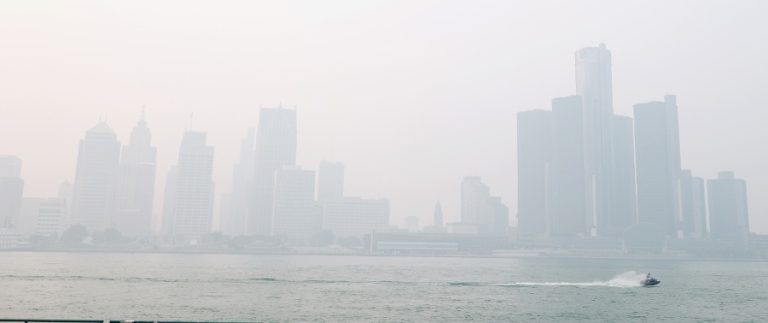
According to Reuters, smoke from wildfires burning across Canada has triggered a major cross-border air pollution crisis in the United States.
Hundreds of wildfires remain active across Canada, sending vast plumes of smoke over the border and into the northeastern and midwestern United States. Air quality has reached dangerous levels in cities including New York, Detroit, Chicago, and Minneapolis, prompting authorities to issue pollution alerts and advise residents to limit outdoor activity and wear N95 or KN95 masks when necessary.
More than 850 wildfires send smoke across the border
According to the Canadian Interagency Forest Fire Centre, nearly 850 wildfires were active across Canada as of this week, with many still classified as out of control. Several communities near Lake Superior in Ontario have been forced to evacuate.
Satellite animations released by the U.S. National Oceanic and Atmospheric Administration show a vast gray band of smoke spreading south from eastern Canada under the influence of the jet stream.
The smoke has blanketed the Great Lakes region, the northeastern United States, and parts of the East Coast, forming a massive swirling plume visible from space.
Success
You are now signed up for our newsletter
Success
Check your email to complete sign up
NASA’s Earth Observatory also released satellite images showing smoke continuing to move into the Midwest and Northeast.
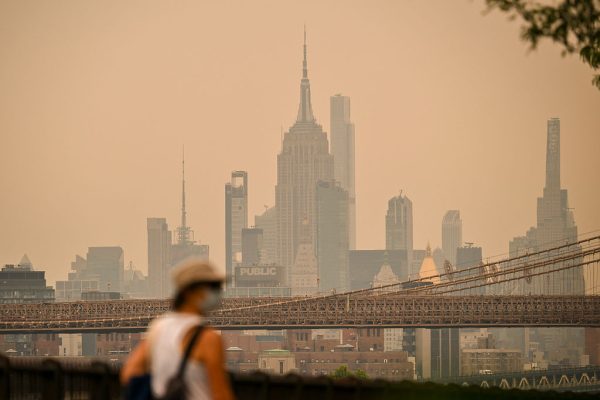
New York City’s sky turned an eerie orange-yellow on July 17 as thick smoke settled over the city. Some residents reportedly mistook the orange-glowing sun for the moon.
The Statue of Liberty, the Manhattan skyline, the Bronx, and other areas were obscured by heavy haze, while many commuters wore N95 masks.
The most polluted major city in the world
According to global air quality monitoring organization IQAir, Detroit’s Air Quality Index briefly surpassed 600, making it the most polluted major city in the world at the time.
Minneapolis and Chicago recorded AQI levels of approximately 289 and 259, respectively, placing both cities in the “very unhealthy” category.
Under U.S. Environmental Protection Agency standards, an AQI reading above 300 is considered “hazardous.”
Residents described the air as carrying a strong burnt smell, comparing it to “living beside a campfire that never goes out.” Some said the smoke was noticeable even indoors.
Michigan issued a statewide air quality alert, while Pennsylvania declared a Code Red warning. The Illinois Environmental Protection Agency also issued a “Red Air Pollution Action Day” for the Chicago metropolitan area.
The Minnesota Pollution Control Agency said PM2.5 concentrations in the Twin Cities had reached their highest recorded levels. Fine ash was also reportedly seen falling in some areas.

Wildfire smoke may carry toxic chemicals and metals
Experts warned that wildfire smoke contains not only fine particulate matter such as PM2.5, but also chemicals, heavy metals, and other toxic particles released when buildings, vehicles, and plastic materials burn.
As a result, wildfire smoke may pose greater health risks than ordinary urban air pollution.
The Associated Press reported that New York had opened cooling centers and begun distributing high-grade masks free of charge.
Authorities across affected areas urged older adults, children, pregnant women, and people with heart or lung conditions to remain indoors whenever possible, close windows and doors, and use air purifiers to reduce their exposure.
Canadian fire officials said high temperatures, dry conditions, and strong winds were continuing to fuel the fires.
Alberta Fire Chief Randy Schroeder told media outlets that wildfires now “burn faster and last longer than they did in the past.” As president of the Alberta Fire Chiefs Association, Schroeder has repeatedly warned that fire seasons in the country are starting earlier, lasting longer, and becoming more destructive due to changing conditions.
Fire crews are working around the clock, but officials said the severe conditions are unlikely to improve significantly in the near term.