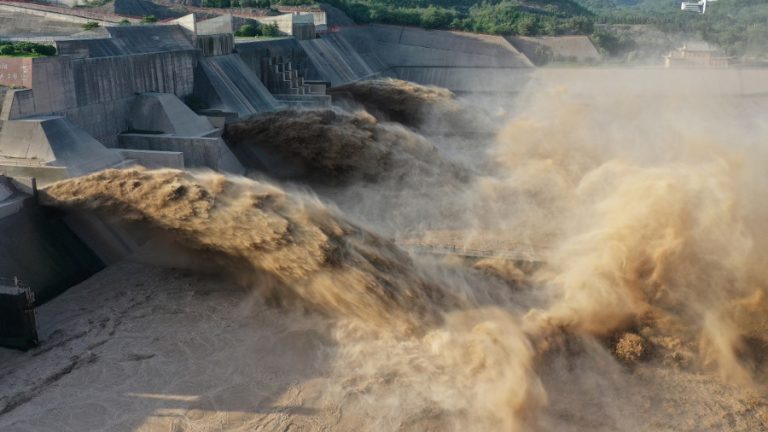
The rain began in early August 1975 and did not let up for days. A dying typhoon had drifted inland, come to a standstill between two mountain ranges in southern Henan, and poured rain over the plain hour after hour. In one day it dropped more water than the region normally receives in a year. The dams built a generation earlier to hold back the Huai River were never meant to take a fraction of that.
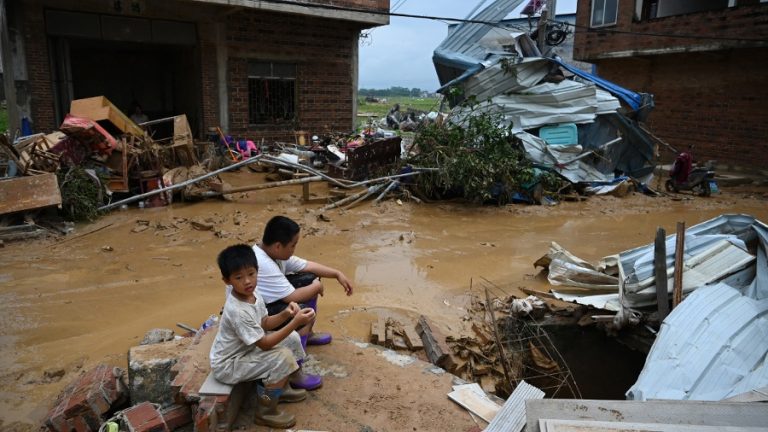
About an hour after midnight on Aug. 8, the water at the Banqiao reservoir rose over the crest of the dam and split the earthen wall open. What came through was a wave several meters tall and more than ten kilometers wide, moving fast across flat country. It took the villages first, then the roads, the bridges, the fields. Most of the people in its path were asleep, with no idea the reservoir above them had burst. By the time the water reached them, all they could do was climb onto rooftops, into trees, and whatever high ground they could reach, and wait for rescue that came slowly, when it came at all.
Mao-era water policy chose storage over safety
The dams that failed that night dated from the early 1950s, when the Huai River flooded year after year and the new Communist government made water control a national priority. Banqiao, Shimantan, and the rest went up fast, meant to do everything at once: stop floods, feed irrigation canals, and generate power. Nobody in China had much experience building large reservoirs then, and much of the work moved at the tempo of a political campaign rather than a construction project. The flaws went in with the concrete.
The prevailing approach was to store as much water as possible rather than release it. With every cadre under pressure to raise harvests, storage capacity became the number that mattered, and the unglamorous work of flood release, drainage, and dredging slid down the priority list. People took to calling Banqiao “the Iron Dam,” a nickname that did real damage: if a structure supposedly could not fail, there was little reason to worry about maintenance, freak weather, or the towns downstream.
Banqiao stood on the upper Ru River and held some 492 million cubic meters when full. The engineers who designed it were working with thin rainfall records and badly underestimated the worst a storm could do. Crews reinforced the structure in later years, but they never corrected the underlying flaw: a low design standard and a spillway too small to release water fast enough in a major flood. A dam is not safe the day the ribbon is cut. It stays safe only through constant inspection, repair, and drills, and in that political climate, anyone who warned that a flagship project might break risked being branded a defeatist.
READ MORE:
- Guangxi Flood Survivors Call Dam Collapse a Man-Made Disaster, Dispute Official Death Toll
- Guangxi Flood Disaster Raises Questions Over Infrastructure, Emergency Response
- As Guangxi Flood Victims Waited for Rescue, Beijing Announced New Aid to Venezuela
Success
You are now signed up for our newsletter
Success
Check your email to complete sign up
A record rainfall, then a chain of collapsing dams
By the first week of August 1975, the remains of Typhoon Nina had stalled between the Funiu and Tongbai mountains, dropping intense rain over the same ground for days. Rivers, reservoirs, and flood basins across the region reached their limits together. At the eye of it, near the town of Linzhuang, gauges caught more than a thousand millimeters of rain in twenty-four hours and over eight hundred in six, enough to break the world record for six-hour rainfall set in Pennsylvania in 1942. Banqiao had been built to survive a once-in-a-thousand-years storm, which the planners pegged at about 300 millimeters a day. What fell on it was closer to a one-in-two-thousand-year event, several times worse than anything it was designed to hold.
Banqiao could not let the water out fast enough. Its five sluice gates and an undersized secondary spillway did not have the capacity to pass the inflow, and downed communication lines left the dam cut off from higher command as the crisis peaked. The reservoir overtopped by roughly a foot in the small hours of Aug. 8 and gave way. Within hours the Shimantan reservoir, the medium-sized Zhugou and Tiangang dams, and dozens of smaller reservoirs failed the same way, each collapse forcing the next.
The flood did not stay within a single channel. It spread out as one moving wall and swallowed whole villages in minutes. Almost nobody downstream knew the dams above them had already broken.
A death toll Beijing has never fully admitted
How many died has been argued over ever since. The number Beijing eventually settled on was about 26,000, all charged to the flood wave itself. Twelve days in, the Henan provincial Party committee drew up a rough count of some 85,600 dead. Add the deaths that came afterward, from disease and hunger, and the total climbs into a range most independent accounts put between 170,000 and 240,000.
The figure of 230,000 came from eight senior economists and engineers on China’s national political advisory body, among them the hydrologist Lu Qinkan, who had opposed the Three Gorges dam project. Their estimate barely moved inside China and reached the wider world only through a 1995 Human Rights Watch report. Around ten million people were caught up in the flood. The water covered some 12,000 square kilometers, ran through about thirty cities and counties, flattened millions of houses, and ripped out stretches of the Beijing-Guangzhou railway, cutting the line for days. The figures give the scale and none of the rest: the families who lost their people, their land, and everything they remembered in a single night.
READ MORE:
- Xi Jinping Rewrites Communist Party History to Place Himself Alongside Mao
- Following Xuanzang Across the Sacred Geography of a Lost Buddhist World
- The Unusual Forces Behind China’s Recent Crackdown on Academic Fraud
Hunger and disease finished what the flood started
The water receding was not the end of it. Flooded fields that would not drain, spoiled grain, poisoned wells, spreading sickness, and rescuers who could not get through set off a slower catastrophe on top of the first. For the people living it, the dam break was the opening of a siege that ran for weeks. Survivors clung to embankments and rooftops with nothing clean to drink and nothing to eat.
The summer heat made all of it worse, turning the disposal of bodies, the treatment of water, and the fight against epidemics into daily emergencies. For a farming family, the loss went well past a house washed away. Grain, seed, draft animals, and tools were gone in one stroke, and with them any way to plant the next season. The people killed outright by the water, the people who died later of hunger and fever, and the people logged in a scattered ledger or never logged at all: that is most of the vast gap between the competing death tolls.
Thirty years of silence, and the price of it
For a long time the country did not talk about any of this. Independent accounts began to surface in the 1990s, but the detailed government reports stayed classified until 2005, which is much of the reason the true toll stayed a guess for so long. That year officials declared that the casualty figures were no longer a state secret.
Historians say the decades-long classification of official reports made it difficult to independently examine what happened or fully assess responsibility. Many engineers have argued that large infrastructure failures are most valuable when they are openly studied, allowing future projects to benefit from their lessons.
The Banqiao disaster has since become a cautionary example cited in debates over engineering, governance, and transparency. Engineers often argue that large infrastructure projects must be designed around the assumption that failure is always possible, with redundant safeguards and clear emergency planning. Banqiao’s reputation as an “Iron Dam” reflected a confidence that history ultimately proved misplaced.