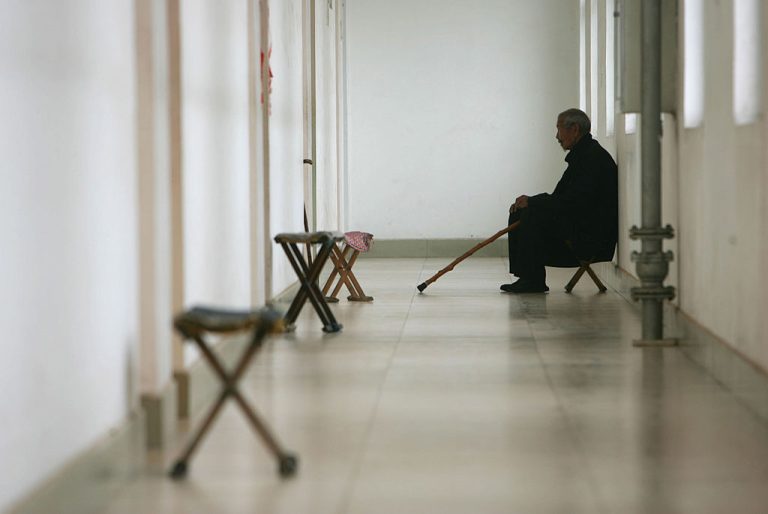
The promise of “old-age care” has long been considered a marker of an inclusive, modern, and humane society. But as China grapples with a rapidly aging population coupled with hefty economic turmoils, the country’s elderly care infrastructure appears to be in crisis.
Over the past five years, the number of registered elderly care institutions has plummeted by 70 percent, raising serious concerns about the future of pension systems and senior care in the country.
According to a recent report from Radio Free Asia (RFA), which cited statistics from registration database Qichacha, the number of registered long term care facilities in China has declined sharply since 2019. As of December 2023, only 681 elderly care institutions were registered across the country. This is equal to a 22.5 percent decrease from 2022 and an alarming 74 percent drop compared to 2019 figures.

RELATED: China’s Subway Boom Becomes a Financial Nightmare as Project Racks Up Trillions in Debt
The report also found that in just five years, the sector has seen a mass exodus of facilities, highlighting a systemic failure in meeting the needs of the country’s growing elderly population.
A widening gap
Success
You are now signed up for our newsletter
Success
Check your email to complete sign up
China’s aging demographics are at the heart of the problem. According to the National Bureau of Statistics, by the end of 2023, China’s population had decreased by 2.08 million, bringing the total to approximately 1.409 billion. More significantly, seniors aged 65 and older now number 216.76 million, accounting for 15.4 percent of the population. Those aged 60 and above represent an even larger share, at 21.1 percent.
MORE ON CHINA’S POPULATION CRISIS:
- A Third of China’s Provinces Saw More Deaths Than Births in 2021, Exacerbating Demographic Crisis
- COVID-19 Worsened China’s Declining Birth Rate, Health Commission Says
- China Calls for Total Abolition of Family Planning Laws as Country Faces Growing Demographic Crisis
- Impact of China’s Demographic Collapse Revealed in Official Numbers
To further complicate matters, the aging trend is only accelerating. According to a report by the Central University of Finance and Economics, China’s average workforce age increased from 32.25 in 1985 to 39.72 in 2022, signaling a shrinking pool of younger workers and a growing number of elderly citizens.
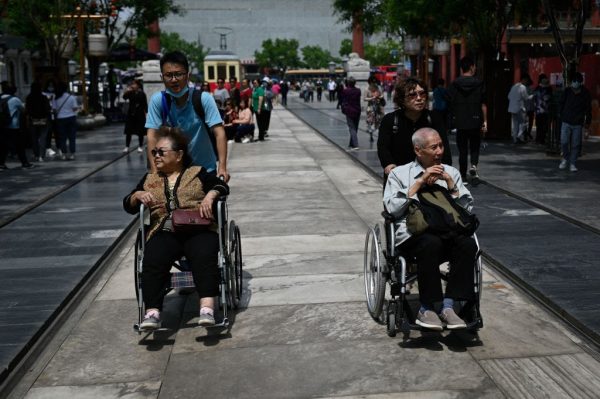
The consequences of this demographic shift are dire, experts note. Debt-saddled local governments — already struggling under economic pressure and a weak real estate market — are finding it increasingly difficult to fund public pensions. In 2019, the Chinese Academy of Social Sciences warned that even with government subsidies, the national pension fund for urban workers could be depleted by 2035, leaving it entirely dependent on contributions from a younger workforce.
The Wall Street Journal has echoed similar concerns, stating that “population aging and declining birth rates could ultimately become fundamental problems plaguing China’s economy.”
Why are facilities shutting down?
The rapid disappearance of elderly care institutions reflects multiple systemic challenges. Operators of these facilities cite two primary reasons: “low willingness among seniors to move in” coupled with limited spending power.
RELATED: Bot Takeover: How Drones Are Disrupting Industries and Threatening Jobs in China
“Elderly individuals in China are reluctant to leave their homes and move into institutions,” an anonymous director of an elderly care facility told the “Economic Observer.” This cultural preference for aging in place, coupled with rising costs of institutional care, has left many facilities unable to sustain operations. “Seniors often have to rely on family support because their pensions are simply not enough,” the director added.

In addition, many seniors in China lack the financial resources to afford professional elderly care. With limited pensions and rising healthcare costs, senior care has become a luxury that few can afford. This decline in demand has left many facilities in limbo as they face mounting debts and uncertainty. What once appeared to be a promising “silver economy” sector has turned into a struggling industry, said the source.
Policy shortfalls
Now, the Chinese government is faced with a monumental challenge. Building more elderly care facilities alone will not solve the problem, experts note. “Ensuring seniors are well-cared for requires comprehensive policy support, basic social welfare, and increased investment,” a financial analyst told RFA. “It is not just about having more nursing homes.”
In the past, China has experimented with policies such as delaying the retirement age to keep workers in the labor force longer and ease pension pressure. But these policies have also been met with widespread backlash, as many workers fear losing their pensions and the chance to enjoy retirement after decades of hard work. Older workers also often face challenges in securing employment due to skill gaps or age discrimination.

RELATED: Desperate Times: China’s Youth Take to Social Media to Lament Skyrocketing Unemployment
At the same time, the government has attempted to promote private investment in elderly care. But with limited profits and declining demand, private investors remain hesitant to jump in. Without stronger incentives, the sector will only continue to stagnate, noted RFA.
A looming crisis
The collapse of elderly care facilities exposes a deeper issue within China’s pension and welfare systems. Faced with an aging population, economic stagnation, and declining birth rates, China is undoubtedly entering uncharted territory.
The closure of 70 percent of elderly care institutions in just five years is a stark indicator of the challenges ahead. While China continues to emphasize the importance of “old-age care,” achieving that goal will require bold policy reforms, increased investment in social welfare, and a cultural shift toward more sustainable care solutions.
“It’s not just about building facilities — it’s about making them accessible and affordable. Seniors deserve to age with dignity,” said the facility director.