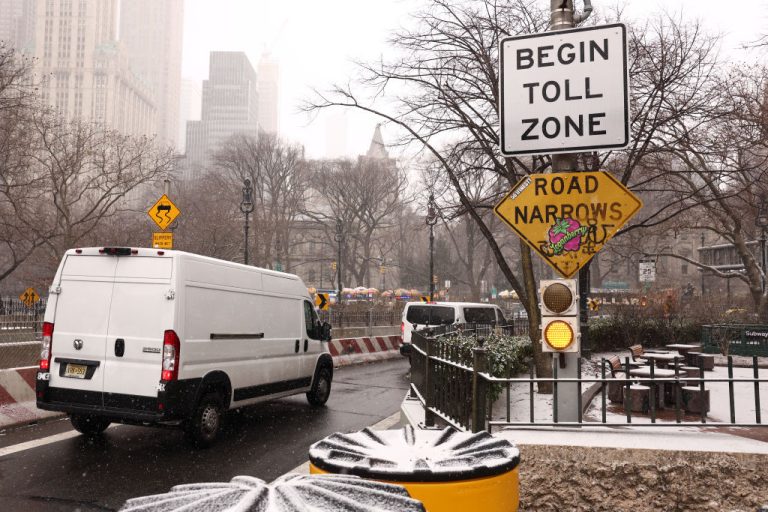
In conjunction with the ball dropping in Times Square on New Year’s Eve, New York’s congestion pricing scheme went into effect and it is already raking in the dough.
According to a website, set up to track revenue, congestion pricing has already raised over $5 million.
The website claims the scheme is bringing in $15.85 every second it’s in place.
The revenue per second is calculated at an average of $15.85 based on reporting by the New York Times, which says congestion pricing will bring in upwards of $500 million annually.
While this toll is a first of its kind in the United States, similar schemes have been implemented in other major cities across the globe including in London, Stockholm and Singapore. It’s even being considered for Canada’s largest city, Toronto, for its purported benefits when it comes to tackling climate change.
Success
You are now signed up for our newsletter
Success
Check your email to complete sign up
The plan is supposed to encourage people to choose public transit over driving into the city, however this is simply not an option for everyone.
Commercial trucks are also charged for driving into Manhattan south of 61st street and are on the hook for anywhere between $3.60 and $21.60 per trip depending on the size of vehicle and time of day.
Commercial trucks do not have the option to place their loads on a subway car.
However, theoretically, with less traffic on the island, it should be easier to deliver goods.
That said, the jury is still out over whether the scheme will be the boon to city coffers proponents of the toll say it will be. There is still a cost to administering the program including the cost to research and launch the toll, communicating the new rules to the public, installing street signage and the ongoing costs associated with enforcing the system.
READ MORE:
- Meta to Replace Fact-checkers With ‘Community Notes’ Like System Similar to X
- Indoor Plant Problems and Solutions – Controlling Mold in Potting Soil
- Canada’s Trudeau Announces Intent to Resign, Prorogues Parliament
Is it equitable?
According to the Metropolitan Transportation Authority (MTA) 1.3 million people currently use public transit to access the affected area, but they will see little change. However the approximately 143,000 people who drive into the area daily will be charged for every trip, and those costs will undoubtedly begin to add up and not everyone is charged the same amount per trip.
Taxis, green cabs and black cars will only pay $0.75 per trip while drivers for ride-hailing platforms like Uber and Lyft will have to pay $1.50 per trip; costs that will inevitably trickle down to the consumer.
Both Uber and Lyft stand to benefit from the scheme, as they expect their ridership to increase since it’s more cost effective to pay the lower tolls afforded ride-hailing platforms than to fork over the $9 private drivers will be charged.
Both companies spent millions lobbying state governments to legalize congestion tolling, according to the New York Post.
READ MORE:
- Why the CCP Fears Truthfulness: Sheng Xue on Shen Yun, Falun Gong, and Their Values
- The Silent Crisis: Pension Woes Mount in China Amid Sharp Decline in Elderly Care Facilities
- ‘My blood is on Xi Jinping’s hands’: Chinese Civil Servant’s Note Exposes CCP Failures
Arrests already made
On January 7, just a week after the toll went into effect, the NYPD arrested two people and seized 17 cars during its congestion pricing zone enforcement operations. In addition 82 summonses were handed out.
The penalties were dolled out on toll evaders and drivers who concealed or altered their license plates.
According to WPIX, Hizzoner said, “There’s going to be an entirely new industry on how to evade tolls. That’s just the ingenuity of mankind.”
According to the Adams administration, more than 70,000 “ghost cars” have been taken off city streets so far and the city has no intention of letting up.