Commentary by Hui Huyu
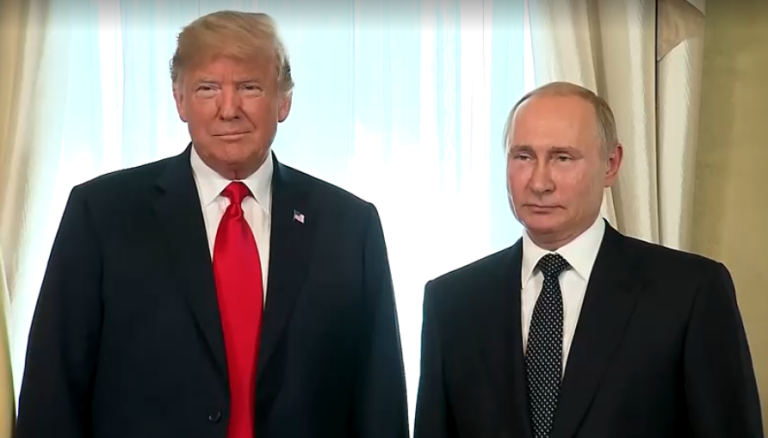
On Jan. 31 (Friday), U.S. President Donald Trump stated that his administration had engaged in “very serious” discussions with Russia regarding the war in Ukraine, mentioning that he might engage in direct talks with Russian President Vladimir Putin to take “significant” action towards ending the nearly three-year-long conflict.
Trump also urged Ukraine’s president Volodymyr Zelensky to reach an agreement with the Kremlin regarding the war, which has killed hundreds of thousands of people since Russia invaded Ukraine on Feb. 24, 2022.
Putin, for his part, had immediately expressed his willingness to negotiate on ending the Russo-Ukrainian war — but only with the United States.
Since taking office, President Trump has implemented sweeping domestic reforms while also adopting a tough foreign policy stance, portending significant adjustments in the global strategic landscape. His administration has taken practical steps towards implementing his proposals to purchase Greenland and reclaim control of the Panama Canal.
The Russo-Ukrainian War as a test of Trump’s global leadership
Success
You are now signed up for our newsletter
Success
Check your email to complete sign up
A primary concern of the second Trump administration’s foreign policy approach is countering the threat posed by the Chinese Communist Party (CCP). Beyond U.S. national security considerations in the Americas, Washington also has to deal with the wars in Europe and the Middle East — conflicts in which Communist China plays a significant backstage role.
Hostilities in the Middle East have gradually subsided under Trump’s mediation, with a ceasefire and prisoner exchange agreement between Israel and Hamas currently being implemented. However, negotiations to end the Russia-Ukraine war are still in their exploratory phase, with no obvious breakthrough in sight. The success or failure of these negotiations will be the first major test of whether “Trump 2.0” can truly command global affairs.
The Russia-Ukraine war has involved four of the world’s most powerful military forces: Russia, the European Union, the United States, and China. Although China has not directly supplied weapons to Russia, starting in 2023 it played a crucial role in revitalizing Russia’s exhausted military-industrial production. This has provided Russia with a steady supply of arms and ammunition, allowing it to regain battlefield momentum in 2024. The Russian army’s continued advances present a challenge to U.S. efforts to negotiate an acceptable end to the conflict.
Given Russia’s advantages on the battlefield, if peace is achieved at the cost of Ukraine’s interests, Trump’s ability to navigate global affairs may come into question. Such an outcome could further strengthen the alliance between China and Russia, creating a real counterweight to the U.S.-European alliance. The Russia-Ukraine war has become a litmus test: will the future of global order be dominated by the U.S. and Europe, or will a Sino-Russian bloc emerge to effectively challenge the EU? The Trump administration must weigh its approach carefully.
Ceasefire or peace treaty?
An immediate question is whether the conflict would end in a ceasefire or formal peace agreement.
A ceasefire deal would establish a demilitarized zone, similar to the division between North and South Korea, where both sides would maintain their current military standoff while leaving the option of reaching a peace deal for the future.
Such an agreement would allow Ukraine to recover and rebuild its national strength. However, Russia is unlikely to accept this arrangement, being focused on an outcome that would preserve Russia’s control over the four Ukrainian oblasts, or regions, that it currently occupies.
During a Russian Security Council meeting on Jan. 20, Putin stated that Russia was open to dialogue with the new U.S. administration regarding the Ukraine conflict, but insisted on a long-term peace plan. He emphasized that “the goal should not be a brief ceasefire, not some kind of period of respite that would allow a regrouping and rearmament of forces, but a long-term peace based on respect for the legitimate interests of all people and all peoples who live in the region.”
A peace treaty, on the other hand, faces the challenge of defining the status of Russian-occupied Ukrainian territories. Analysts speculate that the most likely outcome is freezing territorial disputes for a set period, leaving them to be resolved diplomatically in the future.
Ukrainian President Zelensky, in a Nov. 29, 2024 interview with Sky News, stated that for the war to transition out of its active combat phase and move toward negotiations, Ukraine must first integrate its currently controlled territories into NATO’s security umbrella. As for the territories currently occupied by Russia, he suggested that they could be reclaimed through diplomatic means in the future.
Leverages Trump could create for both sides
On Jan. 21, newly inaugurated U.S. Secretary of State Marco Rubio, after receiving unanimous confirmation in the Senate, said that ending the Russia-Ukraine war would be official U.S. policy. Days earlier, he had admitted the complexity of this task, as it requires both Russia and Ukraine to make concessions.
Keith Kellogg, whom Trump appointed last November as special envoy for Ukraine and Russia, told Fox News on Jan. 31 that ending the war would be beneficial for both U.S. and global security. He added that achieving a ceasefire and lasting peace within months rather than years was not impossible.
Kellogg, a retired U.S. Army lieutenant general and former Chief of Staff for Trump’s National Security Council, described Trump as being focused on creating points of leverage to incentivize both sides to arrive at a deal.
“Trump knows exactly what he’s doing. He knows where to apply pressure, where not to apply pressure,” he said. “More importantly, he will create leverage with both the Ukrainians and the Russians.”
It is likely that Trump’s strategy to mediate the Russia-Ukraine war is not centered on tariffs, economic sanctions, or escalating military aid to secure a Ukrainian victory. Instead, as Kellog indicated, his approach is about offering incentives to Putin while simultaneously ensuring Ukraine’s security.
Regarding Russia, Trump could offer a pathway to friendly cooperation, gradually easing sanctions in exchange for weakening Moscow’s ties with Beijing. In return, Trump may demand that Russia refrain from formally annexing occupied Ukrainian territories using elections or legal maneuvers, effectively freezing the territorial dispute for a set number of years.
For Putin, this means that Russia could continue its military occupation of Ukrainian territory while halting active warfare. He could declare his “special military operation” a success and later enter negotiations with the U.S. over these territories, using the leverage gained from any concessions Trump offers.
Putin has indicated a desire to mend relations with the West.
On Jan. 24, he remarked that if Trump’s 2020 election victory had not been “stolen,” the Ukraine crisis of 2022 might never have occurred. He further claimed that the previous U.S. administration’s refusal to engage with Russia was not Moscow’s fault, asserting that he had always maintained a professional, pragmatic, and trustworthy relationship with whoever was in the White House.
It is evident that if a ceasefire in the Russia-Ukraine war is reached, Putin’s primary objective will be to strengthen ties with the United States. If U.S.-Russia relations undergo a substantial shift, then in future negotiations over Ukrainian territory, Putin (or a future Russian president) may be more willing to make concessions.
Ukraine’s requests–and need–for security guarantees
For Ukraine, if the war is to end with occupied territories in a frozen conflict, then Kyiv’s security must be effectively and reliably guaranteed.
On Dec. 5, 1994, Ukraine, Belarus, and Kazakhstan signed the Budapest Memorandum, agreeing to relinquish the nuclear weapons they inherited from the Soviet Union in exchange for security assurances from Russia, the United States, and the United Kingdom. These commitments included respecting Ukraine’s independence, sovereignty, and existing borders, as well as pledging not to use force or threats against Ukraine’s territorial integrity.
However, Russia — one of the signatories — has since violated these commitments by launching war against Ukraine and occupying its territory. If a new ceasefire or peace agreement is to be signed, Ukraine will demand a more binding agreement to ensure its security.
On Jan. 21, at the World Economic Forum in Davos, Switzerland, President Zelensky stated that any Russia-Ukraine peace agreement would require foreign troops to oversee its enforcement. He proposed deploying at least 200,000 European peacekeepers along the eastern front to prevent Russia from launching another offensive.
Zelensky justified this request by highlighting the imbalance in military strength between Europe and Russia. He noted that Russia was capable of mobilizing between 1.3 to 1.5 million troops, whereas on the European side, Ukraine has around 800,000 troops, followed by France with over 200,000, and then Germany, Italy, and the UK. Thus, he urged for European troops to be stationed in Ukraine.
In short, Ukraine hopes for large-scale European military deployments to Ukraine to secure its remaining territory, and to guarantee long-term NATO protection.
At the Davos forum, Zelensky expressed concerns about Europe’s approach to the war and possible negotiations, urging it to “fully take care of itself, so that the world can’t afford to ignore it.”
“We see how much influence China has on Russia and we are deeply grateful to Europe for all the support it’s given our country during this war,” Zelensky said in his special address. “But will President Trump listen to Europe, or will he negotiate with Russia and China without Europe?”
Hui Huyu (惠虎宇) is a columnist for the Chinese-language edition of The Epoch Times. He has written extensively on the politics, culture, and history of modern China, and authored the editorial series “A Reasoned Critique of Chinese Communist Party Ideology” (《中共意識形態之理性批判》).