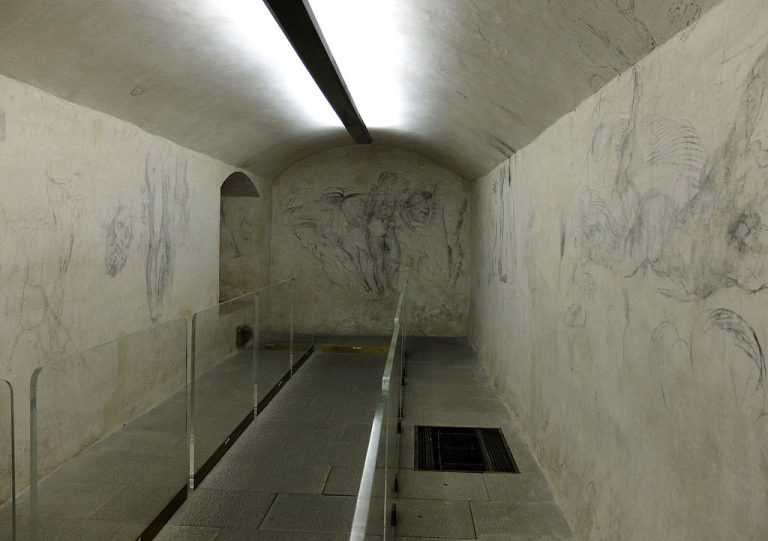
Fifty years ago, a hidden chamber was discovered below an obscured trap door in the floor of the Medici basilica in Florence, Italy. The room had been used to store coal up until 1955, when it was finally sealed off and forgotten; but behind the aging, sooty plaster on the walls was a remarkable treasure — a stunning array of charcoal sketches believed to be the work of one of the greatest artists the world has ever known — Michelangelo.
Throughout history, very few artists have known fame and fortune in their lifetime like Michelangelo. Why would such a renowned figure have any interest in this dingy little room? The answer to this mystery revolves around his rocky relationship with the powerful Medici family.
Michelangelo
Michelangelo (1475-1564) was one of four boys born to Lodovico and Francesca Buonarroti. The family had ties to past nobility but was by then reduced to living in “genteel poverty.” Within a month of his birth in Caprese, where his father had a temporary position as a Florentine government agent, the Buonarroti family returned to Florence.
As was customary for children of the upper class, Michelangelo’s earliest years were spent with a wet-nurse, which had an unexpected impact in his formative years. This woman was the daughter and wife of stonemasons, and Michelangelo later joked, “If I have any intelligence at all, it has come . . . because I took the hammer and chisels with which I carve my figures from my wet-nurse’s milk.”
Indeed, Michelangelo was drawn to the arts from an early age, and always considered himself a sculptor over anything else. Although his own mother died when he was six years old, and his father discouraged his artistic pursuit as a lowly profession, the boy prevailed; and at the tender age of 12, was apprenticed to Domenico Ghirlandiao — a prominent painter in Florence at the time.
Success
You are now signed up for our newsletter
Success
Check your email to complete sign up
The three-year apprenticeship was broken after only one year, however, during which time Michelangelo had apparently absorbed all that his master had to offer. Yet his blossoming talent had already gained the young artist recognition, which earned him an unusual patronage with the most powerful family in Florence — the Medicis.
The Medicis

The Medici family was traveling in the opposite direction on the social ladder. A shrewd Tuscan peasant, Giovanni di Bicci de’ Medici began his ascent as a money lender in Rome in the late 14th century. Then, with his wife’s dowry, he set up a bank in Florence. He made key connections within the Church and the Medicis accumulated tremendous wealth and power.
Aside from securing their rule over the city, these resources were liberally applied to support the advancement of arts and science, and Florence became the birthplace of the Renaissance. As a generous patron of the arts, the Medici family gave young Michelangelo the chance to pursue his passion.
Giovanni’s great-great grandson Lorenzo de’ Medici, known as “Lorenzo the Magnificent,” financed a school for young artists, called the Academy of San Marco. Not only was Michelangelo invited to attend the school, he attracted the attention of Lorenzo himself, who hosted the boy as a family member in his Via Larga residence in Florence from 1490 until Lorenzo’s death in 1492.
In this setting, Michelangelo was surrounded by the Medici’s impressive collection of art (which included ancient Roman sculptures), immersed in high-class society, and granted the great Renaissance artist Donatello as a mentor. After Lorenzo’s death, Michelangelo retained the favor of his sons Piero and Giovanni, who would both become popes of the Catholic Church.
Conflicts
Whether because of his enviable success or his somewhat-prickly nature, Michelangelo was not particularly well-loved by other artists. His crooked nose was a lasting memento of a punch in the face from a fellow student; and his monumental work on the Sistine Chapel ceiling may have been intended to destroy his career — since everyone assumed he would fail to complete it. He did finish it in 1481, but after this grueling, four-year project, Michelangelo left Florence for Rome, where he mostly stayed for the next 25 years.
The Medicis faced their own opposition. When Michelangelo was still a babe with his wet nurse, the rival Pazzi Bank conspired to do away with the influential family. A dual assassination attempt took place during Easter Mass in the cathedral, during which Giuliano de’ Medici was stabbed to death before the altar. Lorenzo escaped to safety and appealed to the crowd, which sided with Medici and destroyed the conspirators.
The Medicis could not maintain public favor forever, though. Lorenzo’s son Piero was forced to flee Florence with his brothers in 1494, to escape an angry mob. They didn’t return until 1512, when Pope Julius II agreed to restore the family to its former position of power.

The Florentines again rejected Medici rule in the 1529 Siege of Florence, creating a Republic, which Michelangelo aligned with and worked to support. After 10 months of resistance, however, the Medicis regained power, and the dissenters were in grave danger. This is why, in the summer of 1530, Michelangelo stuffed himself in a small, secluded room for three months.
What happens when you give Michelangelo a piece of charcoal and a blank wall?

Although Michelangelo considered himself primarily a sculptor, he was an artist through and through, and accomplished in many media. Beyond his well-known works in painting and sculpture, he produced fine architecture and even poetry. He was driven to create, and found endless inspiration in the beauty of God’s creations — especially the human form.
While hiding in fear for his life, Michelangelo covered the walls with sketches. Whether to calm his troubled heart or to keep his mind and hands active, he made many studies regarding his ongoing work, revisiting past work, and may have even left behind a rare self-portrait.

Fortunately, the Medicis valued Michelangelo’s art more than vengeance, and he was granted a pardon which enabled him to come out of hiding and continue his work. The chamber was largely forgotten, and even after it was discovered, for decades it could only be seen by art historians with special permission. A trial for limited public visits began in November 2023.