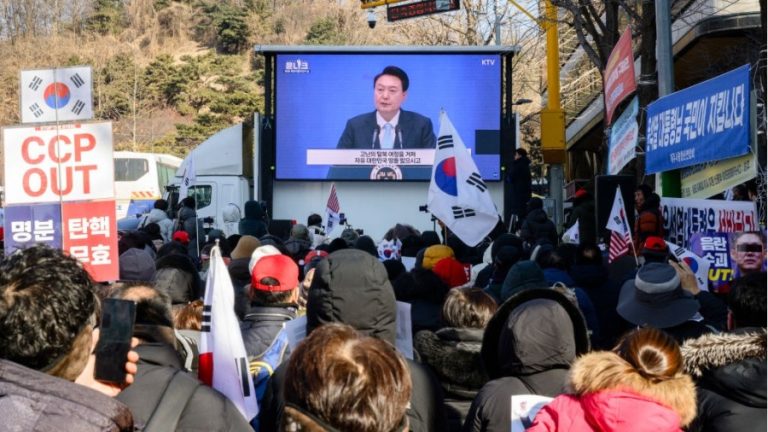
In final statements made at his impeachment trial on Feb. 25, South Korean President Yoon Suk-yeol apologized for the disturbance and inconveniences caused by his Dec. 3, 2024 declaration of martial law, but said the move was intended to call attention to “communist forces” undermining the Republic of Korea and its government.
Yoon, who was arrested in January and has had his presidential powers suspended as he attends court, argued that the political opposition had paralyzed the ROK government and left it unable to effectively deal with threats from North Korea and China.
He also claimed that his martial law move, which lasted less than two hours, was not a plan to suppress the opposition or install a dictatorship, as previous South Korean leaders had done.
The deployment of troops was “was not about using force to suppress the people, but rather a way to warn the public — an announcement that the nation was facing an existential crisis,” Yoon said.
He pointed to the fact that while over 1,000 people — including legislators, aides, and congressional staff — were present at the National Assembly building, the martial law action only deployed 280 soldiers to the National Assembly. Given this, Yoon said the charge of him attempting to arrest lawmakers was baseless.
Success
You are now signed up for our newsletter
Success
Check your email to complete sign up
Moreover, after the members of the National Assembly pushed their way into the building past the soldiers and unanimously voted to declare the martial law illegal, Yoon had immediately cancelled the action.
“Have you ever seen an insurrection that was announced to the entire country and the world? Or an insurrection where, upon request from parliament, the troops were immediately withdrawn?” he said.
He added that “martial law was for the country and the people, but it caused confusion and inconvenience. I sincerely apologize for that.”
Notably, Yoon and his party have risen in South Korean public polling since reaching a low point of just 11-percent support in late 2024 to nearly 50 percent in early February. Over 40 percent of survey respondents had expressed support for the president for three consecutive weeks
Insurrection or cautionary warning?
Yoon, who came to office in 2022, has presided over a government encumbered by the opposition Democratic Party of Korea (DPK) since his election. Observers have noted that Yoon’s People Power Party (PPP) has been largely unable to pass domestic policy proposals due to its weakness in the National Assembly, South Korea’s legislature.
Since and prior to declaring martial law, Yoon has lamented the oppositions’ constant use of “impeachment, legislative obstruction, and budget boycotts with the sole aim of crippling the government” whilst claiming that “these actions are a legitimate exercise of parliamentary authority.”
“They have been attempting to overthrow a democratically elected president. If this is not subverting the constitutional order, then what is?” Yoon questioned.
The president also pointed to recent cases involving North Korean spies, Chinese “students” using drones to film sensitive ROK militray installation, and the leakage of crucial semiconductor technology to China. He accused the National Assembly of obstructing the necessary investigations and punishment for such security breaches.
“Communist forces have infiltrated South Korea through various means,” Yoon said. While, emphasizing that he was otherwise open to cooperating with figures across the political spectrum, “we must not compromise with these [communist] forces. We must prevent them from influencing our political system and safeguard our free democracy.”
“I can say with absolute certainty that martial law was not for my own benefit,” Yoon said in his final court statement. “As president, I am already at the pinnacle of power. The easiest path for me would have been to simply complete my five-year term peacefully — saying nice things to everyone, avoiding risks, making no difficult decisions, and then retiring with the privileges of a former president.”
The Dec. 3 martial law was the first time such an action had been declared in over 40 years. The last instance was in 1980, following the assassination of President Park Chung-hee, the authoritarian leader credited with South Korea’s economic rise. The country spent seven years under military rule until popular unrest led to the ROK’s democratization.
Allegations of collaboration with North Korea and Communist China
Yoon, who was elected on a conservative platform, characterized his martial law declaration as necessary to expose and expunge the “anti-state” forces in the South Korean government that were aligned with its enemies. Various sources had reported that the president was contemplating martial law for months ahead of time.
“As president, I have access to intelligence that most people do not. Even if the country appears to be stable on the surface, without intervention, it could soon face a major crisis — just like a frog slowly boiling in warm water.”
He stressed that foreign forces, including North Korea, were collaborating with groups in South Korea to undermine undermine national sovereignty.
Duirng the impeachment proceedings, on Feb. 7, Woo Won-shik, Speaker for the National Assembly and a figure in the Democratic Party, met with Communist Chinese leader Xi Jinping at the openeing ceremonies of the Asian Winter Games in Harbin, Northeast China.
According to South Korean state outlet Yonhap News Agency, in Harbin, citing the South Korean Parliament Speaker’s Office, the two sides exchanged views on issues of mutual concern. It was the first meeting between the speaker of the ROK National Assembly and the head of the Chinese Communist Party (CCP) since December 2014, and the first formal meeting between a senior South Korean official and Xi since Yoon’s martial law declaration.
Woo, known for advocating deepened exchanges and economic ties with Communist China, also met with Zhao Leji, a member of the 7-man CCP Politburo Standing Committee, the Party’s top decision-making body chaired by Xi.
Woo told Zhao that friendship with Beijing is a core priority in ROK foreign policy and will not change, and that South Korea is willing to “make joint efforts with the Chinese side to push ROK-China relations to a higher level” this year.
Woo’s foreign policy priorities, which also include playing to anti-Japanese sentiment in South Korea, contrast with the approach taken by the Yoon administration, which has actively worked to strengthen its relationship with Tokyo, the U.S., and other allied countries.
Yoon defends martial law
In earlier impeachment trial proceedings, Yoon’ and his legal team had argued that North Korea and China’s “hybrid warfare” against the ROK, coupled with the opposition’s “anti-state” actions aimed at paralyzing his administration, had made the martial law necessary.
During the Jan. 21 impeachment trial, the legal team submitted supporting evidence for these claims, arguing that the conditions justifying emergency martial law were not limited to conventional warfare but included significant political, economic, and national security threats. The martial law order, they claimed, was enacted to counter various threats that were disrupting the country’s governance.
President Yoon’s legal defense had also brought up the discovery of security vulnerabilities in the ROK Election Commission’s system, raising concerns about potential interference by Beijing in the South Korean democratic process.
In additiom, documents related to the THAAD (Terminal High Altitude Area Defense) anti-aircraft systems deployed in South Korea with U.S. cooperation, classified as level-2 secrets, as well as lists of South Korean military intelligence personnel, were found to have been leaked to CCP spies.
Despite these threats, the opposition politicians had blocked the Yoon administration’s efforts to punish those responsible, creating serious national security, economic, and political risks, the president’s legal team said.
Their Jan. 21 statement also referenced foreign cases, noting that Canada and other countries had experienced Chinese election interference. It further revealed that North Korea had previously hacked South Korea’s Constitutional institutions, yet the Election Commission — despite being an independent government body — has consistently refused external audits.
On Feb. 11, four days after Assembly Speaker Woo’s meeting with Xi and Zhao, the impeachment trial had held its seventh debate. A lawyer representing Yoon questioned Shin Won-sik, director of the National Security Office, and other witnesses in court on the CCP’s interference in South Korea’s elections and other related issues.
“The President believes that reviewing the Election Commission’s cybersecurity systems is crucial to ensuring the accurate reflection of public opinion in a democratic society,” the Jan. 21 statement said.
Yang Tianzi contributed to this report.