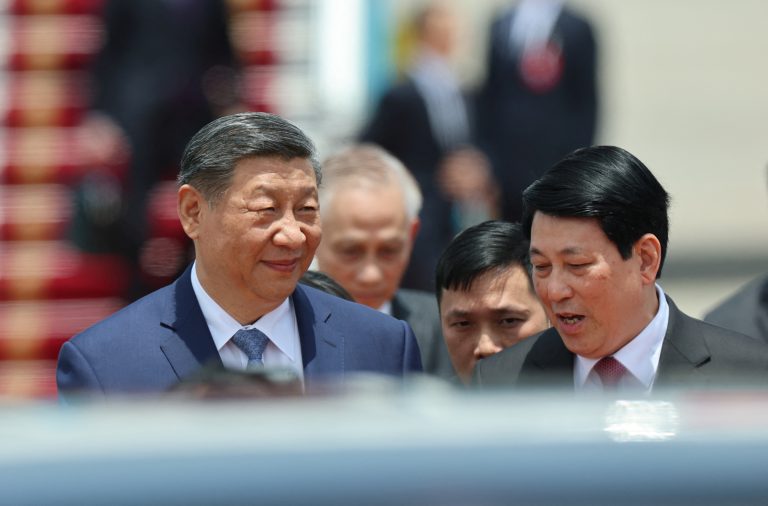
On April 14, Chinese leader Xi Jinping called for stronger ties with Vietnam on trade and supply chains amid disruptions caused by American tariffs, as he attended the signing in Hanoi of dozens of cooperation agreements between the two communist-run nations.
The visit comes as Beijing faces a stiff 145 percent tariff rate, while Vietnam attempts to negotiate a reduction of threatened U.S. tariffs of 46 percent that is slated to go into effect in July after a global moratorium expires.
“The two sides should strengthen cooperation in production and supply chains,” Xi said in an article in Nhandan, the newspaper of Vietnam’s Communist Party, posted ahead of his arrival on Monday. He also urged more trade and stronger ties with Hanoi on artificial intelligence and the green economy.
After he met Vietnam’s top leader, To Lam, the two countries signed dozens of cooperation agreements, including deals on enhancing supply chains and on cooperation over railways, footage of the documents reviewed by Reuters showed.
Chinese and Vietnamese state media later on Monday reported that 45 agreements were signed.
Success
You are now signed up for our newsletter
Success
Check your email to complete sign up
The content of the agreements was not disclosed and it was unclear whether they involved any financial or binding commitments.
READ MORE:
- Shanghai’s Population Crisis Deepens Amid Migrant Exodus, Dwindling Birth Rates
- Nations, Markets Brace as Trump Announces ‘Liberation Day’ US Global Tariffs
Pressure from Washington
Under pressure from Washington, Vietnam is tightening controls on some trade with China to make sure goods exported to the United States with a “Made in Vietnam” label have sufficient added value in the country to justify the label.
“There are no winners in trade wars and tariff wars,” Xi said in his article, without mentioning the United States. Later, in a meeting with Vietnam’s Prime Minister Pham Minh Chinh, Xi said the two countries should oppose unilateral bullying, according to Chinese state media Xinhua.
Vietnam is a major industrial and assembly hub in Southeast Asia. Most of its imports are from China while the United States is its main export market. The country is a crucial source of electronics, shoes and apparel for the United States.
In the first three months of this year, Hanoi imported goods worth about $30 billion from Beijing while its exports to Washington amounted to $31.4 billion, Vietnam’s customs data show, confirming a long-term trend in which imports from China closely match the value and swings of exports to the United States.
U.S. President Donald Trump said on Monday the two countries’ discussions were focused on how to harm the United States, but that he did not blame them for holding such talks.
“I don’t blame China; I don’t blame Vietnam,” Trump told reporters at the White House. “That’s a lovely meeting. Meeting like, trying to figure out, ‘how do we screw the United States of America?'”
A Trump administration official said the Republican president and Vietnam’s Lam “earlier this month agreed to work to reduce reciprocal tariffs and looked forward to an in-person meeting in the near future.”
Despite strong economic ties, tensions frequently surface between China and Vietnam over contested boundaries in the South China Sea.
Vietnam’s concessions to the U.S. to avoid tariffs may also irritate Beijing, as they include the deployment of Elon Musk’s Starlink satellite communication service in the Southeast Asian nation, in addition to the crackdown on some trade with China over possible fraud on rules of origin.
RELATED:
Looking for allies
China wants to deal with the European Union as a partner instead of a rival, its ambassador to Spain recently said, amid shifting geopolitics and Washington’s new trade policy which he described as unilateral economic abuse.
Yao Jing told Reuters the EU’s 2019 strategy that defined China as its “partner for cooperation, economic competitor and systemic rival” made little sense as both championed open markets and rules-based trade.
“We should put our focus on partnership. China will never be a threat or any kind of enemy to the EU,” Yao said, praising the bloc’s multilateral approach to foreign affairs, as opposed to President Donald Trump’s agenda.
Last week, Spanish Prime Minister Pedro Sanchez met with President Xi Jinping in Beijing. The visit was widely seen as a bid to forge closer economic and political ties between China and Europe amid the fallout from Trump’s tariffs.
Just before Sanchez’s trip, U.S. Treasury Secretary Scott Bessent warned that moving closer to China would be “cutting your own throat,” a comment dismissed by Madrid.
Yao said he was shocked by Bessent’s remarks, adding that the U.S. “in fact cuts everyone’s throats” with its unilateral tariffs.
“And this is why China is firmly against this kind of economic abuse by the United States,” he said.
On Tuesday, White House press secretary Karoline Leavitt said that Trump is open to making a trade deal with China but Beijing should make the first move.
“The ball is in China’s court: China needs to make a deal with us, we don’t have to make a deal with them,” Leavitt told a press briefing, saying Trump had given her that statement directly in an Oval Office meeting to use.
“China wants what we have … the American consumer, or to put another way, they need our money,” Leavitt said.
China raised its tariffs on imports of U.S. goods to 125 percent on Friday in a retaliatory move to Trump, who effectively raised U.S. tariffs on Chinese goods to 145 percent, while putting a pause on planned levies for other countries’ goods.
Reuters contributed to this report