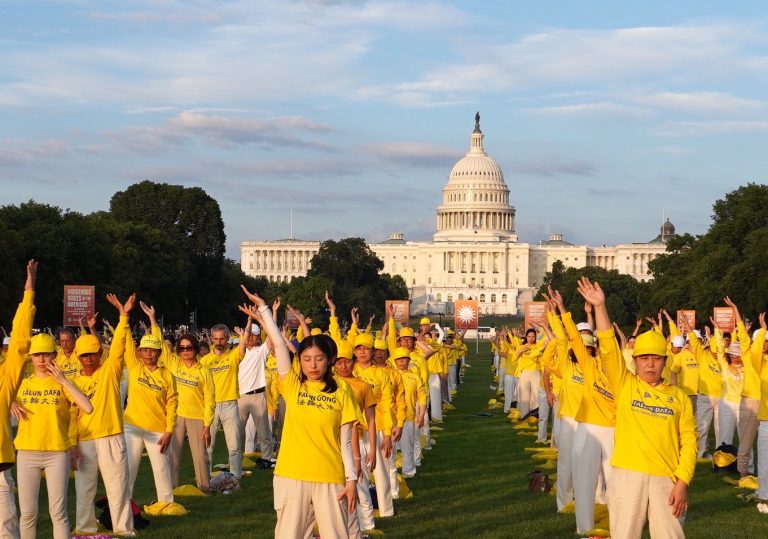
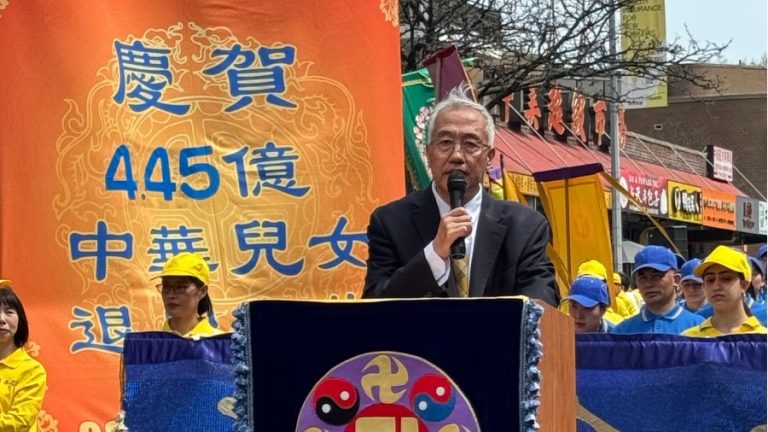
Adherents of Falun Gong, the faith group that is severely persecuted in its native China, held parades and rallies in multiple cities around the world to mark the 26th anniversary of a peaceful appeal in Beijing that came just months before the Chinese Communist Party (CCP) launched its deadly and still-ongoing campaign against Falun Gong and its tens of millions of practitioners.
Also called Falun Dafa (法輪大法), the spiritual practice was first taught to the Chinese public in 1992 by Master Li Hongzhi. Falun Gong includes meditation exercises and a body of moral teachings based on the principles of truthfulness, compassion, and forbearance.
The April 25, 1999 appeal took place at a time when Falun Gong was still freely practiced in mainland China, but the Communist Party leadership was already raising pressure on the popular group, before beginning its all-out nationwide persecution that July 20.
Continuing remembrance amidst transnational repression
Commemorative events were held in New York, London, Toronto, Melbourne, Taipei, Sydney, Berlin, Auckland, and other cities, according to the Falun Dafa Information Center (FDIC).
On April 19, thousands of Falun Gong practitioners in the New York area held a parade in Flushing, Queens borough, to commemorate the Beijing appeal and raise awareness about the persecution of Falun Gong. Speakers at a rally following the parade called upon the international community to help bring an end to the CCP’s decades-long repression.
Success
You are now signed up for our newsletter
Success
Check your email to complete sign up
Among those attending the rally were New York political figures and human rights advocates, including congressional candidate Martha Flores-Vazquez, who called for greater government action to pressure Beijing on its persecution.
While the persecution of Falun Gong is centered on mainland China, it has cast a long shadow abroad. Falun Gong practitioners living in democratic countries have documented surveillance, online harassment, and attempts at intimidation. Many see the recent threats in New York as part of that same campaign.
Later that evening, bomb threats were sent to the Queens Public Library system, as well as to several organizations run by Falun Gong practitioners. The anonymous emails falsely claimed that another parade would take place on April 25 and threatened to attack it with a car bomb.
The NYPD responded swiftly, evacuating several library branches across Queens and deploying bomb squads. No explosives were found. Investigators later traced the origin of the messages to IP addresses in China.
Though the threats turned out to be hollow, the timing — so close to the Falun Gong rally — raised questions among practitioners and the broader community. Just last fall, similar bomb scares disrupted libraries in Brooklyn’s Chinatown. In recent years, cyberattacks and hoaxes have also targeted Shen Yun Performing Arts, a company founded by Falun Gong practitioners that tours internationally and highlights China’s cultural heritage and ongoing human rights abuses.
Significance of the April 25 appeal
The April 25 appeal stands as a pivotal event in modern Chinese history, highlighting the peaceful attempts of Falun Gong adherents in China to state their case even as the communist regime was gearing up to destroy the faith group by all means at its disposal.
While Falun Gong was welcomed by both the Chinese public and authorities in the early 1990s, starting in the middle of the decade, hardliner elements in the CCP began to frame Master Li’s teachings and the spiritual community as a threat to the Party’s atheist Marxism.
Falun Gong and its adherents came under increasing pressure from the regime, including defamatory reports carried by the state media. Eventually, Falun Gong practitioners were threatened and physically harrassed in public as they gathered for meditation or to study Falun Gong teachings.
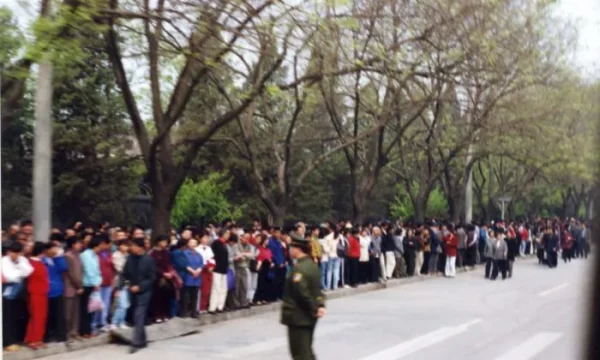
Responding to the mass arrest of Falun Gong adherents in the northern Chinese city of Tianjin, around 10,000 practitioners gathered in Beijing at the government’s appeals office to call for the detainees’ release and secure a lawful environment for them to practice their faith. “Despite the large turnout, the appeal was entirely peaceful. No banners, no slogans, no conflicts—just quiet appeals for justice,” an article by the Falun Dafa Information Center (FDIC) reads.
After several practitioners were invited to talks with China’s then-premier Zhu Rongji, who affirmed Falun Gong’s legality and ordered the release of the detained Tianjin practitioners, “the crowd dispersed quietly, even collecting litter before leaving,” per FDIC.
Zhu’s actions reflected the broad consensus throughout Chinese society and government at the time — Falun Gong practitioners were found across all social backgrounds and fields. A 1998 report commissioned by influential Chinese statesman Qiao Shi lauded Falun Dafa and Master Li’s teachings as “bringing countless benefits and not a single harm” to the country.
But head of the CCP at the time, Jiang Zemin, saw the April 25 appeal as simply further confirmation of his belief that Falun Gong was a dire threat to communist rule and its atheist ideology. Three months later, on July 20, 1999, the CCP began the persecution of Falun Gong, arresting millions of people while state media demonized the group as an “evil religion.” A vast but unknown number of people have lost their lives in the persecution from various forms of abuse, including execution by organ harvesting.
Brian Nieh contributed to this report.