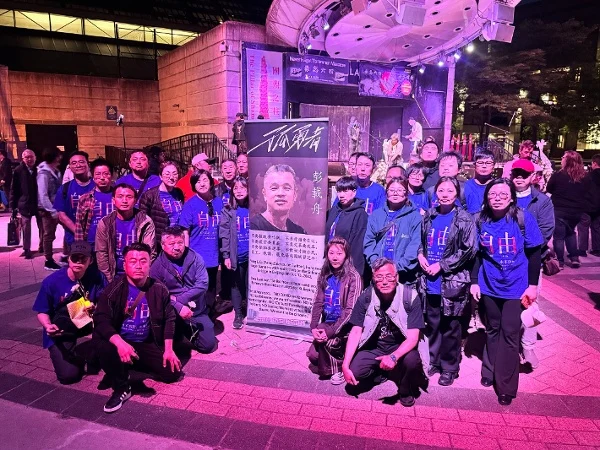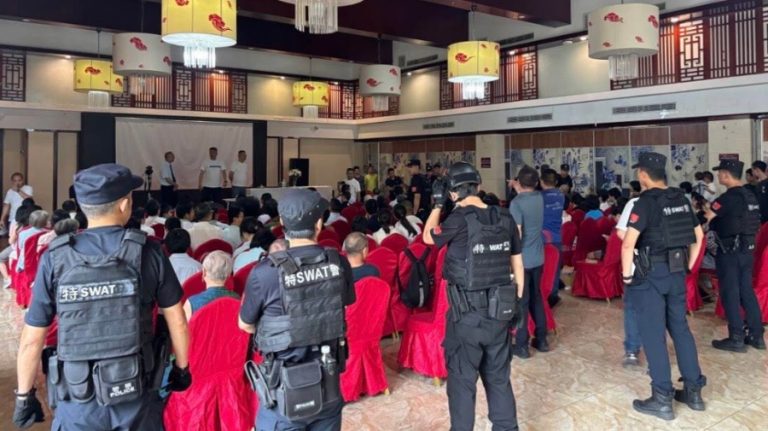
Early Rain Covenant Church, also known as Qiuyu Covenant Church, is one of China’s most prominent unregistered Protestant congregations. Since its founding in 2008, it has operated independently of the Chinese Communist Party’s state-controlled religious system. On June 14, authorities raided the church’s Sunday service in Jiangyou, Sichuan Province, deploying an estimated 50 to 60 police officers. The operation resulted in the detention of 33 people, injuries to at least three congregants, and the removal of several young children in police vehicles.
According to Feng Reng of Bitter Winter, the raid began around 11 a.m. when police officers swarmed the church venue and recorded the national identity card information of every congregant in attendance. Worshippers were then placed on a chartered bus and in several police vehicles before being transported to a local police station.
According to eyewitness accounts, the operation involved approximately 30 special police officers, some of whom were armed, along with about 60 plainclothes and uniformed officers. During the raid, three male congregants were reportedly assaulted by police and sustained injuries.
Among those confirmed detained were Elder Yan Hong, Elder Wu Wuqing, and church members Liu Yingxu, Nie Bo, Li Benli, and a brother known as A Xin, Reng wrote.
A church member identified only as Wang told Radio Free Asia (RFA) that, as of the time of reporting, Elders Yan Hong and Wu Wuqing remained in custody and their families had received no official notification regarding their status. Based on the actions of police at the scene and statements made by officers, Wang said the two men were likely to face administrative detention.
Success
You are now signed up for our newsletter
Success
Check your email to complete sign up
Notably, both elders had been elected by the congregation just one day earlier, during a church meeting on June 13, RFA reported.
Early Rain Covenant Church has been raided before
Protestant congregations in China that decline to join the Three-Self Patriotic Movement, the government-controlled body the CCP established to bring Christianity under Party supervision, are classified as unauthorized and face systematic state harassment.
Another church member, identified by Radio Free Asia only as Yang, said the congregation has faced persistent government scrutiny for years.
“They have been raided before,” Yang said. “Qiuyu Covenant has been watched for years. Gatherings, elder elections, training sessions, internal communications, all of it is monitored. Now the authorities are going after them even when they meet outside their home city, which shows the crackdown on house churches has not loosened at all.”
READ MORE:
- Bill to Sanction Forced Organ Harvesting in China Clears Senate Committee
- Freed But Not Free: Taiwan Publisher Fucha Still Trapped in China After Sentence Ends
A prayer request distributed by the church after the raid listed the agencies involved: domestic security police, uniformed officers, special police units, officials from the government’s ethnic and religious affairs bureau, and township-level government personnel.
ChinaAid, a U.S.-based organization that tracks religious persecution in China, has described Qiuyu Covenant as one of the country’s most influential urban house churches. The congregation has faced sustained pressure from Chinese authorities since December 2018, when a sweeping crackdown shuttered its main church in Chengdu and led to the imprisonment of founding pastor Wang Yi on charges that critics widely viewed as politically motivated. Since then, church members have repeatedly faced detentions, surveillance, and other forms of state harassment.