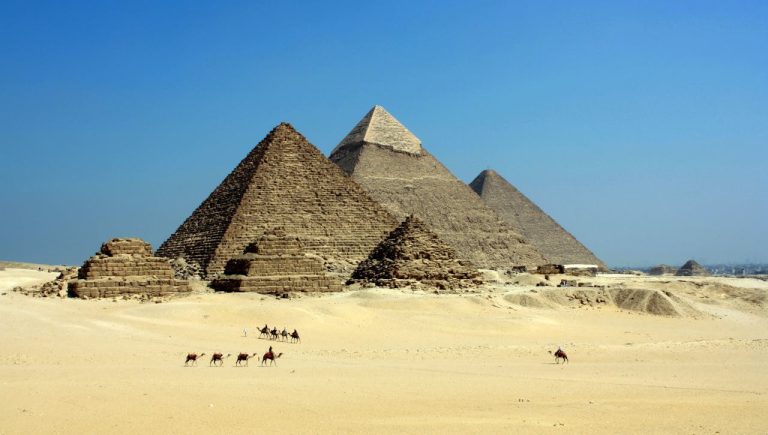
The Egyptian pyramids are the last surviving wonders of the ancient world. Because these giant structures hold the bodies of mummified pharaohs, they are commonly held to be lavish tombs whose precise and impressive construction remains a mystery to this day.
Some, however, say that the pyramids are more than merely massive tombs, and suggest that the design was dictated by a more practical purpose — that of furnishing energy.
Construction of the pyramids
While the pyramids have certainly served as temples honoring the power and memory of Egyptian kings and their passage into the afterlife; this may not have been their primary purpose — at least for the oldest structures. These, the three main pyramids of Giza, are named for the rulers Khufu, Khafre and Menkaure; but evidence regarding who built these pyramids, and when, is nonexistent.
With an estimated 2.3 million massive blocks weighing over 10 tons each, the construction of the Great Pyramid of Giza using primitive tools must have taken decades, even with a huge workforce of skilled humans and powerful animals. Was there a greater purpose behind this phenomenal effort?

Egyptian electricity?
While we often attribute the modern use of electricity to inventors like Benjamin Franklin (1705-1790) and Thomas Edison (1847-1931), ancient Egyptians may have had a huge jump on us.
Success
You are now signed up for our newsletter
Success
Check your email to complete sign up
Piezoelectricity
A puzzling lack of soot remnants within the corridors of the pyramids provoked some archeologists to ponder how early Egyptians created light without candles, oil lamps, or torches. Did they have access to energy in the form of electricity?
A prominent theory suggests that the pyramids were once ancient “power plants,” designed to channel energy to generate electricity. According to writer Christopher Dunn, the stone used for building the pyramids may have been chosen specifically for its piezoelectric properties.
Piezoelectricity is the natural effect in which certain materials — such as quartz, crystals, or limestone — produce electrical charges when subjected to mechanical pressure. The granite chambers and ventilation shafts within the pyramids could, theoretically, provide the right conditions to promote energy flow.
Hydraulic generator
Considering the close proximity of the Nile River, along with signs of water erosion around the base of the nearby Sphinx, it is likely the Egyptians harnessed water power. An alternative theory suggests that the pyramids were part of a hydraulic system that channeled water inside to produce electricity.
Researcher John Cadman hypothesized that water from the Nile would be driven into chambers and passages within the pyramids, especially the subterranean chamber. From there, the water flow could produce sound waves and vibrations that would, in turn, generate electricity.
Tesla’s theory
Even the brilliant inventor Nikola Tesla was enamored with the idea that the pyramids were more than just giant tombs. He was convinced that they generated energy, also based on the piezoelectric properties of the granite and limestone used in construction.
As an experiment, he created a small pyramid using paper and wire, then exposed it to a beam of charged particles. Unexpectedly, the pyramid started to emit a glow, despite not being linked to any power supply.
Tesla theorized that it was tapping into the Earth’s magnetic field for energy, leading to the belief that the real pyramids could be used to harness the power of the Sun and the Earth’s magnetic field for unlimited energy.
Cosmic power generator
A lesser-known theory suggests that the pyramids, given their geometric shape, alignment and orientation, serve as spiritual antennae.
Dubbed Pyramidology, this proposal holds that the pyramidal shape resonates with the Earth’s magnetic field, generating a life force energy. Beings exposed to this energy are charged with positive emotions that heal both mind and body.

Star charter
Aside from energy production, the pyramids may have had scholarly applications. Some suggest they formed star maps. Based on research by Robert Bauval and Graham Hancock, the layout of the pyramids closely matches the alignment of the constellation Orion.
If the three main pyramids of Giza were built to align with three of Orion’s stars — Alnitak, Alnilam, and Mintaka — it demonstrates not only an advanced knowledge of astronomy, but also the Egyptians’ belief in the afterlife. Considering the connection between Orion and Osiris, the Gods of afterlife and rebirth, the alignment seems much more than coincidental.
On top of that, the shafts within the Great Pyramid are directed towards specific stars, suggesting they served as celestial sightlines.
READ MORE:
- The Fujian Tulou – Ancient Sustainable Architecture
- Sustainable Architecture in China’s Ancient Cave Dwellings: The Yaodong
- A Visit to China’s Iconic Shaolin Temple
Although none of these theories is widely supported, and some are casually dismissed as “pseudoscience,” the simplistic tomb theory is equally hard to swallow in many ways. Whether we ultimately learn the secrets of the pyramids or not, they remain a technological marvel and an enchanting enigma to ponder as we test the limitations of our own modern technology.