U.S. President Donald Trump’s tariff decisions since he took office on January 20 have shocked financial markets and sent a wave of uncertainty through the global economy.
Over the last half year, the White House has rolled out a blizzard of tariff proclamations, exemptions, suspensions, and reversals. The actions have led to upheaval in financial markets, America’s diplomatic ties, and global supply chains.
The Trump administration promotes tariffs — including on U.S. allies — as important economic tools to even out trade inabalances, counter Communist China, and raise revenue for the debt-laden United States. Detractors say that Washington’s uncertain and abrasive policies are only contributing to economic instability and undermining America’s global influence at a time when China is banking on an aggressive mercantilist international strategy and hoping to make inroads with governments around the world.
RELATED REPORTS
- China’s ‘Internal Circulation’ Trade Policy Invites Backlash for Maximizing Exports, Restricting Imports
- US Targets Chinese Goods With Vietnam Trade Deal
- Purges in China’s Guangxi Hint at Rare Earths Smuggling, Factional Struggle
- Nations, Markets Brace as Trump Announces ‘Liberation Day’ US Global Tariffs (April 2025)
- US Could Replace China’s Rare Earth Supply, But Building the Infrastructure Would Take Years (April 2025)
Timeline of important US tariff actions since Trump’s inaurguration
Feb. 1 – Trump imposes 25 percents tariffs on Mexican and most Canadian imports and 10 percent on goods from China, demanding they curb the flow of fentanyl and illegal immigrants into the United States.
Feb. 3 – Trump suspends his threat of tariffs on Mexico and Canada, agreeing to a 30-day pause in return for concessions on border and crime enforcement. The U.S. does not reach such a deal with China.
Success
You are now signed up for our newsletter
Success
Check your email to complete sign up
Feb. 7 – Trump delays tariffs on de minimis, or low-cost, packages from China until the Commerce Department can confirm that procedures and systems are in place to process them and collect tariff revenue.
Feb. 10 – Trump raises tariffs on steel and aluminum to a flat 25 percent “without exceptions or exemptions”.
March 3 – Trump says 25 percent tariffs on goods from Mexico and Canada will take effect from March 4 and doubles fentanyl-related tariffs on all Chinese imports to 20 percent.
March 5 – He agrees to delay tariffs for one month on some vehicles built in Canada and Mexico after a call with the CEOs of General Motors and Ford and the chair of Stellantis.
March 6 – Trump exempts goods from Canada and Mexico under a North American trade pact for a month from the 25 percent tariffs.
March 26 – Trump unveils a 25 percent tariff on imported cars and light trucks.
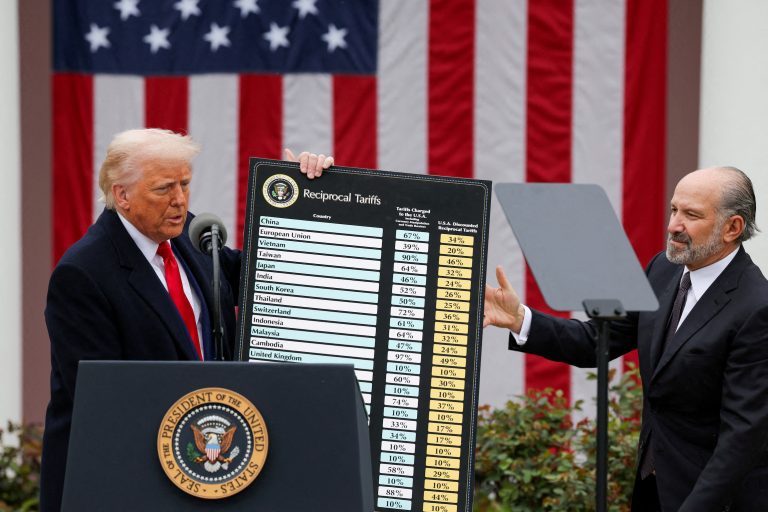
April 2 – He announces global tariffs with a baseline of 10 percent across all imports and significantly higher duties on some of the United States’ biggest trading partners.
April 9 – Trump pauses for 90 days most of his country-specific tariffs that kicked in less than 24 hours earlier following an upheaval in financial markets that erased trillions of dollars from bourses around the world.
The 10 percent blanket duty on almost all U.S. imports stays in place.
Trump says he will raise the tariff on Chinese imports to 125 percent from the 104 percent level that took effect a day earlier. This pushes the extra duties on Chinese goods to 145 percent, including the fentanyl-related tariffs imposed earlier.
April 13 – The U.S. administration grants exclusions from steep tariffs on smartphones, computers and some other electronics imported largely from China.
April 22 – The Trump administration launches national security probes under Section 232 of the Trade Act of 1962 into imports of both pharmaceuticals and semiconductors as part of a bid to impose tariffs on both sectors.
May 4 – Trump imposes a 100 percent tariff on all movies produced outside the U.S.
May 9 – Trump and British Prime Minister Keir Starmer announce a limited bilateral trade agreement that leaves in place 10 percent tariffs on British exports, modestly expands agricultural access for both countries and lowers prohibitive U.S. duties on British car exports.
May 12 – The U.S. and China agree to temporarily reduce reciprocal tariffs. Under the 90-day truce, the U.S. will cut the extra tariffs it imposed on Chinese imports to 30 from 145 percent, while China’s duties on U.S. imports will be slashed to 10 from 125 percent.
May 13 – The U.S. cuts the low value “de minimis” tariff on China shipments, reducing duties for items valued at up to $800 to 54 percent from 120 percent.
May 23 – Trump says he is recommending a straight 50 percent tariff on goods from the European Union starting on June 1. He also warns Apple it would face a 25 percent tariff if phones it sold in the U.S. were manufactured outside of the country.
May 25 – Trump backpedals on his threat to slap 50 percent tariffs on EU imports, agreeing to extend the deadline for talks until July 9.
May 28 – A U.S. trade court blocks Trump’s tariffs from going into effect in a sweeping ruling that the president overstepped his authority by imposing across-the-board duties on imports from U.S. trade partners.
The Trump administration says it will appeal the ruling.
May 29 – A federal appeals court temporarily reinstates the most sweeping of Trump’s tariffs, pausing the lower court’s ruling to consider the government’s appeal, and orders the plaintiffs in the cases to respond by June 5 and the administration by June 9.
June 3 – Trump signs an executive proclamation activating a hike in the tariffs on imported steel and aluminum to 50 from 25 percent.
June 12 – Trump warns that he may soon hike auto tariffs, arguing that could prod automakers to speed U.S. investments.
July 3 – Trump says the U.S. will place a 20 percent tariff on many Vietnamese exports, with trans-shipments from third countries through Vietnam facing a 40 percent levy.
July 6 – Trump says on Truth Social that countries aligning themselves with the “Anti-American policies” of BRICS will be charged an additional 10 percent tariff.
July 7 – Trump says on Truth Social the additional higher duties announced in earlier months will kick in with delay on August 1, as the U.S. closes on completion of several trade deals.
In letters sent to 14 countries including Japan, South Korea, and Serbia, he says he will introduce tariffs between 25 percent and 40 percent from August 1.
July 10 – Trump says the U.S. will impose a 35 percent tariff on imports from Canada next month and plans to impose blanket tariffs of 15 or 20 percent on most other trading partners.
Reuters contributed to this report.