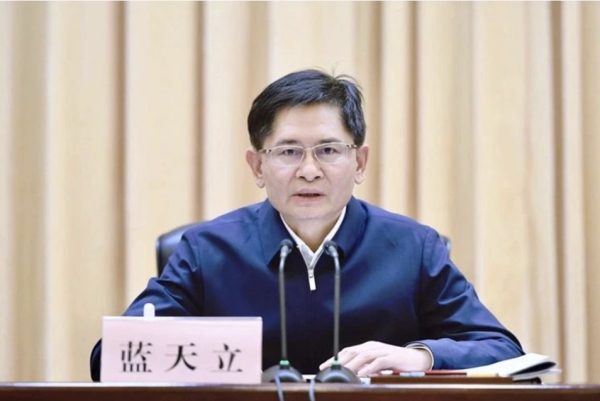
The governor of China’s southern Guangxi region, Lan Tianli, has been abruptly placed under investigation for “serious violations of discipline and law,” as announced by the Communist Party’s Central Commission for Discipline Inspection (CCDI) on May 16.
According to state mouthpiece Xinhua, Lan was still working as recently as May 11, conducting local inspections then and the previous day, and showing up for a discussion meeting in the evening of May 11.
Lan is also the deputy Communist Party secretary of Guangxi.
On May 16, the Guangxi Party Committee Standing Committee held an expanded meeting to announce the investigation into Lan. The regional CCP branch committee announced at the meeting that it firmly supported the central CCP’s decision and praised the probe as reflecting the “resolute determination and strong will” of the Party with Xi Jinping as its leader to “consistently and thoroughly advance the comprehensive and strict governance of the Party.”
- ‘Vast Technocratic Bureaucracy’ Said to Be Aiming for Removal of Xi Jinping
- Cracks in the ‘Iron Rice Bowl’: Chinese Workers, Government Employees See Their Wages Delayed, Benefits Cut
Four bureau-level officials in Guangxi, all high-ranking members of the regional CCP, were also placed under investigation between May 9 and May 14. Some of their assignments overlapped with the areas that Lan Tianli served in.
Success
You are now signed up for our newsletter
Success
Check your email to complete sign up
For instance, one of those purged, Pan Liaoting, was deputy general manager of Guangxi Beibu Gulf International Port Group. Lan, meanwhile, had been promoted to vice governor of Guangxi in November 2011, a role that saw him tasked with overseeing regional cross-border trade initiatives, including the Beibu Gulf Economic Zone.
Another such trade initiative was the China–Malaysia Qinzhou Industrial Park. Zhong Hengqin, Standing Committee member of the Qinzhou Municipal Party Committee and Qinzhou vice mayor, was another one of the bureau-level officials put under investigation.
Rare earth smuggling and ‘iron-cap princes’
SinoInsider, a risk consultancy focusing on Chinese politics, noted in a May 22 newsletter entry that the last provincial level official to be investigated by the CCP disciplinary authorities was Jin Xiangjun.
Jin, who was investigated starting April 12, had served as the governor of Shanxi Province since late 2022. From 1998 to 2018, he worked in the Guangxi regional government before being transferred out of the area.
- China Issues Pay Raise for Civil Servants Amid Economic Slump, Sparking Public Ire
- Beijing and Vietnam Ink Agreements During Xi’s Hanoi Visit as US Tariff Pressure Looms
- In Rare Admission, Xi Jinping Says China’s Economy Is Struggling (January 2024)
At the May 16 meeting of the Guangxi CCP committee discussing Lan Tianli’s investigation, it was said that his case serves as a warning that no Chinese officials enjoy the benefits of “red books and iron coupons” (丹書鐵券, i.e. no “get-out-of-jail-free” card), and that no one may consider himself an “iron-cap prince” (鐵帽子王, or someone who is above the law).
Lan himself had a long career in the government of the Guangxi Zhuang Autonomous Region, as the provincial-level region is officially known. After becoming GZAR vice governor in 2011, in 2018 he was promoted to chair the Guangxi People’s Political Consultative Conference, an important interface organization between the CCP and the Chinese public.
The SinoInsider analysts also drew connections between the downfall of Lan Tianli, recent efforts by the Chinese authorities to crack down on the illegal export of rare earth minerals, and long-standing factional struggle between CCP general secretary Xi Jinping and his opponents in the regime.

- Fear in the Forbidden City (September 2023)
- ‘Disappeared’ Former Chinese Foreign Minister Qin Gang Demoted but ‘Off the Hook’ From Jail: Report (September 2024)
In recent months, the CCP has been leveraging China’s dominance in rare earth mineral mining to strengthen its position in trade negotiations with the United States, which relies on Chinese goods for its high-tech production.
Guangxi contains China’s largest and most important deposits of rare earth elements. China, in turn, has the most complete rare earth industry chain, with 86 percent of global rare earth processing dependent on Chinese capacity — and hence Beijing’s good graces.
Cracking down
On May 9, the Office of China’s National Export Control Coordination Mechanism convened a special meeting with various departments to launch a crackdown on the smuggling of strategic mineral exports.
Local authorities from provinces such as Inner Mongolia, Jiangxi, Hunan, Guangdong, Guangxi, Guizhou, and Yunnan were represented at a second meeting — as were various central government departments — held on May 12 in Changsha, Hunan Province to discuss the implementation of the crackdown.
The May 9 meeting noted that despite China’s export controls on a number of rare earths, “some foreign entities have colluded with domestic criminals and have been constantly devising new smuggling methods in an attempt to evade enforcement.”
- Over 1 Million Taiwanese Participate in Movement to Recall ‘Pro-Communist’ Legislators
- Watchdog Report: CCP Using Belt and Road to Expand Organ Harvesting Network
Smuggling of rare earths out of China potentially makes up a significant portion of the country’s total exports and could confound the CCP’s efforts at controlling its trade.
SinoInsider in its May 22 newsletter wrote that Guangxi, located on the Sino-Vietnamese border, “has long grappled with systemic corruption and various forms of smuggling,” adding that “Guangxi officials like Lan Tianli are likely to have had a hand in smuggling operations or facilitating smuggling.”
It pointed to a 2022 ruling by the Guangxi High court on a case in which smugglers misdeclared 8,183.445 tons of high-value minerals like antimony ingots as low-value goods, with a case value of 170 million yuan — “equivalent to 20.5 percent of China’s 2022 antimony ingot exports,” the analysts noted.
“Rare earth smuggling appears to be undermining the PRC’s strategic material export controls and driving down prices amid the restriction of supply,” SinoInsider wrote, citing China’s Hua Jing Industry Research Institution.
The central Chinese authorities directing Xi’s anti-corruption campaign to focus on the Guangxi officialdom would be a natural consequence as “Beijing comes to grips with the Sino-U.S. trade war and other issues pertaining to rare earths and other strategic materials.”
High-level factional struggles reaches Guangxi
SinoInsider’s analysis observed that Guangxi has been largely and “curiously” spared serious bureaucratic upheaval in the course of Xi’s lengthy anti-corruption campaign.
One potential reason for the lack of activity affecting local officials in the GZAR could be the ties between Guangxi cadres and powerful figures associated with Jiang Zemin, the former CCP regime head who dominated Chinese politics between the late 1990s and when Xi came to office in 2012.
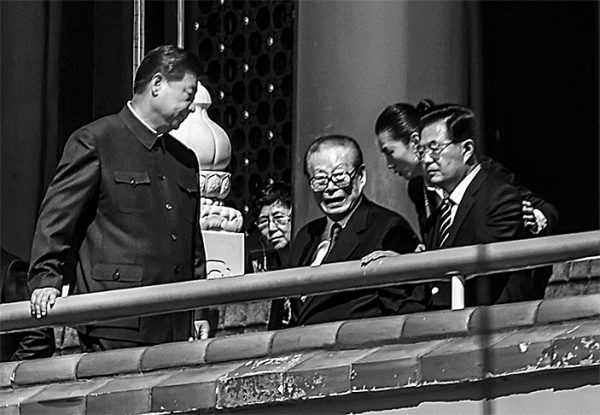
Though Jiang himself died in 2022 and Xi has increasingly consolidated power in the CCP in the 13 years since assuming leadership, members of the remnant Jiang faction continue to wield influence via their patronage networks behind the scenes.
“Guo Shengkun, a Jiang faction lieutenant and former Politburo member who was Guangxi Party secretary from 2004 to 2012, previously headed major SOEs in the nonferrous metals sector,” SinoInsider noted.
“Large-scale rare earth smuggling is typically controlled by state-owned enterprises backed by elite factions and Party princelings” (“princelings” refers to descendants of CCP officials and generals who took part in bringing the communists to power), the analysis reads. Due to continuous protection of lower-lower officials and their illicit activities such as Lan Tianli by the Jiang faction, the Xi leadership may not have felt it necessary to move against the regional Party leadership in Guangxi until recently.
In describing the possible connection to the Xi-Jiang struggle, SinoInsider wrote:
“The most notable sign that Lan’s investigation is connected with factional struggle is the warning to officials made at the May 16 expanded meeting of the Guangxi Party Committee Standing Committee. The meeting made a rare reference to “red book and iron coupons” and ‘iron-cap princes,’ or phrases that the Xi leadership previously used when targeting Zeng Qinghong, Jiang Zemin’s former political enabler and current de facto leader of the remnant Jiang faction.”
“That the Guangxi Party Committee Standing Committee would choose those phrases suggests direct input from the Xi leadership,” the analysis adds.