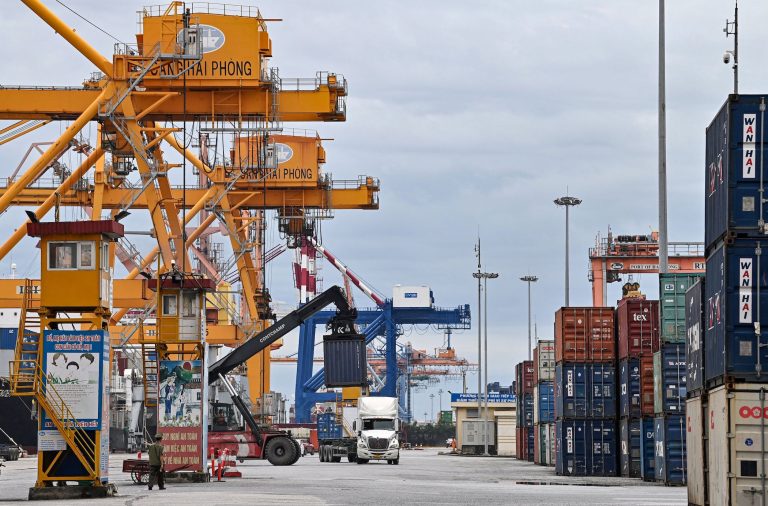
The Trump administration on July 2 concluded a trade agreement with Vietnam that subjects the Southeast Asian country’s exports to a 20 percent tariff, while Chinese goods transshipped via Vietnam to the U.S. are taxed at a higher rate of 40 percent.
Washington has been engaged in high-level trade talks with China in an attempt to even out the nearly $300 billion trade deficit and have Beijing open its markets.
Chinese goods exported directly to the United States are currently subject to a 30 percent tariff. Since the U.S.–China trade war began under the first Trump administration in the late 2010s, Chinese producers have skirted American duties by transshipment — exporting to the U.S. via third countries.
Vietnam agreed not to place tariffs on U.S. goods.
In early April, President Donald Trump announced tariffs on dozens of countries in what he termed “Liberation Day,” but the following week postponed those tariffs for 90 days, leaving them at the base rate of 10 percent, something the president had promised on the campaign trail.
Success
You are now signed up for our newsletter
Success
Check your email to complete sign up
Many countries were slated to have high tariff rates imposed on them, including U.S. allies such as Canada, Japan, Taiwan, and others.
- Nippon Steel to Raise $5.6 Billion in Subordinated Loans to Fund US Steel Purchase
- China’s ‘Internal Circulation’ Trade Policy Invites Backlash for Maximizing Exports, Restricting Imports
With the 90-day deadline reached on July 9, on July 7 Trump announced tariffs of varying rates on over 12 countries, including 25 percent tariffs on Japan and South Korea, writing to their prime minister and president, respectively, that this was “far less than what is needed to eliminate the Trade Deficit disparity we have with your Country.”
The new U.S. tariffs are to go into effect on Aug. 1 so as to allow more time for negotiations.
Discussions and delays
So far, only Vietnam and the United Kingdom have reached trade deals with Trump. The UK has secured a base 10 percent tariff.
On July 8, Treasury Secretary Scott Bessent said that the U.S. could collect $300 billion in tariffs this year, and has already taken in $100 billion. Tariffs are a central aspect of the Trump administration’s economic agenda, with proponents arguing that they can be used to raise government revenue in lieu of other taxes.
Talks with Japan have been at an impasse, with the U.S. president demanding Tokyo lower import barriers to American cars, rice, and other products, as well as take on more of the costs of hosting U.S. military bases. Japanese officials have pointed to the low domestic demand for these products, and Japan currently pays for 75 percent of U.S. military basing costs
Similar issues are affecting the trade talks between Taiwan and South Korea, important allies that the U.S. State Department has been trying to bolster strategic ties with in the face of Communist China’s growing military power.
South Korea recently saw the election of left-leaning President Lee Jae-myung following the impeachment of his right-wing predecessor, Yoon Suk-yeol, who fell from grace after a botched martial law attempt last December. While continuing to stress the U.S.-South Korean military alliance, Lee and others in his Democratic Party are seen as taking a more neutral stance in balancing economic relations between the U.S. and China.
Taiwan, which produces cutting-edge semiconductors, was not among the countries that received tariff letters from Trump.
Trump also issued letters imposing tariffs of 40 percent on Burma (also known as Myanmar), 40 percent on Laos, 30 percent on South Africa, 25 percent on Kazakhstan, 25 percent on Malaysia, 25 percent on Tunisia, 32 percent on Indonesia, 35 percent on Bangladesh, 35 percent on Serbia, 36 percent on Cambodia, 36 percent on Thailand, and 30 percent on Bosnia and Herzegovina.
Dealing with China
The agreement Trump has reached with Vietnam, though one of only two deals concluded at the time of publication, highlights the manner in which the U.S. hopes to put pressure on Beijing in its talks with the world’s second-biggest economy.
Other countries that face high tariffs from the U.S. due to the high volume of Chinese transshipments include Cambodia, Madagascar, and Lesotho.
On July 3, a spokesperson for the Chinese Ministry of Commerce said that the Chinese communist regime “firmly opposes any party reaching a deal at the expense of China’s interests” and that “China will resolutely counter it.”
- US Strikes on Iranian Nuclear Facilities Deliver Stark Message to Beijing
- Xi’s Lost Control. Or Has He?
In May, right after a visit from Chinese leader Xi Jinping, the Vietnamese government had issued guidelines for its trade ministry to crack down on unwanted transshipments, saying this would jeopardize trade talks ongoing at the time.
Meeting in London in early June, the U.S. and China agreed to a trade deal framework that restored market confidence following a bout of escalating tariffs on both sides that saw U.S. rates on Chinese goods reach 145 percent before Beijing and Washington both lowered them.
In addition to tariffs, China has also restricted exports of rare earth elements, crucial for the manufacture of high-tech goods, before nominally lifting those barriers following the initial talks in June. China is especially strong in rare earths due to its well-developed mining and processing infrastructure primarily in the country’s southwest.
Trump said following the framework agreements that Beijing had agreed to a 55 percent tariff rate on its exports to the U.S., while American goods will be subject to a 10 percent Chinese tariff.
On June 25, Trump said that the U.S. and China had reached a further agreement, but did not offer any details except that “we’re starting to open up China.”
The extremely high tariffs Trump initially imposed on China have been delayed until Aug. 12, by which time the U.S. expects to reach a trade deal with Beijing.
Amid the talks, U.S. Secretary of Agriculture Brooke Rollins on July 8 unveiled a seven-point “National Farm Security Action Plan” that, among other ordinances, seeks to “address U.S. foreign farmland ownership from adversaries.”
While Trump declined to answer reporters’ questions about the policy on July 9, the Department of Agriculture’s plan describes China as being among those countries whose land investments in the United States will be targeted, along with other adversarial states such as Russia and Iran.