Commentary by Li Deyan and Janet Huang, Vision Times
A mysterious video has emerged from mainland China, reportedly showing a strange convoy moving through one of Beijing’s most politically sensitive areas — Chang’an Avenue — late at night. The vehicles were completely covered in blue rain canopies, concealing even their wheels, and were each flanked by large white canopy vans.
The timing of the video coincides with the recent appointment of Jin Shanwen as deputy secretary of the Central and State Organs Working Committee, serving under Cai Qi. Jin’s appointment has sparked speculation that he was placed there by former CCP leaders Hu Jintao and Wen Jiabao to counter Cai’s influence.
Bizarre convoy spotted in Beijing
The footage, which first surfaced on Chinese social media platform Xiaohongshu, shows civilian traffic being blocked off with barricades as a heavily concealed convoy passes through undisturbed. The blue trucks at the head of the line bore signs reading “Road Inspection Vehicle,” yet none resembled typical utility or maintenance vehicles.
Each truck was encased in a blue tarp supported by metal frames, obscuring every detail — including the wheels. Only small slits at the front and rear were visible, presumably for navigation. From certain angles, the internal support structure of the canopy could be faintly seen through the rear window.
Success
You are now signed up for our newsletter
Success
Check your email to complete sign up
Accompanying each vehicle was a white canopy van, driving alongside on the convoy’s right flank. Meanwhile, figures could be seen jogging along the sidewalk beside the vehicles.
Netizens quickly began speculating, with many suggesting that the blue canopies were hiding tanks. “If they weren’t tanks, why hide the wheels?” one user asked. Others pointed out that the pairing of shrouded trucks and escort vans resembled military logistics or troop movements rather than routine inspections.
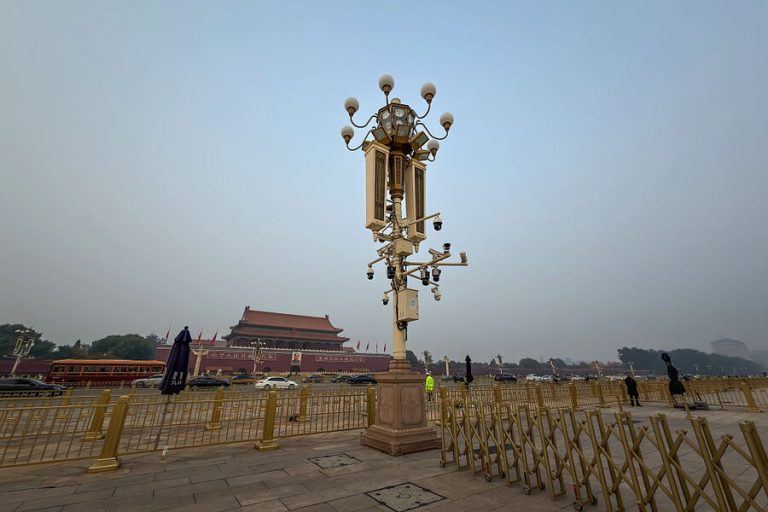
Judging by landmarks and buildings, some observers believe the video was filmed near the intersection of Chang’an Avenue and Wangfujing — an area just steps from Tiananmen Square and the heart of China’s political power.
Ghost convoy sparks alarm
U.S.-based Chinese commentator Tang Jingyuan called the footage “highly intriguing” in an analysis on his media channel. He noted that ever since the Tiananmen massacre in 1989, the movement of tanks or armored vehicles within Beijing — especially along Chang’an Avenue — has been an extremely delicate matter. Even during national parades, armored units are typically rerouted along peripheral roads to avoid visibility.
RELATED: Beijing Courts Global Influencers in New Propaganda Push to Shape Public Opinion
The suggestion that the vehicles might be preparing for the upcoming military parade on Sept. 3 is plausible, Tang said. He explained that equipment for parades usually enters Beijing through Jianguomen before staging in the Tongzhou military base. The convoy in the video did appear to be heading east—toward Tongzhou.
Still, what struck many as unusual was the level of secrecy. Every vehicle was shrouded top to bottom, including its headlights, despite the CCP already having publicly announced the parade. Typically, such events are promoted with pomp and media coverage — not covert nighttime convoys down politically charged boulevards.
If this was simply part of parade prep, Tang questioned, why conceal the vehicles so thoroughly? “A grand display of military might would normally be welcomed,” he noted, adding that the route only fueled more curiosity rather than quelling it.
Tang also pointed out that if discretion were the goal, quieter routes like the Fifth or Sixth Ring Roads would have sufficed. Those highways offer ample space and fewer public eyes — eliminating the need for disruptive roadblocks and increasing operational secrecy.
More unusually, the convoy’s headlights were deliberately disabled. Every armored vehicle was dependent on a guiding van, driving in tandem. According to Tang, this may have been a deliberate tactic to keep the drivers unaware of their destination. Without headlights or GPS navigation, the convoy would be forced to follow its escort blindly—further suggesting that secrecy, even from those involved, was a priority.
The result, he said, was a “ghostlike procession”: a line of hidden, headlight-less vehicles rolling quietly down the nation’s most iconic political avenue.
Implications beyond the parade
Although the video clip was just 40 seconds long, Tang emphasized the broader implications. If this were truly a parade rehearsal, he argued, the number of vehicles would be larger and the secrecy less extreme. Instead, the operation appeared unusually clandestine — raising the possibility of a sensitive mission rather than a celebratory march.
Tang speculated that the vehicles might be armored personnel carriers (APCs) rather than tanks, given the lack of turret outlines beneath the canopies. That raises additional questions: Were the APCs transporting troops? If so, where — and for what purpose?
State-affiliated media offered a more benign explanation: that the convoy was conducting a load-bearing test in preparation for the parade. But Tang was skeptical. “If it were a standard pre-parade operation,” he said, “there would be no need to hide the vehicles so thoroughly. The authorities could simply let them drive through openly, properly labeled as part of a road test.” The excessive secrecy, he concluded, suggests something far more sensitive was being concealed.
Political power play behind the scenes?
The bizarre convoy footage coincides with a notable shift inside Beijing’s power structure. On July 7–8, CCP leader Xi Jinping toured Shanxi Province, but conspicuously absent was his close ally Cai Qi, who remained in Beijing. Instead, Cai appeared at a war memorial event in the capital — an appearance that, according to commentator Li Muyang, upstaged Xi’s lower-profile visit.
Cai currently holds several powerful positions, including Director of the CCP Central Office and Secretary of the Central and State Organs Working Committee — a critical political organ within Zhongnanhai. However, a series of recent personnel changes suggests a weakening of his political footing.
Two of Cai’s longtime deputies, Zou Xiaodong and Cai Shumin, were both reassigned or demoted in recent weeks. Their replacement, Jin Shanwen, is notable for his low profile and close ties to former CCP leaders Hu Jintao, Li Ruihuan, and Wen Jiabao.
On May 29, Zou was transferred from his deputy secretary post to lead the State Council’s Counselors’ Office—a demotion in both influence and visibility. Zou, long considered a key figure in Xi Jinping’s “New Zhijiang Army,” had worked closely with Cai since their time in Zhejiang. His removal, Li Muyang argues, was a significant political setback for Cai.
Similarly, Cai Shumin’s role has been quietly scrubbed from the Working Committee’s leadership roster. On June 23, the site was updated to show Jin Shanwen as Cai Qi’s new deputy, with no reference to Cai Shumin’s new position.
Jin Shanwen, born in Anhui Province, shares a political and regional background with several Hu-Wen era officials. He spent most of his career within the All-China Federation of Trade Unions and served under three consecutive chairmen: Wang Zhaoguo, Li Jianguo, and Wang Dongming — all of whom are linked to the Hu-Wen political camp.
Hu-Wen network re-emerges
All three of Jin’s former superiors have deep ties to China’s pre-Xi political establishment. Wang Zhaoguo once served as Director of the Central Committee’s General Office, where both Hu and Wen worked under him. Li Jianguo was chief of staff to senior party elder Li Ruihuan. Wang Dongming, too, served as Wen Jiabao’s top aide during his premiership.
Jin Shanwen’s appointments under each of them point to a political lineage rooted in the Hu-Wen camp. Now placed in a sensitive role directly under Cai Qi, the appointment appears more than coincidental.
According to Li Muyang, the shake-up hints at an effort by retired leaders to push back against Xi Jinping’s influence by reasserting themselves within central party organs. The move could also signal that Cai Qi is being sidelined — or even quietly placed under watch.
Barton, a senior researcher at Czech think tank Sinopsis, echoed that view, suggesting the maneuvering reflects broader political turbulence within the CCP. He warned that the sidelining of Xi’s allies may point to rising internal pressure — possibly putting Xi himself at risk of being pushed from power.