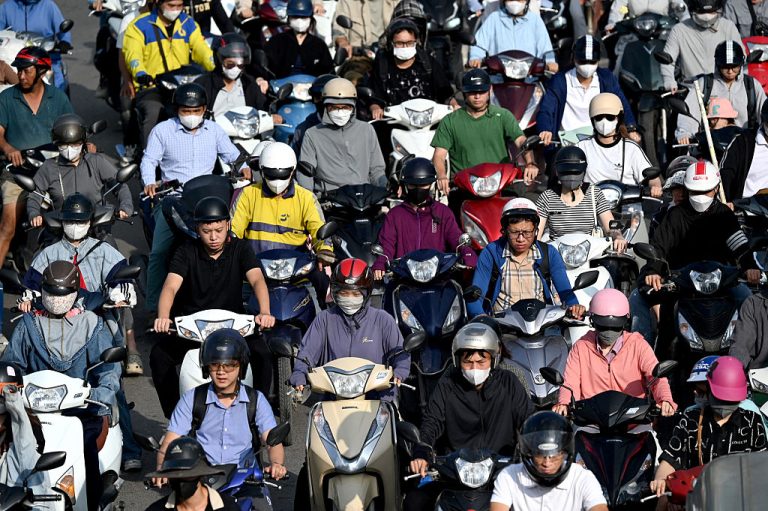
Motorcycles and mopeds have traditionally been the primary mode of transportation for Vietnam’s over eight million residents in Hanoi.
However, in a move to combat air pollution, the Vietnamese government is planning to ban gas-powered motorbikes in central Hanoi starting July 2026, state media reported on July 21.
Under Directive 20/CT-TTg, the city will prohibit the usage of internal combustion engine (ICE) motorcycles in the area within the main ring road — Ring Road 1 — around the city center, which has around seven million motorbikes and one million cars. These areas include the popular Hoan Kiem and Ba Dinh districts, where heavy traffic emits high levels of pollution.
Data from Hanoi’s Department of Transport (now the Department of Construction) reads that the capital had around 6.9 million motorbikes at the end of 2024; 6.4 million of them running on gasoline.
Future expansions of the directive are planned for the other two ring roads — Ring Roads 2 and 3 — in 2028 and 2030 respectively.
Success
You are now signed up for our newsletter
Success
Check your email to complete sign up
The government, under the orders of Prime Minister Pham Minh Chinh, made the plan to replace gas-powered vehicles with electric ones to curb air pollution and climate change.
According to local EV manufacturer VinFast, while it controls about 20 percent of the overall market, its share of the two-wheeler market is still minor.
The directive is scheduled to be expanded in 2028, widening the geographical range of the ban and also including private cars.
Hanoi also plans to upgrade its electric bus fleet, introducing 8- to 12-seater and 4-seater electric vehicles to operate within the inner city. Charging stations would also be made available in public parking lots and residential areas.
READ MORE:
- US Launches Rare Earth Pricing Push as E-Waste Recycling Gains Momentum
- US Targets Chinese Goods With Vietnam Trade Deal
- Croatia Opens ‘Red History Museum’ Exhibiting Communist Past Under Yugoslavia
Concerns of the people
Despite the environmental benefits, the plan has sparked concerns of its impact on low-income residents, who rely on motorbikes to get through their daily lives.
”It will affect people who rely on motorbikes to earn a living,” Nguyen Van Hung, a three-decade motorbike taxi driver, told the Associated Press. “How can people just discard their vehicles?”
Others also said that the directive is too sudden, without enough time to consider any financial reasoning.
”The life cycle of a car lasts for several decades, not just a few years or a few months,” Pham The Anh, an economics professor, wrote on Facebook. “The policy roadmap must be announced long enough before being applied so that people can proactively choose” their mode of transportation.
Experts predict that once gas-powered motorbikes are phased out of Hanoi, the vehicles would move to the city’s outskirts or nearby provinces; areas with fewer restrictions on emissions and no bans on older models.
This would, however, prompt “gas bike dumping” in rural areas, which would move the pollution elsewhere. Moreover, older vehicles may be sold cheap or abandoned, stacking up mechanical waste.
Other concerns are also directed at the city’s infrastructure, with worries that Hanoi is not prepared for the transition to electric-powered vehicles.
”Motorcycles are essential for economic activity, especially in densely populated cities and rural areas where public transport is lacking,” Kho’o’ng Kim Tao, former Deputy Chief of the National Traffic Safety Committee Office, said.