On July 28, Thailand and Cambodia agreed to a ceasefire, ending a five day dangerous border dispute that caused at least 43 deaths and displaced thousands.
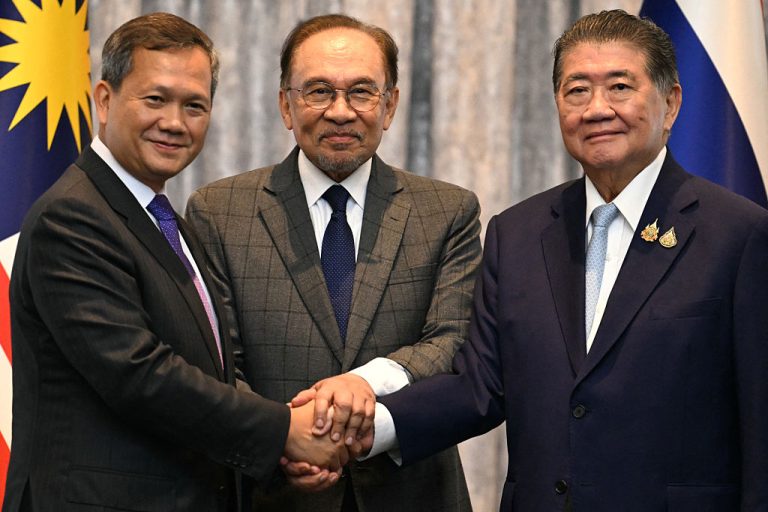
Negotiations for the ceasefire were held by Malaysia’s Prime Minister Anwar Ibrahim, who is also the current chair of the ASEAN regional bloc. Cambodia’s Prime Minister Hun Manet and Thailand’s acting Prime Minister Phumtham Wechayachai shook hands, celebrating the armistice and the end to the conflict.
“Today we have a very good meeting and very good results… that hope to stop immediately the fighting that has caused many lives lost, injuries, and also caused the displacement of people,” Hun Manet said.
Phumtham also said the deal would be “carried out successfully in good faith by both sides.”
According to Radio Free Asia (RFA), citing a source, gunfire near the Ta Muan Thom and Ta Kwai temples had stopped. Artillery strikes fired near the Cambodian city of Samraong also ceased, as reported by a reporter for Agence France-Presse (AFP).
Success
You are now signed up for our newsletter
Success
Check your email to complete sign up
After the ceasefire deal was made, military commanders from both sides were required to meet on Tuesday to settle relations. On Aug. 4, Cambodia will host a meeting for the General Border Committee, mandating foreign and defense ministers of Cambodia, Thailand and Malaysia to develop plans and maintain the truce.
As of July 30, around 43 people were confirmed killed. Thailand had lost 15 soldiers and 15 civilians, while Cambodia saw eight civilians and five military personnel dead, The Guardian wrote.
During the conflict, more than 200,000 people in both countries were displaced from their homes, many taking shelter in makeshift evacuation centers. Photos have shown people queuing up for food and tents to sleep in.
READ MORE:
- Vietnam Moves to Phase Out Gas-Powered Motorbikes in Central Hanoi in 2026
- Mount Lewotobi Laki-laki Erupts Twice Producing Giant Ash Cloud
- Power and Propaganda: Observable Indications About Whether Xi Has Lost Control
Claims of ceasefire violation
Following the ceasefire, Thailand accused Cambodia of “deliberately” breaching it, saying it took continued gunfire from Cambodian soldiers “at multiple locations.”
Speaking to AFP, Cambodia’s defense ministry said there were “no armed clashes” following the ceasefire.
Shortly after, a second accusation was made, claiming that Cambodian troops launched another attack on the border.
”This represents a flagrant violation of the ceasefire agreement,” Thailand’s foreign ministry said in a statement.
Relations between Cambodia and Thailand have been strained since 2008, when the former tried to register a temple from the 11th century in a disputed location as a UNESCO World Heritage Site, which attracted Thailand’s ire.
With sporadic clashes between the two over the years, relations hit an all-time low in May, which saw restrictions, bans on imports and escalated troop deployments across the border.
Months later, a Cambodian soldier was killed in a clash. Soon after, five Thai soldiers were injured in a landmine explosion, leading to the five-day conflict.
Other than Malaysia’s efforts, economic pressure from both the U.S. and China also influenced the need for a ceasefire.
Being the chair of ASEAN since Jan. 1, Anwar Ibrahim’s efforts to mediate peace between Thailand and Cambodia have been hailed by members of ASEAN and other countries, including the U.S., several European nations and Australia.
This diplomatic victory came as Anwar’s leadership as Prime Minister was questioned following a rally in the capital of Kuala Lumpur, where thousands called for his resignation.