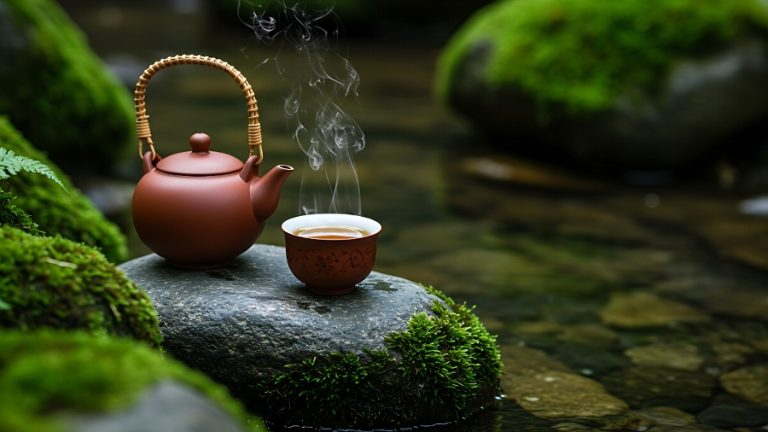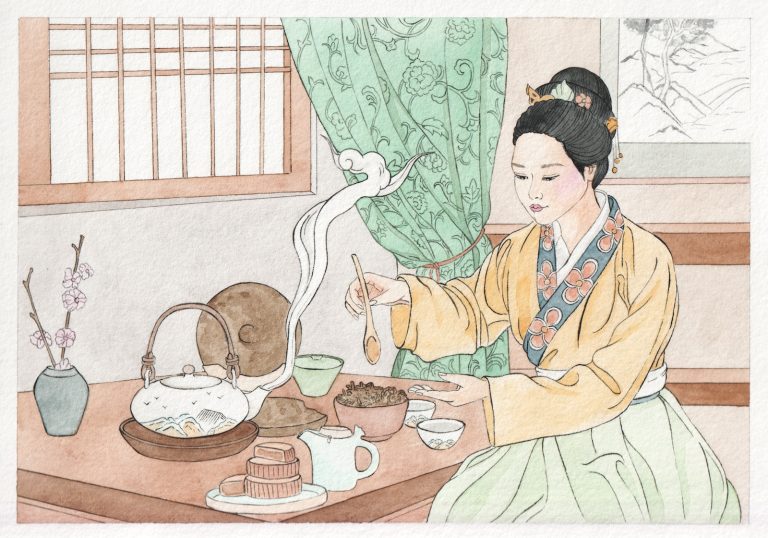
The seven necessities for daily life in China, as described during the Song Dynasty, were “Firewood, rice, oil, salt, soy sauce, vinegar, and tea.” As insignificant as it may seem, tea was a fundamental element of existence that developed into an enduring tea culture.
First discovered in China over 5,000 years ago, tea has a rich history of evolving customs and applications. The simple act of taking a cup of tea after a meal is an important cultural tradition, inspiring the couplet: “A cup of spring tea temporarily keeps a guest, a simple and clean life inspires one to become immortal.”
According to Chinese legend, Shennongshi, “the Divine Farmer,” discovered tea some 4,800 years ago, during his humanitarian effort to discover medicinal herbs and help people stay healthy. Shennongshi was endowed with a transparent belly, so he could see the effect of each plant that he ingested.
One day he tasted the foliage from a white-flowered, evergreen shrub, and observed it moving around and cleaning up his stomach. The leaves also left a fresh, clean taste in his mouth. Since the leaves acted like a doctor, he called them 察 “cha” (examine), later changed to 茶 “cha” (bitter plant). Believing tea was a gift from the gods for his kindness, he used the leaves to detoxify whenever he tasted poisonous plants.
Once, he encountered 72 poisons in one day and used tea as an antidote. Tea not only neutralized poison, it also had a stimulating effect. The helpful plant was cultivated and, over time, its use extended well beyond medicine. From a refreshing beverage consumed daily, to a spiritual offering of ceremonial status, join us in the fascinating evolution of tea culture, and what it can teach us.
The Development of Tea

Success
You are now signed up for our newsletter
Success
Check your email to complete sign up
Early tea was a bitter concoction of foraged leaves, boiled in a pot. This was called 粥 茶 (zhōu cha), or porridge tea. By the Qin and Han dynasties, tea leaves were pressed into “cakes” and baked for preservation. The dry cakes were ground into powder, and mixed with other dried ingredients like scallions, ginger, and orange peels to make a more flavorful 茶 烤 (kǎo cha), or baked tea.
In the Tang dynasty, Lu Yu, after years of research, wrote 茶 經 Cha Jīng (Tea Sutra), detailing methods from growing and harvesting tea to making and tasting it; thus shaping the earliest Dao of tea. At this time, tea was brewed in bowls from a fine powder made by grinding and sifting the tea cakes.
With this refined status, tea culture flourished, and “tea drinking” was transformed to “tea tasting” among the upper class. Tea became a ceremonial offering at palace banquets, temples, and scholarly gatherings. Such events demanded high-quality tea, pure spring water, and premium tea service, with the banquet master himself preparing the tea to honor the guests. Upon receipt, guests would take time to admire the aroma, flavor, and quality of their tea before partaking in conversation, reflecting on the scenery, or composing prose or poetry.
Tea drinking was simplified in the Ming dynasty, when loose tea leaves were brewed directly in pots or cups. The fast pace of more modern life brought tea bags, instant teas and herbal blends for health, with most people “drinking” rather than “tasting” their tea; but this deviates from the “Dao of tea.”
Lao Zi said, “The Dao can be called the Dao, but it is not an ordinary Dao” and “The Dao is extensive and is everywhere right beside you.” The Dao is to follow nature, as stated in The Golden Mean: “The mandate of heaven is called nature; to follow nature is called the Dao.” In Cha Jing, Lu Yu, also known as the “Sage of Tea,” reflected on the integration of tea and the Dao.
Tea Culture and the Dao

On the surface, the Dao of tea involves etiquette, practices, methods, techniques, arts, and essence — six aspects from which the spirit of the Dao of tea can be understood. While these techniques are the primary focus, the ultimate goal is to grasp the spirit.
All phenomena, including cosmic rotation, human life cycles, and dynastic change, can be said to follow the Dao’s law of creation, stasis, degeneration, and destruction. Ancient Chinese people regarded the Dao as profound and solemn. By following the Dao, one could return to one’s original, pure nature, reuniting with the Divine.
Today, many Chinese people regard the Dao as superstition, and not worth following. In the past, it was a meritorious pursuit of all trades — including tea tasting. Honoring China’s rich tea culture can serve as an instrument for preserving and passing on traditional Chinese culture. As Liu Zhenliang listed in his Ten Virtues of Tea, tea is helpful in “practicing the Dao” and “refining one’s aspirations.” Then what is the Dao of tea?
Inner tranquility
The Dao of tea values being “harmonious, calm, contented, and truthful,” since one can only achieve the goal of selfless benevolence with inner tranquility. Reflected on the outside, it is an easy-going serenity through which one enjoys life. In tea tasting, one must release the mental burdens of fear and anxiety to fully appreciate the tea’s appearance, flavor, fragrance, and form. This way, one can reflect on life, cultivate temperament, and savor contentment.
Understanding bitterness
Tea’s bitter, yet pleasant flavor prompts one to reflect on the bitter-sweetness in life. Buddhism teaches that every stage in the cycle of life, plus grievances, partings, and unfulfilled desires all bring suffering. It is said, “The sea of suffering is boundless; yet with a turn of the helm one can return to the shore.” Tea helps us accept the natural order of bitterness followed by sweetness, find joy in hardship; and through this understanding, transcend the mundane world of suffering.
Embracing simplicity
The sixteenth century Japanese tea ceremony master Sen no Rikyu once advised, “… know that the nature of tea is no more than boiling water to make tea.” This captures the Dao of tea: understanding life and the universe through daily simplicity. Similarly, cultivation in Buddhism and Daoism involves enlightening to great principles through ordinary practice. Ancient sayings advise us to conduct ourselves well; since even the smallest good deed accumulates virtue, while committing even small wrongs may bring misfortune.
Letting go
The Buddha taught that enlightenment requires releasing attachments — including worries, reputation, personal interests, desires, and all one clings to in life. We suffer because we cannot let go of these things. Letting go brings peace, comfort and clarity; and the world suddenly appears brighter and more beautiful. Tea tasting also emphasizes setting aside our daily concerns to relax the mind and be present in the moment.
放下亦放下 (Fàngxià yì fàngxià)
何處來牽掛 (Hé chǔ lái qiānguà)
做個無心人 (Zuò gè wúxīn rén)
笑談星月大 (Xiào tánxīng yuè dà)
Let go, just let go
What is there to worry about?
Be one with few concerns
Delight in the magnificent moon and stars.
The Dao of tea is about cultivating the mind and temperament. Through tasting tea, one reflects on bitterness, simplicity, and clarity to gain insight on life, and enlighten to profound principles of the universe.