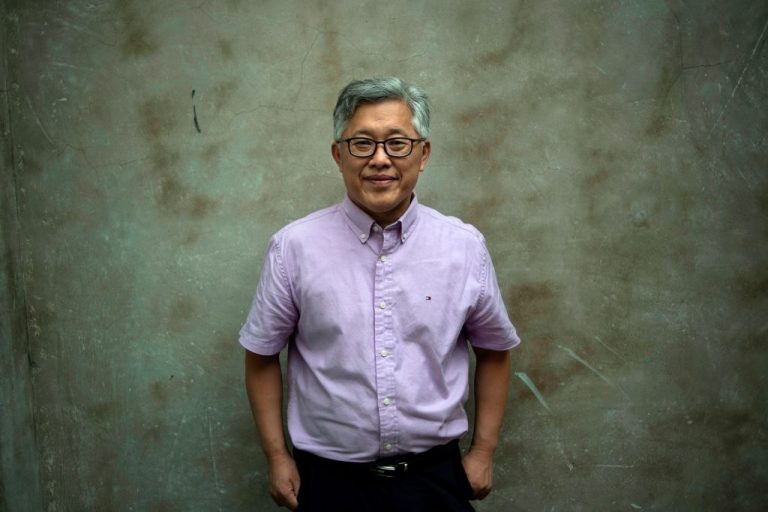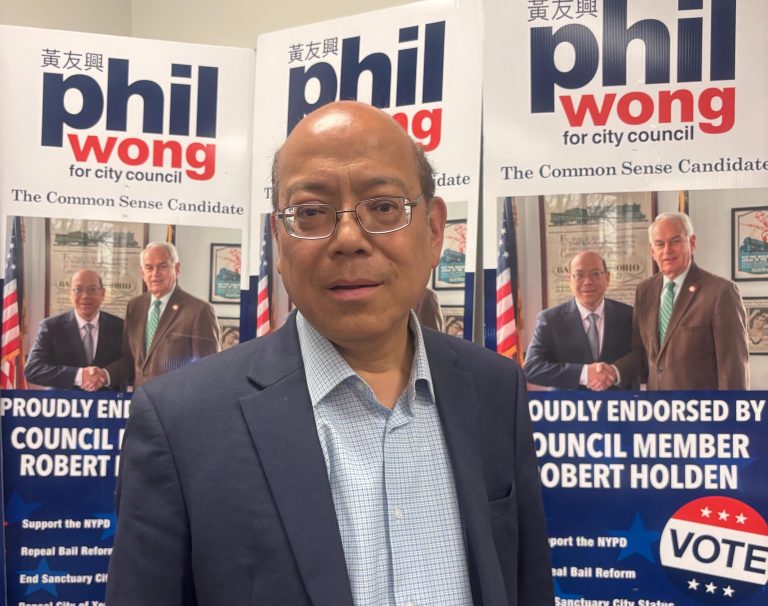
New York, NY – Phil Wong, a Democratic candidate for city council, is running as a self-described “doer” whose practical approach and deep community roots have propelled him from an ordinary parent to a formidable advocate for his district. Despite his Democratic affiliation, Wong’s policies resonate strongly with Republican values, focusing on common-sense solutions over party loyalty. “My policies are Republican policies, but my party is Democrat,” Wong said in an exclusive interview. “I don’t care about party labels—just what we can do for the people, understanding their needs and solving their problems.”
Wong’s journey into politics was not planned. A former patent translator and dedicated parent, he was drawn into community activism when his daughter’s school faced overcrowding due to a nearby hotel being converted into a migrant shelter under former Mayor Bill de Blasio. This experience ignited his passion for advocacy, leading to a 12-year record of tangible achievements, from fighting shelter expansions to defending elite education programs. His service on the local education committee and work with City Councilmember Robert Holden have cemented his reputation as a results-driven leader. “I learned: you fight, you might win; you don’t fight, you definitely lose,” Wong said.
From parent to advocate: A track record of action
Wong’s entry into public service began with a personal grievance. When a hotel at the end of his street was abruptly turned into a shelter housing 600 migrants, his daughter’s school—already the most overcrowded in District 24—was forced to accommodate 60 additional students in makeshift spaces like lunchrooms and gymnasiums. “We became victims,” Wong recalled. “They need to study, but so do we. Where are our rights?” He joined forces with the PTA to challenge the city, uncovering that the shelter system was more about profit than service. “It’s a business harming people, not helping the homeless,” he said, noting how hotel owners charged the city $700 per person monthly without addressing residents’ needs.
Wong’s activism led to small victories, such as forcing the city to install kitchens in shelter rooms, reducing capacity by a third. His persistence continued in battles against other shelter proposals, including a successful campaign to block a Holiday Inn conversion and a 51-week protest that shut down a shelter in a former Jewish synagogue in Grand Ave. These efforts earned him a reputation as someone who “can get things done,” a sentiment echoed by voters who supported him in the Democratic primary against a teacher’s union representative and a volunteer with little substantive record.
A common-sense platform rooted in experience
Wong’s platform prioritizes public safety, education, housing, and fiscal responsibility, shaped by his hands-on experience. On public safety, he highlighted the critical shortage of police officers, noting that response times for crimes like car theft or burglary have ballooned to two hours, compared to one or two minutes under former Mayor Bloomberg. “We’re short at least 6,000 officers,” Wong said. “Police aren’t lazy; there just aren’t enough of them.” He plans to push for increased funding to bolster the NYPD and reverse anti-police legislation that has demoralized officers.
Success
You are now signed up for our newsletter
Success
Check your email to complete sign up
Addressing the city’s homeless crisis, Wong advocates for mental health interventions and temporary support with clear limits. “The streets aren’t a mental hospital,” he said, pointing to incidents of violence by untreated individuals. He proposes restoring mental health facilities, closed in recent decades, and providing job training to help the homeless transition to self-sufficiency within a year. “You can’t just house them and forget them,” he emphasized.
On immigration, Wong takes a firm stance against open borders and the city’s “sanctuary” policies, which he calls a “bottomless pit” costing $22 billion annually. “The federal government should handle immigration, not New York City,” he said. He supports legal pathways for migrants but insists on deporting those who break the law or fail to contribute. “Kids as young as 10 or 11 are selling fruit instead of studying, and some turn to gangs,” he observed, citing issues in areas like Jackson Heights.
Defending education and meritocracy
As a former education committee chair, Wong is a staunch defender of merit-based education, particularly the Specialized High School Admissions Test (SHSAT). “Special high schools are for those who pass the test,” he said. “I oppose lotteries or quotas based on address or income.” He rejects proposals to abolish elite schools, arguing that the focus should be on improving the city’s 400+ middle schools by addressing teacher shortages and quality. “Blaming three top schools for the system’s problems is nonsense,” he said. “Fix the real issues: bad teachers, lack of resources.”
Wong also supports reinstating Gifted and Talented programs, emphasizing that elite education benefits the entire community by fostering excellence. His commitment stems from his own experience as a parent fighting for his daughter’s education in an overcrowded system.
Protecting retirees and addressing environmental challenges
Wong opposes efforts to shift retiree healthcare costs from union-backed plans to individuals, warning that such changes could bankrupt seniors. “Retirement benefits were promised; they must be honored,” he said. On environmental issues, he supports initiatives like organic waste recycling but criticizes the city’s lack of infrastructure. “There’s only one composting center for all of New York,” he noted. “Queens needs its own facility to make it practical.”
Tackling community pain points
Wong’s district, encompassing areas like Rego Park, Maspeth, and Elmhurst, faces varied challenges. Public safety is paramount in Maspeth and Middle Village, while Elmhurst struggles with garbage and declining civic responsibility near busy transit hubs. “People eat and toss trash; rats follow,” Wong said, calling for cleaner streets and better government coordination. He also addresses rising rents, warning against “free lunch” promises that lead to higher taxes and drive residents away. “Socialism doesn’t work,” he said, citing examples from Cuba and China. “You can’t tax the rich if they leave.”
A reluctant candidate with a practical vision
Wong’s path to candidacy was organic, spurred by Councilmember Holden’s endorsement after years of collaboration. “I was helping Holden, fighting Harvard’s discrimination, suing the mayor,” Wong said. “Last November, he said he’d support me to run for his seat.” Despite his late start, Wong’s record of action and community trust led to his primary victory.
Known for his mild demeanor and ability to find common ground, Wong sees politics as a dialogue. “The City Council has 51 members, about 20 lean socialist,” he said. “You don’t ignore them; you talk, find agreement, and move forward.” His campaign’s grassroots approach, including door-knocking and meeting voters at bus stops and schools, was bolstered by a dedicated team. Even a last-minute office eviction forced him to campaign from a truck for three days, which he turned into an innovative way to stay accessible. “We kept going, picking up flyers wherever the truck was parked,” he said. “It became a way to serve people on the move.”
A candidate for the people
Wong’s story is one of a practical, results-oriented leader who entered politics not for ambition but to address real community needs. “People see me as reasonable, not loud,” he said. “I focus on what we can agree on to get things done.” As he campaigns, Wong urges voters to look beyond party labels and focus on his proven track record. “I’m here to fight for safety, education, and a community where people can thrive,” he said. “That’s what matters.”