President Donald Trump on Monday warned that tariffs on Chinese goods could surge to 155 percent if Beijing fails to reach what he called a “fair trade agreement” with the United States by Nov. 1.
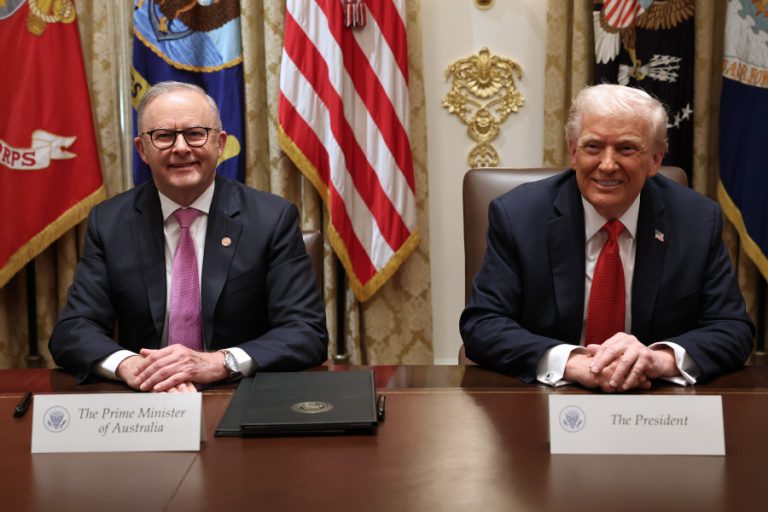
The remarks came during a White House ceremony where Trump and Australian Prime Minister Anthony Albanese signed a new critical-minerals partnership, designed to strengthen U.S.–Australia supply chains and reduce China’s dominance over the global rare-earth market.
Trump: “Those Days Are Over”
Speaking to reporters ahead of his bilateral meeting with Albanese, Trump said China was already “paying huge sums” in tariffs imposed over the past year.
“China has shown great respect for us,” Trump said. “They’re paying a tremendous amount in tariffs — 55 percent right now — and if we don’t reach a deal by Nov. 1, it could go to 155 percent.”
Success
You are now signed up for our newsletter
Success
Check your email to complete sign up
He added that Washington had renegotiated trade arrangements with several countries that “took advantage of us for years.”
“That won’t happen anymore,” he declared.
Still, Trump said he believed a “very fair deal” with Chinese leader Xi Jinping was possible.
“When it happens, you’ll all be there,” he told reporters. “It’ll be exciting.”
New tariffs and export controls
Earlier this month, Trump announced plans to impose an additional 100 percent tariff on Chinese imports and to introduce export controls on key U.S. software starting Nov. 1.
These measures would stack atop existing duties, sharply increasing costs for Chinese exporters.
“During my first term they paid a lot,” Trump said of Beijing. “Now they’re paying even more. Maybe they can’t handle it — and that’s fine. We can bring it down a bit, but they have to give something back. It’s not a one-way deal anymore.”
Framing his stance as a move toward trade reciprocity, Trump said:
“We’ve been treated unfairly for decades. Those days are over.”
U.S. Treasury Secretary Scott Bessent confirmed that American and Chinese officials are set to meet later this week in Malaysia to discuss tariffs, technology exports, and ways to stabilize trade flows.
The talks signal that both sides remain open to dialogue, even as economic and geopolitical tensions deepen.
“Our approach is firm but open,” one Treasury official said. “We want fair competition — not confrontation.”
Economists say the latest move marks a shift in the U.S.–China trade war from traditional tariffs toward strategic leverage over critical industries.
With rare-earth elements — vital for semiconductors, batteries, and defense technology — now at the center of the dispute, Washington and its allies are seeking to rewire global supply chains.
“This is no longer just about trade,” said one analyst in Singapore. “It’s about who controls the next generation of industrial power.”
As the November deadline approaches, markets are bracing for turbulence — and Beijing faces mounting pressure to decide whether compromise or confrontation serves its long-term interests.