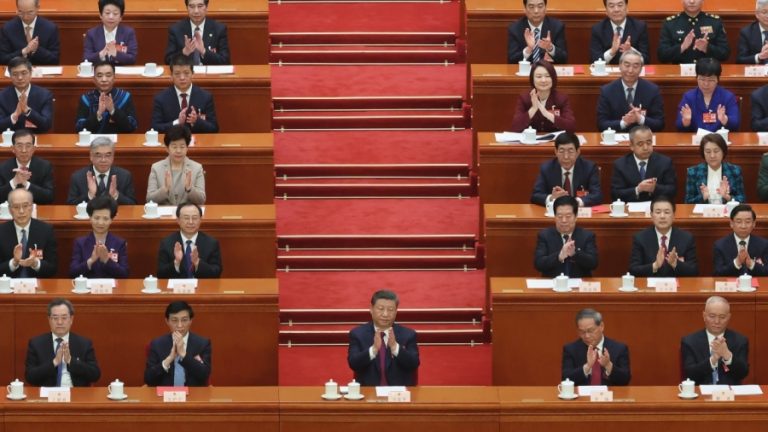
The Chinese Communist Party’s (CCP) 20th Fourth Plenary Session concluded in Beijing without the leadership overhaul many had expected. While Xi Jinping retained all three of his top positions — Party general secretary, state president, and chairman of the Central Military Commission (CMC) — subtle wording in the official communiqué and new personnel signals point to a gradual erosion of Xi’s personal authority, particularly over the military.
Online speculation that the plenum would see a reshuffling of the CMC or a petition by military leaders to force Xi’s resignation proved false.
The only major personnel move was the promotion of Zhang Shengmin, head of the CMC’s Discipline Inspection Commission, to vice chairman — a post that grants influence over both political oversight and appointments.
State media hailed the move as evidence of “stability,” yet analysts say the details tell another story.
Commentator Wang Jian noted that while Xi formally retained his posts, the communiqué’s tone was unusually restrained, lacking the typical praise of Xi’s leadership.
Success
You are now signed up for our newsletter
Success
Check your email to complete sign up
“His base hasn’t collapsed, but the evaluation was muted,” Wang observed.
Political analyst Zhang Tianliang added that Xi showed no sign of planning to step down before the 21st Party Congress. However, he warned that Xi’s age and health will inevitably erode his dominance:
“He remains the core today, but his control is no longer absolute.”
Military analysts: Xi’s command is being undermined
Observers say the Fourth Plenum revealed a widening gap between Party control and military obedience.
Commentator Tang Jingyuan argued that Zhang Shengmin’s promotion — without elevation to the Politburo, which traditionally accompanies the CMC vice chairmanship — marks a departure from the principle of Party supremacy over the military.
“Zhang’s exclusion from the Politburo signals that the slogan ‘the Party commands the gun’ has been weakened,” Tang said.
Tang also noted that recent purges of nine generals, many of them previously loyal to Xi, were reportedly initiated by the Defense Ministry before being rubber-stamped by the plenum — a sign that the military acted independently of Xi’s command.
“On paper, Xi is still commander-in-chief,” Tang remarked. “In reality, the two vice chairmen and most CMC members are not his men. He’s a general without troops.”
The plenum also brought unexpected appearances by two generals previously believed to have been sidelined or investigated — a move interpreted as a symbolic rebuke to Xi.
The first, General Wang Qiang, commander of the Central Theater Command, was abruptly replaced during the Sept. 3 military parade, a decision widely viewed as an embarrassment for Xi.
His reappearance at the plenum confirmed that he remained in office, but still without the parade commander role — an arrangement Tang described as a deliberate humiliation orchestrated by Vice Chairman Zhang Youxia.
The second officer, General Wang Kai, head of the Tibet Military Region, had been absent from Xi’s public meetings in August, prompting speculation of a purge. His renewed presence at the plenum suggested otherwise.
Tang argued that Zhang Youxia may have intentionally sidelined both officers during high-profile events to show that he, not Xi, controls loyalty within the PLA.
Both Wang Qiang and Wang Kai, he noted, hail from Zhang’s long-standing 13th Group Army faction, strengthening the vice chairman’s influence.
Communiqué emphasizes Party, not Xi
Analyst Zhou Xiaohui pointed out subtle but significant changes in this year’s plenum communiqué, which shifted emphasis from personal rule to collective leadership.
References to “Xi Jinping Thought” were omitted entirely, breaking precedent, and the Party’s loyalty pledge — known as the “2442 slogan” — appeared only once, buried deep in the text.
“This is a token inclusion, not a declaration of faith,” Zhou wrote.
He also noted a revised call to “uphold and strengthen the centralized and unified leadership of the Party Central Committee.”
The addition of “strengthen,” he said, implies that the Party apparatus — not Xi personally — is now reasserting institutional authority.
“The Party chose stability and self-preservation over Xi’s personal dominance,” Zhou concluded.
Taken together, developments at the Fourth Plenum suggest that China’s political system is shifting from one-man rule toward institutional recalibration.
Xi remains the nominal “core,” but the balance of power within the CCP appears to be tilting back toward collective leadership, with the military no longer uniformly loyal.
“The Party leadership has chosen compromise over confrontation,” Tang said.
“The rifts between Xi and the military, and between Xi and Party elders, remain unresolved. The turbulence at the top is far from over.”
By Jingyao Li