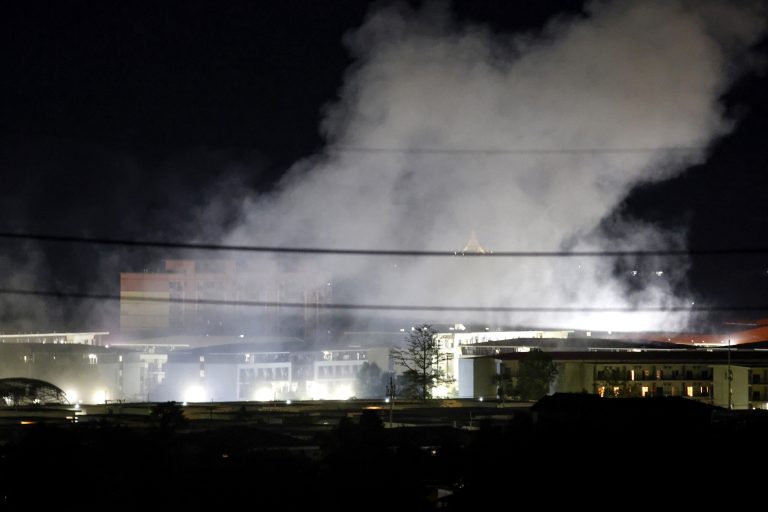
Recent operations by the Myanmar army have targeted an infamous e-fraud center, dubbed “KK Park,” that is allegedly linked to the Chinese Communist Party (CCP). The latest action, which began starting Friday, Oct. 24, saw Myanmar’s armed forces bomb buildings across the criminal compound, prompting a mass exodus across the border into neighboring Thailand.
The bombing of KK Park comes after joint U.S. and UK actions against Cambodia’s Prince Group — whose owner Chen Zhi is also believed to be closely linked to the CCP — to seize over US$14 billion in bitcoins from the scam enterprise.
According to Thailand’s Public Broadcasting Service, explosions were heard repeatedly along the Thai–Myanmar border as the Myanmar military, called the Tatmadaw, conducted its operation lasting until Oct. 26.
The Tatmadaw then declared that it had captured the notorious cyber-scam base located near the Thai border, calling it a “key piece of territory lost during the civil war.”
Myanmar has been embroiled in conflict since 2021, when the military junta launched a coup against the National League for Democracy led by Aung San Suu Kyi. The Tatmadaw’s coup led to rebellions by various ethnic insurgencies throughout the country.
Southeast Asian scam compounds under fire
Success
You are now signed up for our newsletter
Success
Check your email to complete sign up
Myanmar forces had already launched intensified attacks on KK Park on Oct. 16, prompting thousands to flee in the chaos. Thai officials said on Oct. 24 that more than 1,000 people, most of them Chinese nationals, had crossed the border into Thailand.
As of Oct. 27, Thai authorities reported that 1,525 foreign nationals had crossed the Moei River into Thailand.
Videos circulating online showed people dragging suitcases, riding motorcycles, or escaping on foot, with some even jumping into a river to flee to Thailand.
Thailand’s Third Army commander, Lt. Gen. Warat, said that if Myanmar’s military continues to target other scam compounds, even more people may flee across the border.
The UN Office on Drugs and Crime (UNODC) reported earlier this year that criminal syndicates in Myanmar, Laos, and Cambodia have been operating “industrial-scale online fraud and scam centers.” The international community has recently intensified pressure on Myanmar and Cambodia to crack down on these operations.
According to Bloomberg, Myanmar military spokesperson Zaw Min Tun accused the ethnic armed group Karen National Union (KNU) — which opposes the junta — of allowing the KK Park to operate along the Thai-Myanmar border by leasing land and providing security, allegedly for profit. KNU spokesman Saw Taw Neh denied the accusation, saying the junta was scapegoating them under international pressure.
Located south of Myawaddy, KK Park has become synonymous with online fraud, money laundering, and human trafficking. Thousands have been lured there with fake job offers, only to be forced to run sophisticated scams that have stolen billions of dollars from victims worldwide.
The area drew international attention earlier this year after Chinese actor Wang Xing was kidnapped in Thailand and trafficked to Myawaddy. Following Thailand’s decision to cut off power and fuel supplies, thousands of Chinese workers were evacuated from the scam compounds and flown back to China.
But KK Park is only one among dozens of such scam zones in the region.
Cambodia under pressure after death of Korean student
Another hotbed of cyber fraud, Cambodia, is now under scrutiny from South Korea. A 20-year-old Korean student surnamed Park was lured by a fake job ad to Cambodia, where he was tortured after refusing to work in a scam center. His body was found on Aug. 8 near Bokor Mountain in Kampot Province. His ashes were returned to South Korea on Oct. 21.
On Oct. 13, South Korean President Lee Jae-myung issued a stern warning to Southeast Asian scam networks during a senior aides’ meeting: “Do not touch Koreans, or we will destroy you.”
The next week, on Oct. 22, Cambodian police raided a suspected scam building in Phnom Penh’s Por Sen Chey District, arresting 86 suspects — including 57 Koreans and 29 Chinese nationals. A delegation from South Korea’s National Assembly observed the operation in person.
Muted response from Beijing; alleged CCP ties
Chinese state media have downplayed the Tatmadaw’s bombing of KK Park. Xinhua News Agency published only a brief dispatch of under 200 characters on Oct. 20, while Phoenix News provided merely a short summary. When Epoch Times reporters viewed a video on Douyin (the Chinese version of TikTok) showing scenes of the bombing on Wednesday (Oct. 29), the clip was deleted just a few hours later for unknown reasons.
Some overseas netizens questioned: “Those who are so enamored with the CCP’s ‘great-power’ narrative — think carefully. Is this so-called powerful country truly good for you, or bad for you?”
This January, Chinese actor Wang Xing was lured to the Myawaddy area in Myanmar but was eventually rescued. Around that time, a Weibo user named @稀薄20 created a shared online document to collect information about people trapped in scam compounds to help families rescue their relatives. Within days, it contained over a thousand pleas for help, but the entire document was soon deleted from the Chinese internet.
When Myanmar’s military began bombing the Myawaddy scam compounds this time, some Chinese netizens joked: “We’ve been taking traditional Chinese medicine for years, but one injection of Western medicine cured the illness.”
The quip meant that Beijing’s repeated “statements” and “negotiations” had been useless — yet once the United States imposed sanctions, the scam centers suddenly began releasing people within days.
Other Chinese users on X (formerly Twitter) analyzed the situation more bluntly:
“It’s not that the CCP can’t deal with Myawaddy — the CCP created Myawaddy. It’s both the instigator and the hidden participant.”
According to earlier reports, there are over thirty fraud syndicates operating along the Thai–Myanmar border, collectively scamming tens of billions of U.S. dollars each year. These scam parks have become an important part of Myanmar’s wartime economy. The junta, while fighting rebel groups, continues to rely on Chinese support to sustain its power.
Insiders previously told The Epoch Times that Southeast Asia’s scam compounds and China’s Belt and Road Initiative are intertwined — part of a symbiotic relationship involving covert overseas colonization projects tied to the financial interests of CCP “red elites” and the children of high-ranking officials.
US-led sanctions against Prince Group
The KK Park bombing occurred against a broader backdrop: in mid-October, the U.S. and U.K. governments jointly sanctioned Cambodia’s Prince Holding Group and its founder Chen Zhi (also known as Vincent Chen), accusing them of running a transnational scam empire involving telecom fraud, cryptocurrency theft, and even sexual extortion — with estimated illicit proceeds of $14–15 billion. The sanctions freeze Chen’s and the group’s global assets, including 128 affiliated companies and 17 individuals.
Chen Zhi, now formally indicted by the U.S. Department of Justice, has become the focus of public attention due to his mysterious and powerful background.
A former Chinese intelligence operative known as Eric, now living in exile in Australia and once employed by Prince Group, told The Epoch Times that the company is one of the CCP’s most important agents for covert activities in Cambodia and across Southeast Asia, far more than a mere commercial entity. The group provides comprehensive logistical support for China’s overseas intelligence network, from financing and personnel to transportation. “Chen Zhi’s businesses,” he said, “have essentially become the CCP’s spy network treasury and logistics base.”
According to U.S. Department of Justice documents, Chen Zhi has received protection from China’s Ministry of State Security, the Ministry of Public Security, and the United Front Work Department.
Chinese internet users report that since Chen Zhi and the Prince Group were exposed as part of a transnational criminal organization and targeted by law enforcement from the U.S., U.K., and South Korea, the CCP has been deleting posts and videos exposing the scandal.
One user commented: “The CCP itself is stepping in to cover for the Prince Group by forbidding the public to discuss it. Their connection is obvious!”